What Hastings actually adopted
On May 18, 2020 the Board of Trustees passed a resolution encouraging low embodied carbon concrete for village projects. In September 2024 the Green Building Code was updated to award points for lower‑GWP mixes and to spell out how applicants prove performance. That combo moves the policy from a statement of intent to a procurement signal.
The scoring and the benchmarks
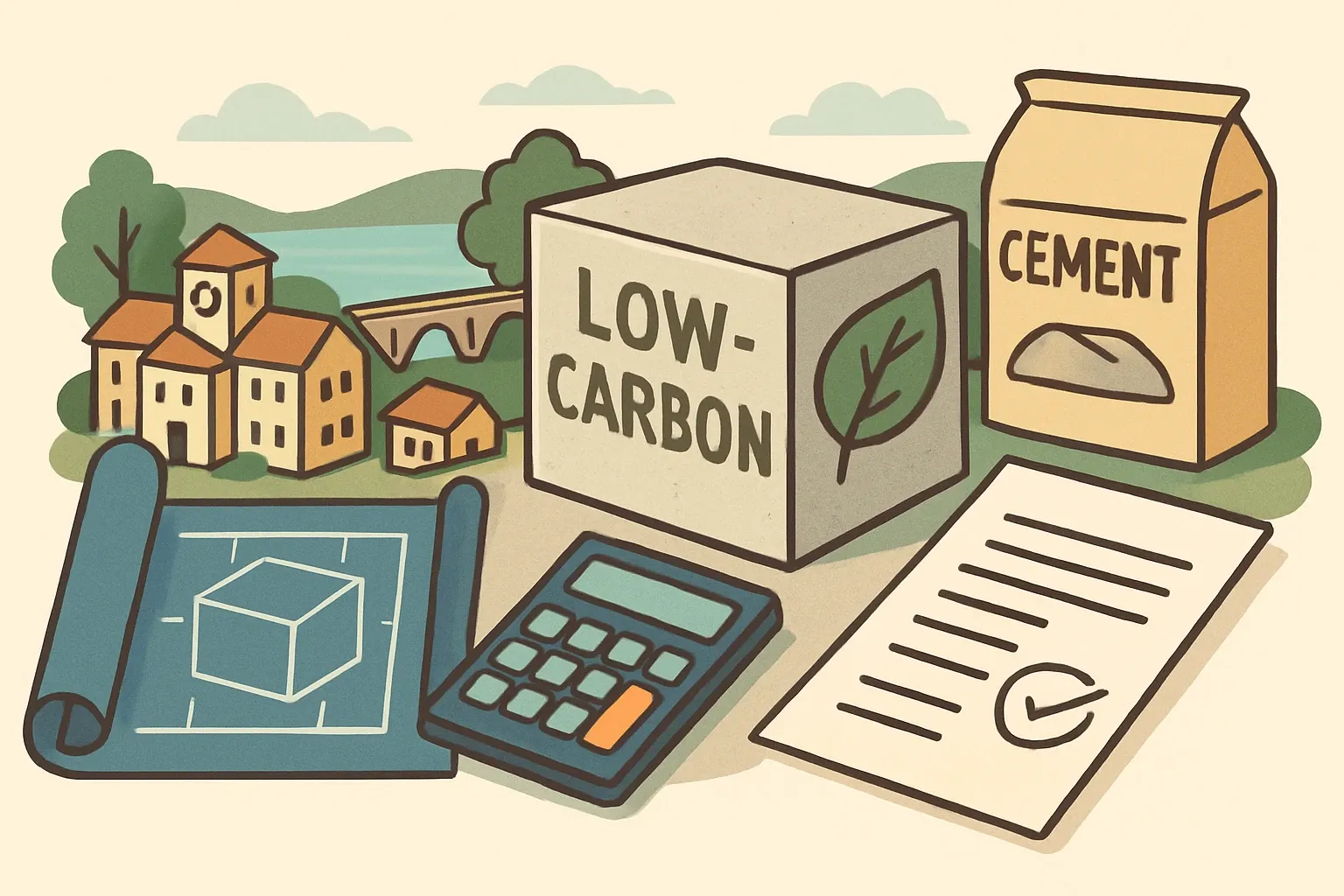
The code grants 1 to 3 points for mixes that beat published Global Warming Potential baselines by 10 to 30 percent or more, with submittals calculated in the ZGF Concrete LCA Tool and filed to the building inspector. Example baseline: 4000 psi at 261.21 kg CO2e per cubic yard, with a full table by strength class in the ordinance (Hastings Green Building Code, 2024).
Why this matters beyond one ZIP code
Concrete shows up in every public job, so even a small points swing can tip selections when designs are tight on carbon. Policies often spread by copy‑paste between municipalities. Getting your documentation and mix catalog ready now keeps you in the conversation when neighboring jurisdictions borrow the same playbook.
EPDs are your proof of concept
A product‑specific, third‑party verified EPD puts your mix’s GWP on the record, aligns with how architects compare options, and dovetails with LEED v5’s focus on embodied carbon. Think of the PCR as the rulebook and the EPD as the scorecard. Without it, teams must use pessimistic defaults that make your mix look heavier than it is.
Need clarity on low-carbon concrete regulations?
Follow us on LinkedIn for insights that help you stay compliant and win more tenders.
The carbon reality check
Cement is responsible for roughly 7 percent of global CO2 emissions, which is why cities are zooming in on concrete first (IEA, 2024). The good news is market tools already exist. Portland‑limestone cement is now approved by all 50 state DOTs, and industry reports more than 60 percent of U.S. cement production as lower‑carbon cement in 2023 (PCA, 2024).
Hitting the Hastings targets in practice
Lower GWP is usually unlocked by three levers that do not compromise strength when engineered correctly. Reduce clinker content with well‑characterized SCMs, optimize water and aggregate gradation so you use less binder for the same performance, and cut transport miles by sourcing closer inputs. It is like swapping a V8 for a turbo four that still pulls the same load.
Your submittal stack, simplified
- Product‑specific EPD for the mix design being bid, with declared unit and GWP clearly shown.
- Mix sheet with SCM percentages, cement type, and supplier locations that mirror the EPD scenario.
- ZGF tool printout matching the code’s strength class and benchmarks, saved to PDF for permit review (Hastings Green Building Code, 2024).
Choosing an LCA partner without losing a quarter
Pick a team that handles plant data collection end‑to‑end, standardizes utility and materials records across facilities, and publishes with the operator your market prefers. Speed matters because mix design work in precon moves fast, and submittals that align with how plan reviewers read specs recieve fewer redlines.
A quick note on incentives
Federal programs are in flux this year, so count municipal and private procurement as your near‑term demand drivers. Local rules like Hastings create immediate pull for documented low‑GWP mixes. If your 3000 to 5000 psi families have current EPDs and clear GWP deltas, you are already ahead of rivals relying on generic declarations.