What LEED Actually Asks For
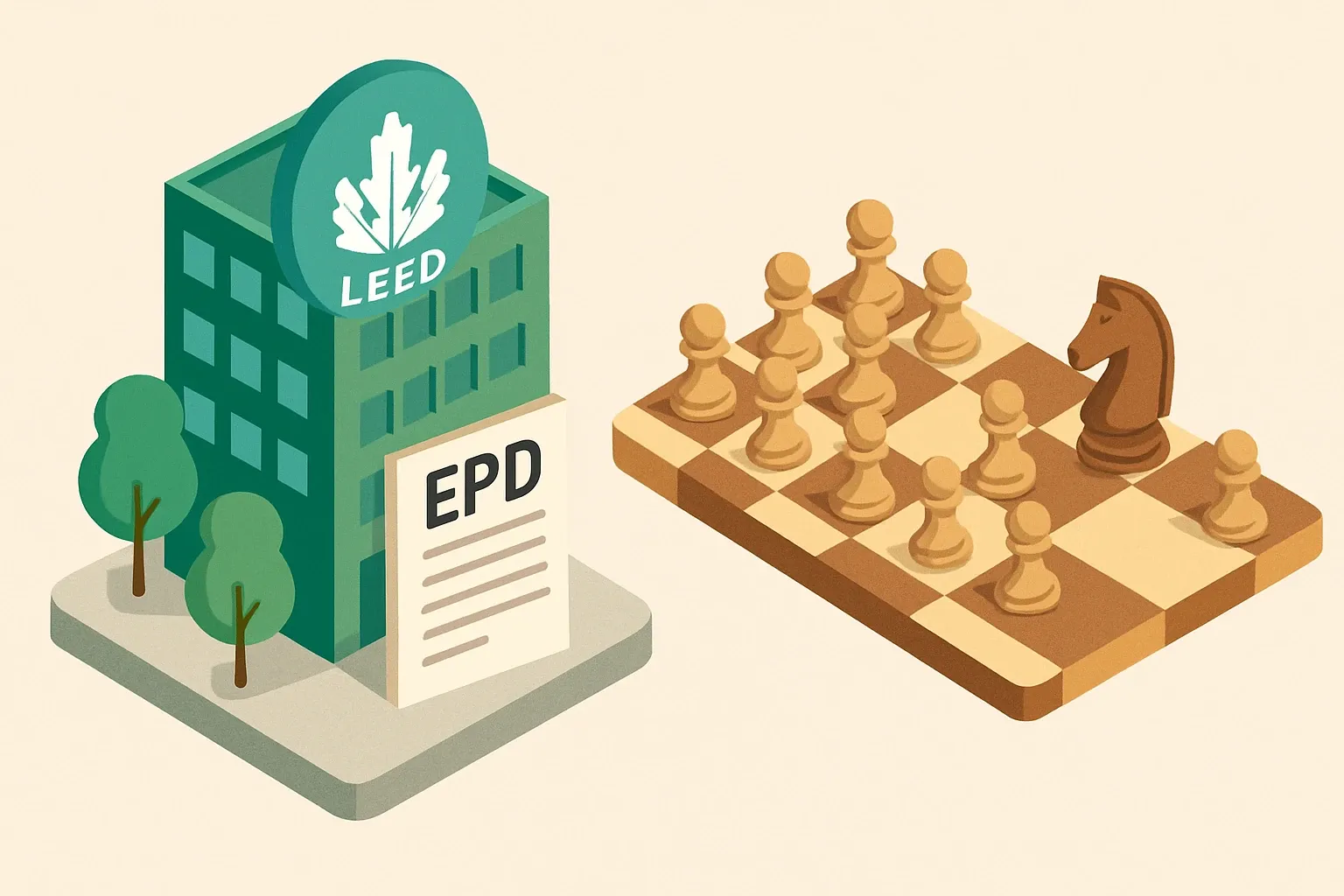
LEED projects are not forced to use EPDs across the board. Instead, EPDs contribute to the Building Product Disclosure and Optimization credit in Materials and Resources, which is commonly pursued on BD+C and ID+C jobs. Owners and GCs increasingly treat EPDs as a procurement expectation even when the rating system does not strictly require them.
How Many EPDs Help Under LEED v4.1
Under LEED v4.1, Option 1 typically asks for at least 20 permanently installed products from 5 manufacturers with qualifying declarations. Certain project types allow 10 products from 3 manufacturers, and the credit is worth up to 2 points (USGBC, 2024) (USGBC v4.1 guide, 2024). Product specific Type III EPDs are weighted more heavily in v4.1. USGBC counts a product specific Type III as 1.5 products, while industry wide Type III and some other declarations count as 1 product in that path (USGBC, 2024) (USGBC v4.1 guide, 2024).
Where LEED v5 Stands Today
LEED v5 was ratified by USGBC members on March 28, 2025, after two public comment periods in 2024. It elevates decarbonization while keeping familiar disclosure pathways for materials, with credit forms and calculators now delivered through Arc (USGBC, 2025) (USGBC LEED v5, 2025). Credit substitutions from v5 into v4 or v4.1 are not permitted, so teams must follow the version they register under unless USGBC states otherwise (USGBC, 2023) (USGBC Guidance, 2023).
Want to boost your LEED project specs?
Follow us on LinkedIn for insights on how EPDs can unlock new business opportunities and help you stay ahead in a competitive market.
What Counts As a Qualifying EPD
LEED recognizes Type III EPDs that conform to ISO 14025 and either EN 15804 or ISO 21930, are third party verified, and publicly accessible. That is the baseline to play. If your product has a product specific Type III EPD, you typically get more credit value than an industry wide EPD under v4.1. Think of it like getting bumped to priority boarding.
Common Misreads That Slow Teams Down
“Any sustainability PDF will do.” Not true. LEED looks for EPDs that follow ISO and are verified by a program operator. A spec sheet with green icons will not move the needle. “Variations count as different products.” Only if they are distinct formulations or compositions. Colorways or simple reconfigurations usually do not count as separate products under BPDO rules (USGBC, 2024).
LEED Points Meet Commercial Reality
On busy bid days, submittal reviewers default to compliant, easy to verify documentation. A clear, current EPD removes friction and reduces the risk of being value engineered out when embodied carbon targets tighten. The price of a well built EPD is frequently recouped with even a single mid sized project win, because it keeps your SKU in play when EPDs are screened first.
What Manufacturers Should Prepare
Start with the products that drive the most revenue or are most often specified. Publish product specific EPDs for those first. Make data collection painless for plant teams. Choose an LCA partner who will do the heavy lifting instead of handing you a spreadsheet marathon. That is how we protect R&D and operations time while still shipping enviromental proofs fast.
Timing, Versions, and Submittals
If a project is registered under v4.1, use the v4.1 EPD credit language and weightings. If a team chooses v5, follow the v5 credit library and Arc calculators published for that track. Swapping between versions mid stream is not allowed unless USGBC addenda say so (USGBC, 2025) (USGBC LEED v5, 2025). Make sure your EPDs are publicly accessible and easy to download. Hidden PDFs stall submittals and can cost points.
Bottom Line For Spec Wins
LEED does not require an EPD for every project. LEED does consistently reward products that have them, and project teams reward speed and clarity even more. Get credible, product specific EPDs live for the SKUs that matter, and you will show up higher in the spec when it counts.