Start with a map: model × plant × market
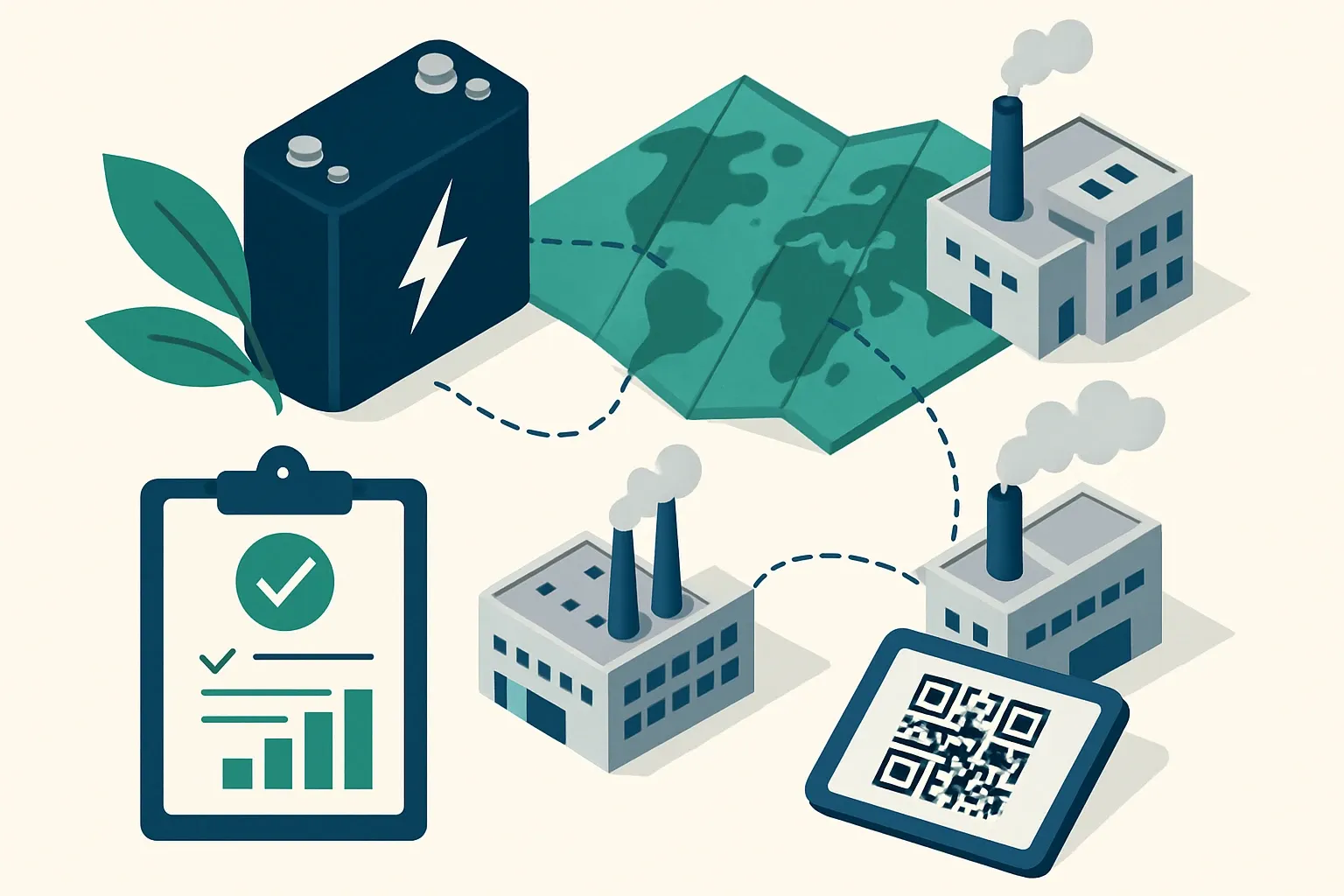
Before software or sampling plans, list which plants feed the EU and which SKUs or variants they build. The Regulation requires life‑cycle carbon footprint to be calculated for a specific battery model per manufacturing plant using that plant’s bill of materials and energy inputs (EUR‑Lex, 2024). (eur-lex.europa.eu)
Decide scope: how many LCAs you actually need
Two visually similar packs from different plants are different regulatory objects. If line recipes, cell chemistries, supplier mixes, or on‑site energy differ, plan separate LCAs. Where plants share identical BOMs and utilities, one study can serve as a template with plant‑specific parameters documented for verification. This avoids copy‑paste models that break under audit.
Data plumbing that never leaks
Match plant utilities, production volumes, scrap, and maintenance inputs to SKU‑level BOMs for a full reference year. For new lines, collect a defensible initial window then formalize the annual cycle once a full year of production exists. Keep supplier‑provided datasets, transport routes, and allocation rules versioned so verification does not turn into archaeology later.
Build verification‑ready evidence
Regulators expect a carbon‑footprint declaration per model‑plant, backed by technical documentation and conformity assessment by a notified body. The Commission has published the draft methodology for EV batteries and a format for the declaration, which signals exactly what auditors will check (European Commission, 2024). (op.europa.eu)
Want to master compliance with battery regulations?
Follow us on LinkedIn for insights that help you streamline your LCA processes and unlock new market opportunities.
Passport handoff: from verified results to QR access
Battery passports will be mandatory for EV batteries, LMT batteries, and industrial batteries above 2 kWh placed on the EU market from 18 February 2027. Access is via a QR code that must meet defined identification standards, and the passport data must be accurate, interoperable, and role‑based by design (EUR‑Lex, 2025) (EUR‑Lex, 2025). (eur-lex.europa.eu)
Timeline math that drives resourcing
The Regulation staggers obligations. Performance classes for carbon footprint start for EV batteries on 18 August 2026 and for most industrial batteries on 18 August 2027. Maximum footprint thresholds follow from 18 February 2028 for EV and 18 February 2029 for industrial, subject to the timing of delegated acts (EUR‑Lex, 2024). Due‑diligence obligations on raw‑material sourcing were postponed to 18 August 2027 to give industry more time (Council of the EU, 2025) (Council of the EU, 2025). (eur-lex.europa.eu)
A repeatable LCA pattern for large fleets
Think of each model‑plant pair as a tile. Standardize a template LCA model with hooks for plant energy, yield, scrap, and supplier factors. Automate the import from plant historians and ERP so tiles update without hand‑cranking. Keep a change log that shows when a supplier swap or line upgrade triggers re‑verification instead of letting surprises pile up in Q4.
Verification without the drama
Drafts should be review‑ready for a notified body. Include foreground data lineage, allocation rationale, transport modeling, labelling proofs, and the public summary for the CFB declaration. The Joint Research Centre has published methodological support for industrial‑battery footprints, which is a helpful cross‑check for system boundaries and data quality rules (JRC, 2025) (JRC, 2025). (joint-research-centre.ec.europa.eu)
Passport data design that scales
Treat the passport as a living data product, not a PDF. Map what is public, what authorities see, and what requires legitimate interest. Keep identifiers stable so QR links persist even when product revisions land. Align master data so the same model code cannot mean three different BOMs across regions. You dont need a monolith platform, you need clean interfaces and ownership.
Choosing partners and tools without regrets
Prioritize partners who take on data wrangling, not just modeling. Look for multi‑plant scoping discipline, program‑operator agnosticism, and a crisp plan to route verified results into passport systems. Ask for a sample audit trail before you sign. The right workflow saves engineering hours and prevents late‑stage rework that quietly taxes margins.
Make compliance boring and scalable
When model‑by‑plant mapping leads the process, LCAs become modular, verification gets faster, and passports publish on time. The reward is market access with less stress and a portfolio that keeps pace with regulatory updates rather than chasing them.