What CPR 2025 actually is
The EU has replaced Regulation 305/2011 with Regulation 2024/3110. It entered into force on January 7, 2025, with most provisions applying from January 8, 2026. Article on penalties applies from January 8, 2027. These dates are now live policy, not proposals (Council of the EU, 2024) (Council of the EU, 2024).
The aim is simple. Keep the single market functioning, scale digital transparency, and embed sustainability in core product information. National rules for how buildings perform still sit with each Member State, while product marketing rules are harmonised at EU level (Council of the EU, 2024).
Who is in scope and when
Coverage follows harmonised standards and European Assessment Documents. Products remain under the 2011 framework until their technical specifications migrate to the new regime. A long transition of up to fifteen years runs to 2039 to avoid gaps in harmonisation (UNMZ, 2025).
In practice, your status depends on whether your product uses a harmonised standard or an EAD already adopted under the new framework. If not, you operate under the old CPR until that switch happens (EFCC, 2025).
Documentation you will hand over
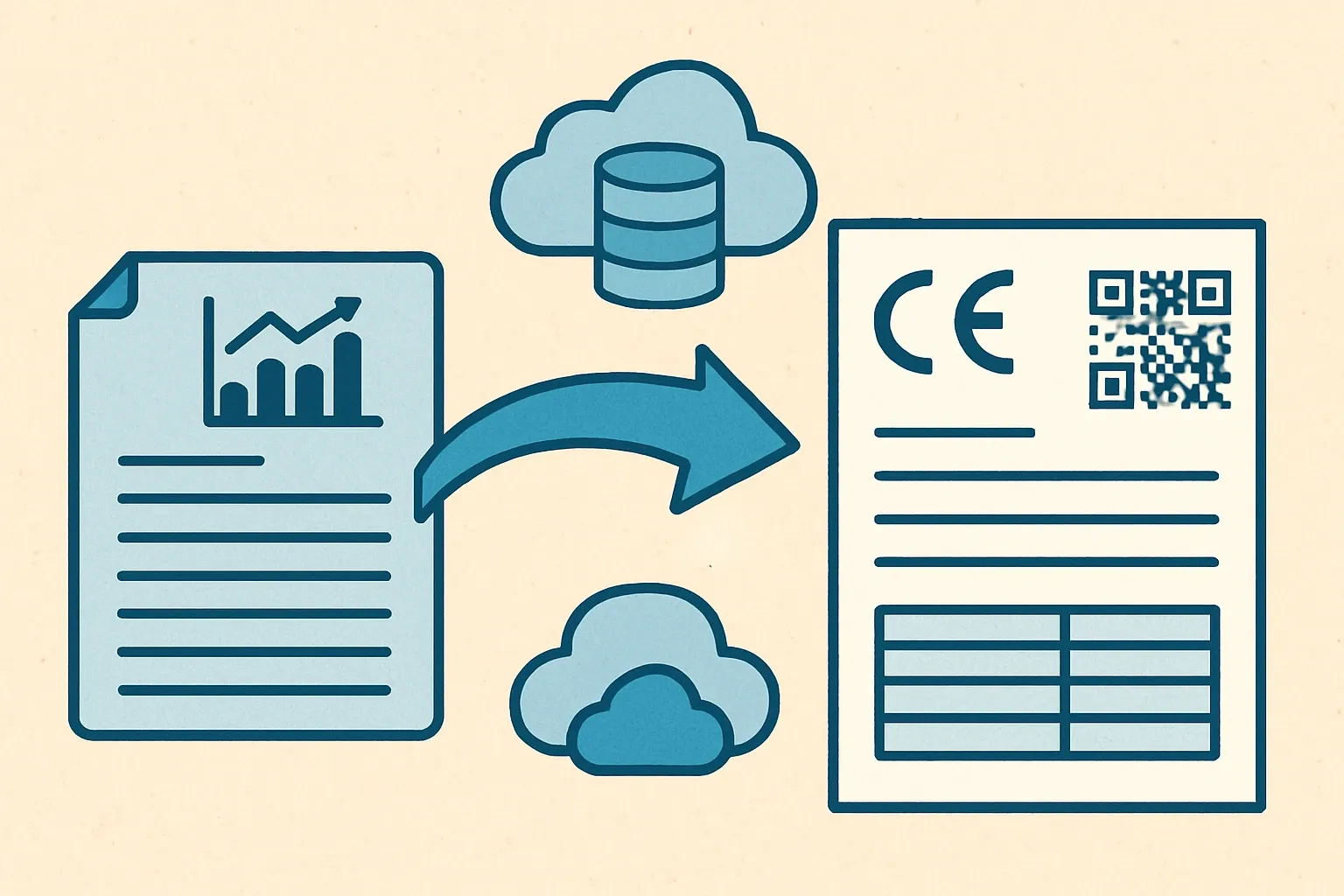
The new combined Declaration of Performance and Conformity is the anchor record. It must include the product’s environmental sustainability performance over its life cycle and can be supplied electronically or via a digital product passport once available (Eur Lex, 2025) (Eur Lex, 2025).
Sustainability values must be calculated using product category rules and the latest version of Commission supplied software, which will be provided free of charge. Updates become mandatory one year after publication. That means your calculation tools and data pipelines cannot be static anymore (Eur Lex, 2025) (Eur Lex, 2025).
Digital Product Passport for construction
The regulation creates a passport system for construction products. Think of it as a scannable profile that carries performance, conformity, and environmental data in a machine readable format, designed to ease checks across borders (Council of the EU, 2024) (Council of the EU, 2024).
The DoPC template will evolve to stay interoperable with the passport. The Commission is empowered to adapt the model and IT format so data can flow reliably into the passport system (Eur Lex, 2025) (Eur Lex, 2025).
Ready for the new Construction Products Regulation changes?
Follow us on LinkedIn for updates that help you stay compliant and competitive in the EU market.
Timed rollout of what you must declare
The DoPC will cover essential characteristics in stages. Group one starts January 8, 2026, with further groups added on January 9, 2030, and January 9, 2032. Plan your datasets with those dates in view so you are not rebuilding your templates twice (Eur Lex, 2025) (Eur Lex, 2025).
What this means for EPDs and EN 15804
EPDs remain the gold standard for communicating quantified environmental impacts under EN 15804. The new DoPC requires life cycle based sustainability performance and explicitly ties the calculations to applicable product category rules, which aligns with EPD practice (FPS Economy Belgium, 2025) (FPS Economy Belgium, 2025).
Industry guidance signals that EPD data becomes part of the common technical language for products, and EPD content will sit alongside declared performance inside the DoPC. That is a strong nudge to treat the EPD not as an optional brochure but as core compliance data (Construction Products Europe, 2025).
No overnight change to CE marking
Do not expect the label on the box to flip this quarter. Existing harmonised standards and routes continue until new specifications are adopted under the revised regime, so CE processes stay familiar for a while (Euralarm, 2025).
Use the breather wisely. Teams that clean up data now will coast when new templates go live.
The business case if you sell into the EU
The construction ecosystem represents roughly 5.5 percent of EU GDP, employs about 25 million people, and includes more than 5 million firms. The construction products industry alone counts around 430 thousand companies and €800 billion in turnover. These are not niche markets, they are table stakes for global manufacturers (Council of the EU, 2024) (Council of the EU, 2024).
Specification teams increasingly prefer products with third party verified EPDs because it removes penalty assumptions in carbon accounting. LEED v5 proposals continue to reward product specific declarations, so a clean EPD portfolio does double duty for EU bids and North American work.
A simple 180 day plan
- Map your EU relevant SKUs against current harmonised standards or EADs and note which ones will migrate first.
- Inventory data for life cycle modeling. Prioritise primary energy, water, waste, and transport for the latest full production year.
- Choose the right PCR and EN 15804 pathway your competitors use. Align where it helps comparability.
- Decide where to publish EPDs. In Europe many choose IBU. In the US Smart EPD is common. Operator choice is flexible.
- Prepare the DoPC template now, including the fields that will become mandatory on the 2026 and 2030 dates.
What to watch between now and 2027
Standardisation requests will set the practical details for categories and test methods. The Commission will release the free calculation software that DoPC sustainability sections must use and will update it over time. Keep a change log so your team knows which version generated each result (Eur Lex, 2025) (Eur Lex, 2025).
Expect more national tenders to reference digital passports and DoPC completeness once the system matures. That shift will reward manufacturers who treat environmental data as master data rather than a side document.
Final take for busy teams
The new CPR tightens the loop between CE marking and credible environmental data. Treat the EPD as the data engine that feeds the DoPC, not an afterthought. The clock is ticking fast, dont wait.