Sweden’s climate declaration rules in a nutshell
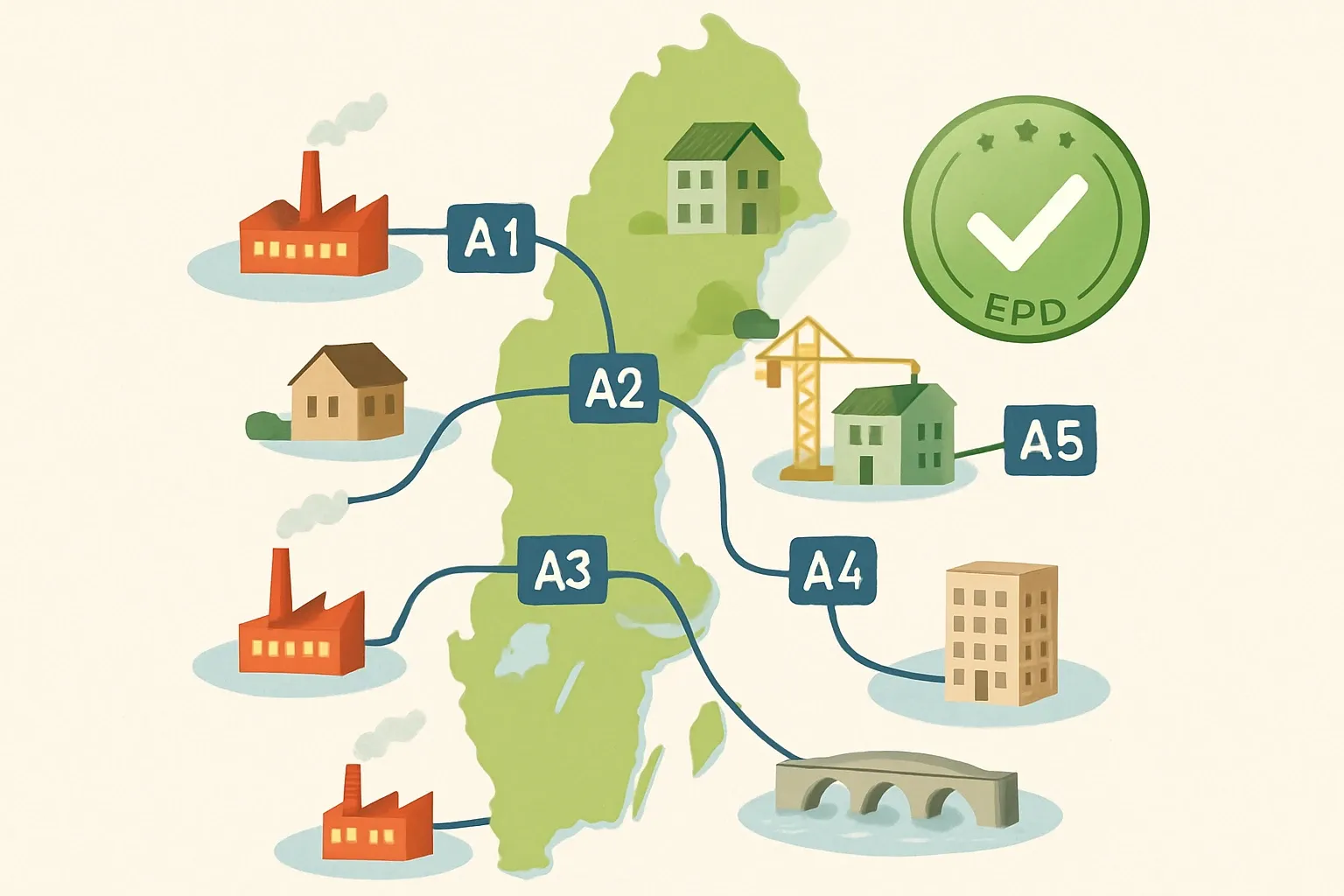
Sweden requires a climate declaration for new buildings with permits filed on or after 1 January 2022. The declaration covers the construction stage only, modules A1–A5, and must be registered with Boverket before final sign‑off. Boverket reports 1,765 declarations registered during 2022–2024 and a 10.3 percent oversight selection rate (Boverket, 2025) (Boverket, 2025).
Boverket has also proposed climate limit values and an expanded declaration scope. Earliest introduction was assessed as 1 July 2025 for limit values, with broader scope proposed from 2027, subject to government decisions (Boverket, 2023).
Do climate declarations require an EPD?
Not strictly. The authority hosts a free climate database that can provide default values when no product-specific EPD exists. Teams still prefer verified EPDs because defaults are conservative and can make the building look heavier than it is. An EPD replaces guesswork with proof and reduces the risk of penalties in project carbon accounting.
Where EPDs are usually published
Most Sweden-facing manufacturers choose the International EPD System run by EPD International AB, a subsidiary of IVL in Stockholm. The program crossed 10,000 valid EPDs in September 2024, with construction products dominating the library (EPD International, 2024) (EPD International, 2024). By September 2025, more than 2,700 organisations from nearly 50 countries held valid EPDs under the scheme (EPD International, 2025).
Other European operators appear often in Swedish projects, including IBU in Germany and EPD Norge for neighboring procurements. All credible operators align with EN 15804 and ISO 14025, so acceptance is typically about reviewer familiarity and documentation quality, not the logo alone.
Procurement signals beyond buildings
Infrastructure buyers are vocal. Trafikverket’s climate requirements set reduction targets versus a 2015 baseline and accept third-party verified EPDs as verifikat inside the Klimatkalkyl system. Targets include 30 percent by 2025 and 60 percent by 2030, on a path to climate‑neutral infrastructure by 2040 (Trafikverket, 2025) (Trafikverket, 2025). For materials like cement, concrete, steel and asphalt, having current, plant‑specific EPDs shortens reviews and avoids rework.
Want to navigate Sweden's EPD landscape effectively?
Follow us on LinkedIn for insights that help you get spec'd on projects and meet climate declaration requirements.
Standards Swedish reviewers expect
Aim for EN 15804+A2 with ISO 14025 as the umbrella. Use declared units and system boundaries that match the PCR, and document transport and energy data clearly. Reviewers will check verification statements, cut‑off rules, and that background datasets are recent and consistent with European practice.
Picking the right PCR in this market
Start by scanning competitor EPDs in Sweden and the Nordics, then pick the PCR family that dominates your category. That reduces friction during verification and publication. If two PCRs are in play, consider expiry dates and which operator the specifiers read most in your segment. When a PCR is due for revision, coordinate timing so you do not publish into a rulebook that changes next quarter.
Data Sweden cares about most
- Plant location and energy mix, including fuels and district heat shares.
- Transport distances into Sweden or within the Nordics, not generic global averages.
- Concrete, steel, asphalt and insulation often face deeper scrutiny. Keep mix designs, SCM shares, and recycled content traceable. Boverket’s climate database is openly accessible in Swedish and English, with exportable data and an API, developed with Trafikverket and partners, which is handy for cross‑checks.
Digital EPDs are arriving
The International EPD System began publishing fully digital EPDs in 2025. As of 20 May 2025, 62 digital EPDs were live, enabling faster updates and easier data exchange into BIM and procurement portals (EPD International, 2025b). If your portfolio changes often, plan your workflow so structured data can be refreshed without a full rebuild.
A Sweden‑ready plan, step by step
Pick a clean reference year for utilities, volumes, and waste. Gather supplier EPDs and invoices early, then confirm transport legs that actually occur for Sweden. Select the PCR and operator, line up an accredited verifier, and keep a tidy evidence binder that a municipal reviewer can parse quickly. If “epd sweden” is on your roadmap, this sequence avoids last‑minute hunts.
Choosing help without slowing down
Successful teams rarely chase data over email. They centralize requests, track plant responses, and keep a single source of truth so LCA modeling can move in parallel. Look for partners who manage the heavy lifting of data collection, are operator‑agnostic, and know how to publish quickly with IBU or the International EPD System. Speed is about process, not heroics. Getting this right pays back fast on bids and specs, sometimes quicker than people expect. It’s definately worth it.
Where this leaves you
Sweden rewards manufacturers that bring specific, verified carbon numbers to the table. Publish product‑specific EPDs that align with EN 15804, keep data plant‑true, and you will glide through climate declarations and public tenders with fewer surprises. When targets tighten, your groundwork is already done.
(References for numeric statements: Boverket statistics on climate declarations 2022–2024 and supervision shares, reviewed 21 March 2025; Boverket 2023 proposal on limit values and expanded scope; EPD International milestone counts 2024 and programme size 2025; Trafikverket climate‑reduction targets and EPD verification process 2025; EPD International digital EPD count 2025.)