

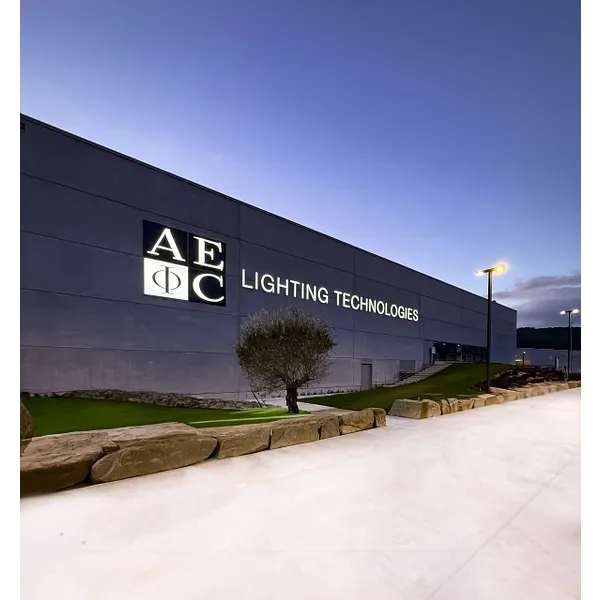
Twenty-seven reasons to raise a glass in Subbiano
Congratulations are in order for AEC Illuminazione S.r.l. Between October 30 and 31, 2026, the company pushed 27 new Environmental Product Declarations into EC3. Its current portfolio there now stands at 30 declarations, and every one of them is valid until January 2031.
That's a big number for any manufacturer. For an outdoor lighting specialist it's even bigger, because this product space is still thin on product-specific environmental data. Plenty of luminaires reach a project shortlist with only a datasheet. That forces carbon assessors to fall back on generic values, and those usually come with a conservative penalty attached.
Who AEC Illuminazione is and why lighting matters here
AEC is a family-owned company based in Subbiano, near Arezzo, and it has been in business for more than 65 years (EPDItaly, 2025). It makes public and urban lighting: street luminaires, area floodlights, tunnel systems and architectural fixtures. Its installations run through Milan, Berlin, London, Oslo, Auckland and Dubai.
Norway has a special place in that story. The company's project pages list the Arendal E18 road lighting scheme, the Ringerike tunnel, the Strand tunnel and the Hålogaland Bridge. So the choice of a Norwegian program operator for this batch looks like a deliberate fit with where AEC already sells.
What the batch actually covers
The 30 EPDs in EC3 span seven product ranges. Each declaration is tied to one specific coded configuration (for example "Q-DROME 5P5 STU-S 7040.140-4M") instead of averaging across a whole family. Specifiers like that kind of precision, because the number in the carbon model matches the product on the drawing.
- I-TRON (ZERO, MICRO, 1 and 2): seven street lighting configurations
- MX PRO (1, 2 and 3): seven configurations split between outdoor floodlight and tunnel versions
- ITALO (1, 2 and 3): six street luminaire configurations
- NOOS (1 and 2): four configurations in TP and BR variants
- Q-DROME, ECO RAYS and ARYA: two configurations each
The tunnel entries stand out. Tunnel lighting is a niche where few manufacturers publish product-level data at all, and road authorities planning large tunnel upgrades buy in volume.
Join Parq Pulse!
Our weekly newsletter for manufacturers mobilizing product and environmental insights to remain competitive and win more projects.
EPD Norway and a luminaire-specific rulebook
Every EPD in the batch was issued by EPD Norway (the Norwegian EPD Foundation, which now also operates online as EPD-Global) under "Part B: Requirements on the EPD for Luminaires, lamps and components for luminaires". We cover the operator in more depth in our guide to EPD-Norge and its Nordic-built credibility.
The PCR choice matters. It's the same rulebook a Nordic lighting heavyweight like Glamox uses, so AEC's numbers sit on the same footing as the declarations Scandinavian specifiers already know. Think of it as playing on the home team's pitch with the home team's rules. The EC3 records don't name an LCA developer or consultant for this batch.
Building on an existing EPDItaly foundation
This isn't AEC's first time doing this. The company already holds family-level EPDs with EPDItaly under the Part B PCR for public lighting (EPDItaly 020), covering ranges such as I-TRON, ITALO, MX PRO, Q-DROME, NOOS, ECO RAYS and ARYA, along with COMPASS, FALKO, DRAGON and others. Those declarations list Greenwich Srl as technical support.
So the new batch deepens coverage more than it opens new categories. The same core ranges now have configuration-level declarations under a second, Nordic-aligned framework. Specifiers in Italy and Norway can each work with the program operator their tools and tender teams already recognise.
How the batch stacks up against competitors
In EC3, the lighting field is uneven. Glamox has more than 450 current EPDs under the same EPD Norway luminaire PCR, and much of that is indoor commercial lighting. iGuzzini has 20 current EPDs through PEP ecopassport, including outdoor families such as Agorà. Thorn Lighting has 16 current EPDs published through IBU.
Against outdoor-focused peers, 30 configuration-specific EPDs puts AEC firmly in the conversation for road, area and tunnel projects. It won't match the volume of the giants that cover huge indoor catalogues. In the niche where AEC actually competes, though, this batch moves it from being a credible option to one of the better documented ones.
Why this changes the spec conversation
On projects with embodied carbon targets, a luminaire without a product-specific EPD often gets modelled with pessimistic default values. That makes it an easy candidate for value engineering out of the job. With a verified EPD, AEC products bring their own numbers. The conversation can then stay on optics, efficiency and durability instead of turning into a price-only fight.
The upside is hard to see from the inside. Manufacturers rarely find out about the tenders they were never invited to because a declaration was missing. A single mid-sized road or tunnel contract can easily pay back the effort behind a batch like this.
Closing the gap between issue and discovery
There's one detail worth flagging. Several validity windows start on January 1, 2026, which suggests most of these declarations were issued around the start of the year, roughly ten months before they appeared in EC3. During that time, specifiers searching the database simply couldn't find them.
Cutting that lag means products show up in searches while the design decisions are still being made. Readers who want to get future EPDs listed faster can reach out to the author via LinkedIn or email, using the contact details below this article.
Making sure specifiers can find the EPDs
AEC already does a lot right here. Its website has a dedicated Environmental Product Declaration hub and a download page for EPD certificates organised by product family. Those pages currently point to the family-level EPDItaly documents. Adding the new EPD Norway configuration declarations next to them, and linking each one from the matching product page, would let Nordic specifcation teams grab the right file in one click.
A brighter baseline for AEC's next tender
AEC Illuminazione has turned a strong EPDItaly foundation into a two-track transparency strategy. It now has configuration-level EPD Norway declarations for the road, area and tunnel ranges that already light up Norwegian infrastructure. That's a real milestone in a category where product-specific data is still scarce.
What's left is mostly housekeeping: faster listing, clear links from product pages and keeping an eye on the 2031 renewal horizon. With those in place, the next tender team that opens EC3 looking for a verified tunnel or street luminaire should find AEC near the top of the list.