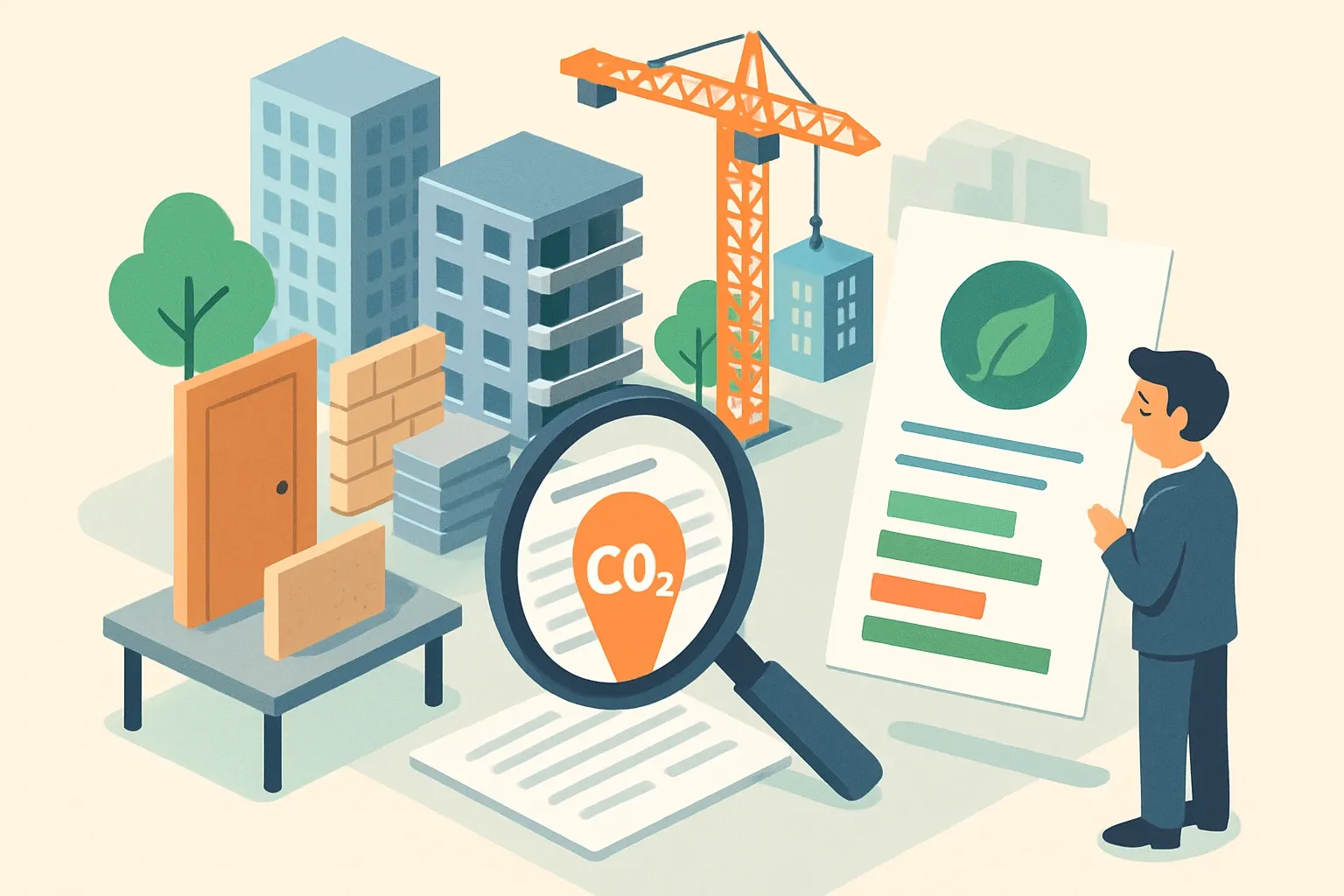
Denmark’s LCA rules just tightened, hard
From July 1, 2025, Denmark set an average whole‑life carbon ceiling of 7.1 kg CO2e/m²/year for new buildings, added a separate 1.5 kg CO2e/m²/year cap for the construction phase, and published typology limits like 7.5 for offices and 4.0 for smaller holiday homes. The combined cap including the construction phase is 8.6 for 2025, with staged tightenings to 7.7 in 2027 and 6.9 in 2029 (Social‑ og Boligministeriet, 2024).
Urban Partners reads the room
By baking whole‑life carbon modelling into all new projects, Urban Partners is aligning design choices with these caps from day zero. Think of it like setting your GPS before you drive, not after you miss the exit. Early LCA closes the gap between design intent and permit‑proof numbers.
Why manufacturers should care
Carbon‑capped projects reward material transparency. Product‑specific, third‑party‑verified EPDs let project LCAs use measured values instead of pessimistic defaults that can sink a spec. Clear, current EPDs also de‑risk substitutions when caps tighten mid‑design.
What the Danish building LCA actually counts
Denmark’s method fixes a 50‑year reference period and includes A1–A3, A4–A5, B4, B6, C3–C4, and reports D separately. That fixed time horizon is not negotiable in submissions, so data completeness matters from the start (LCAbyg Guide, 2024).
Join Parq Pulse!
Stay ahead in the green building race with weekly insights on environmental data and regulations.
The construction phase now has its own ceiling
Transportation to site, site energy, and waste are not footnotes anymore. With A4–A5 capped separately at 1.5 kg CO2e/m²/year for 2025, products that ship smarter, pack lighter, and install with less waste help teams stay under the building cap and the construction cap at the same time (Social‑ og Boligministeriet, 2024).
The short list favors products with ready data
Specifiers under BR18 will default to materials with credible EPDs and clear transport, packaging, and end‑of‑life assumptions. No EPD often means a higher placeholder in the LCA, which makes your product harder to justify on a capped project.
Your fast‑track data kit
A lean prep package gets manufacturers LCA‑ready without chaos:
- One recent 12‑month utility and production dataset per plant, plus material recipes.
- Standard routes to Denmark, transport modes, and packaging bills of materials.
- Installation yields and site waste rates for common assemblies, in writing.
- Replacement cycles for wear parts and maintenance inputs that affect B4 and B6.
Timeline pressure is real, and predictable
Caps step down again around mid‑2027 to 6.4 kg CO2e/m²/year for building impacts, with the construction‑phase limit tightening to 1.3, then to 5.8 and 1.1 in 2029. Project teams will target below‑cap designs earlier to avoid redesigns and permit risk, which puts validated product data in the critical path (Social‑ og Boligministeriet, 2024).
What to do next if Denmark is on your sales map
Begin with the PCR your competitors use, confirm fit with EN 15804, and plan data collection around a fixed reference year so results land cleanly in BR18 submissions. Pick an LCA partner who takes the data burden off your core team and can publish with the program operator your buyers expect. Speed matters because design teams now model carbon in the concept sketch, not at tender.
Where this goes
Denmark’s enforcement gives everyone a shared scoreboard. Urban Partners’ workflow shift shows where developers are heading, and it raises the bar for material data readiness. Manufacturers who meet that bar with trustworthy EPDs and practical logistics details will find that carbon compliance is not just paperwork, it is a spec advantage.