Why this plan matters for manufacturers
Sound Transit’s plan shifts carbon from sidebar to selection. It calls for a Buy Clean procurement strategy that sets embodied emissions limits across concrete, steel, glass, asphalt, insulation, and masonry. If a product cannot show its numbers with a third party verified EPD, it risks sitting out key scopes.
What Sound Transit will measure
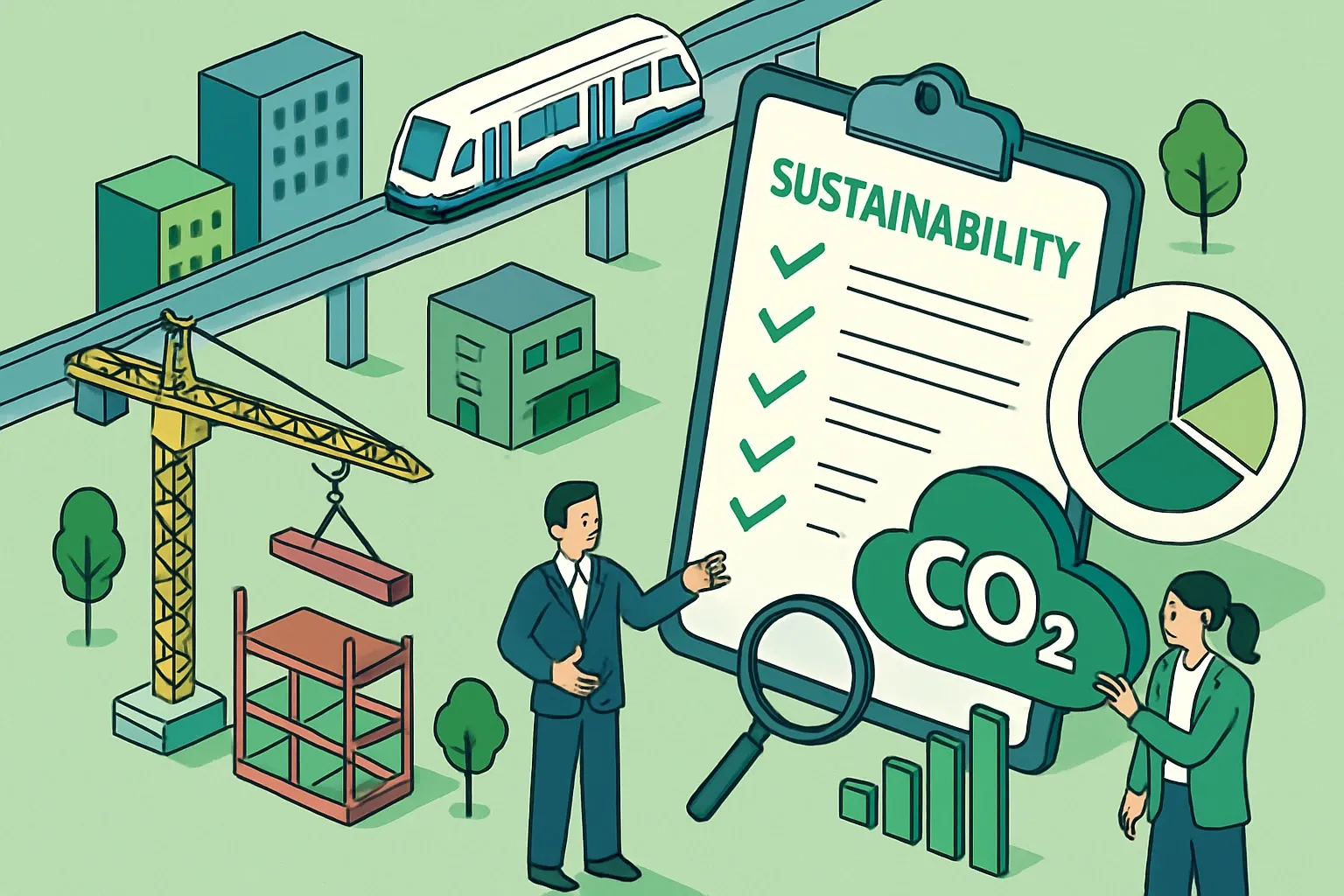
The plan adds whole building global warming potential per square meter as a design metric and expands the number of material categories covered by Buy Clean. It also commits to sunset purchases of fossil fuel powered revenue vehicles by 2030, make facility electricity greenhouse gas neutral by 2030, and funds improvements through a 25 million dollar Efficiency and Sustainability Program. Eight facilities already carry LEED certification and all new ones must reach LEED Gold. Two corridors are certified to Envision Platinum. These are formal, budgeted targets, not slogans (Sound Transit Sustainability Plan, 2026) (Sound Transit Sustainability Plan, 2026).
The regional rulebook is tightening
Washington’s Buy Clean and Buy Fair law begins state reporting in July 2025, including facility specific EPD and material quantity reporting. That raises the bar for disclosures used on public projects statewide, including transit expansions (OMWBE Buy Clean and Buy Fair RFP, 2025) (OMWBE Buy Clean and Buy Fair RFP, 2025). King County already requires low embodied carbon concrete with maximum global warming potential thresholds in its capital projects, which influences specs that interface with Sound Transit work (King County SCAP Biennial Report, 2024) (King County SCAP Biennial Report, 2024).
Translation to EPD and HPD actions
Procurement language that mentions Buy Clean usually expects recent, product specific EPDs. Facility or supply chain specific data earns trust because it reflects local energy, clinker blends, recycled content, or resin choices. HPDs remain a fast credibility signal when riders, neighbors, and agencies care about material health in stations and depots. The combo quiets risk questions in preconstruction and keeps your product in play when alternatives look similar on performance.
Join Parq Pulse!
Stay ahead with weekly insights on environmental data and product disclosures to win more projects in construction manufacturing.
Get ready in weeks, not quarters
A smart path is simple and sequenced. It also avoids burning time on back and forth emails that stall submittals.
- Confirm the dominant PCR your competitors use and its renewal date, then lock scope.
- Pick a clear reference year and collect utilities, throughput, scrap, and transport legs across all plants serving Washington.
- Document mix designs or formulations that can flex to lower carbon routes without cutting performance.
- Choose a program operator that your target owners and GCs already recognize in the region.
- Publish digital ready EPDs and template spec language so estimators can drop them in instantly.
What buyers will ask next
Estimators will look for a declared GWP number, plant location, and a verification date that will be valid through bid and build. Designers will ask whether lower carbon options like SCM blends, recycled metals, or alternate binders change cure time, finishes, or strength classes. Provide concise notes on performance trade offs, not marketing fluff, and you remove excuses to swap your product.
Timing beats perfection
Sound Transit’s plan runs from January 2026 through December 2030. Waiting for the perfect dataset can push you past RFQ windows tied to design milestones. Publish now with solid, auditable numbers and iterate at renewal or when PCRs update. Most owners care that an EPD is current and verified, not whether every upstream supplier filed a flawless utility record last quarter.
The ROI case you can take to sales
Public owners in Washington value proof. Where EPDs and HPDs are absent, design teams often assign conservative impacts, which can sideline a product that would otherwise meet cost and performance. One mid sized transit linked award can repay the credentialing effort many times over. It’s definately cheaper than watching a competitor win on a disclosure you could have had ready.
Closing thought
Treat the Sound Transit plan as a spec forecast. If your materials touch stations, guideways, OMFs, or TOD buildings in the region, equip your team with product specific EPDs, crisp HPDs, and a response pack that answers embodied carbon questions in one go. The teams that make carbon easy to see are the teams that keep getting invited back.