What actually happened
Siemens announced that its internal EPD creation tool is approved by EPD‑Global, allowing independently verified EPDs to be published through that operator with a shortened verification path (Siemens, 2025) (Siemens, 2025). They report EPD coverage above 50 percent today and a target of 100 percent by 2030 for their relevant portfolio (Siemens, 2025).
Why this matters for any manufacturer
Large buyers, especially public ones in Europe, are dialing up environmental weighting in tenders. In Norway, climate and environment must count at least 30 percent in public procurement awards starting January 1, 2024 (DFØ, 2025) (DFØ, 2025). Faster verified EPDs mean fewer missed submittal windows, less risk of being sidelined by a competitor with current documentation, and fewer frantic data hunts at bid time.
Tool approval 101
Program operators sometimes pre‑verify parameterized EPD tools. Once the tool is approved, each product instantiation still needs conformity checks, yet reviewers can focus on inputs and boundary conditions rather than re‑auditing every formula. EPD‑Global explicitly runs an EPD‑tool verification scheme with a published verifier roster (EPD‑Global, 2025) (EPD‑Global, 2025). The result is a smoother lane from plant data to a published, third‑party verified declaration.
The speed play is real, but the bottleneck is data
Automation accelerates verification. The slow part is still internal data capture across sites, shifts, and ERP silos. That means calendar‑blocking utility pulls, metering clarity, waste stream logs, and supply chain primary data where feasible. Treat the reference year like a financial close, not an afterthought. Do this well and tool‑driven verification feels almost unfairly fast.
Are you ready to meet rising buyer expectations in EPDs?
Follow us on LinkedIn for updates that can help you streamline your verification process and win more projects.
Standards are moving in parallel
Construction EPDs increasingly align on EN 15804+A2. For the International EPD System, the updated construction PCR notes a transition that ended on June 20, 2025 for version 2.0.0 to 2.0.1 (EPD International, 2025). National databases also tighten inputs. The Dutch NMD requires A2 data based on ecoinvent 3.9.1 from July 1, 2025 for inclusion in their database (NMD, 2025). These details matter when your declarations must travel across markets without rework.
A quick read on EPD‑Global’s footprint
EPD‑Global reports a portfolio exceeding 9,500 published EPDs in 2025, which signals market familiarity among European specifiers who routinely check that registry (EPD‑Global, 2025) (EPD‑Global, 2025). Publishing where your buyers actually look still beats playing hide and seek with PDFs.
What buyers will infer from moves like this
If one manufacturer can deliver verified, comparable numbers quickly, others can too. Expect procurement to tighten submission windows and to ask for product‑specific, third‑party verified EPDs as a default rather than a nice‑to‑have. In markets with explicit weighting rules, tardy or generic documentation becomes a scoring handicap, not just a paperwork nuisance (DFØ, 2025).
How to prepare your own pipeline
Pick the right PCRs by studying competitor declarations and operator norms in your target markets, then lock scope and sites early. Stand up a clean data room for the reference year, including energy invoices, metering splits, material formulations, packaging, yield losses, and outbound transport. Decide on your publishing operator based on recognizability where you sell, not just habit. The boring prep work makes enviromental excellence look easy.
A small but telling rule tweak to watch
EPD‑Global’s technical committee has moved the reference service life for building product EPDs from 60 to 50 years, taking effect as PCRs get revised. That is a comparability detail with real math implications in down‑stream models (EPD‑Global, 2025).
Bottom line for spec‑driven revenue
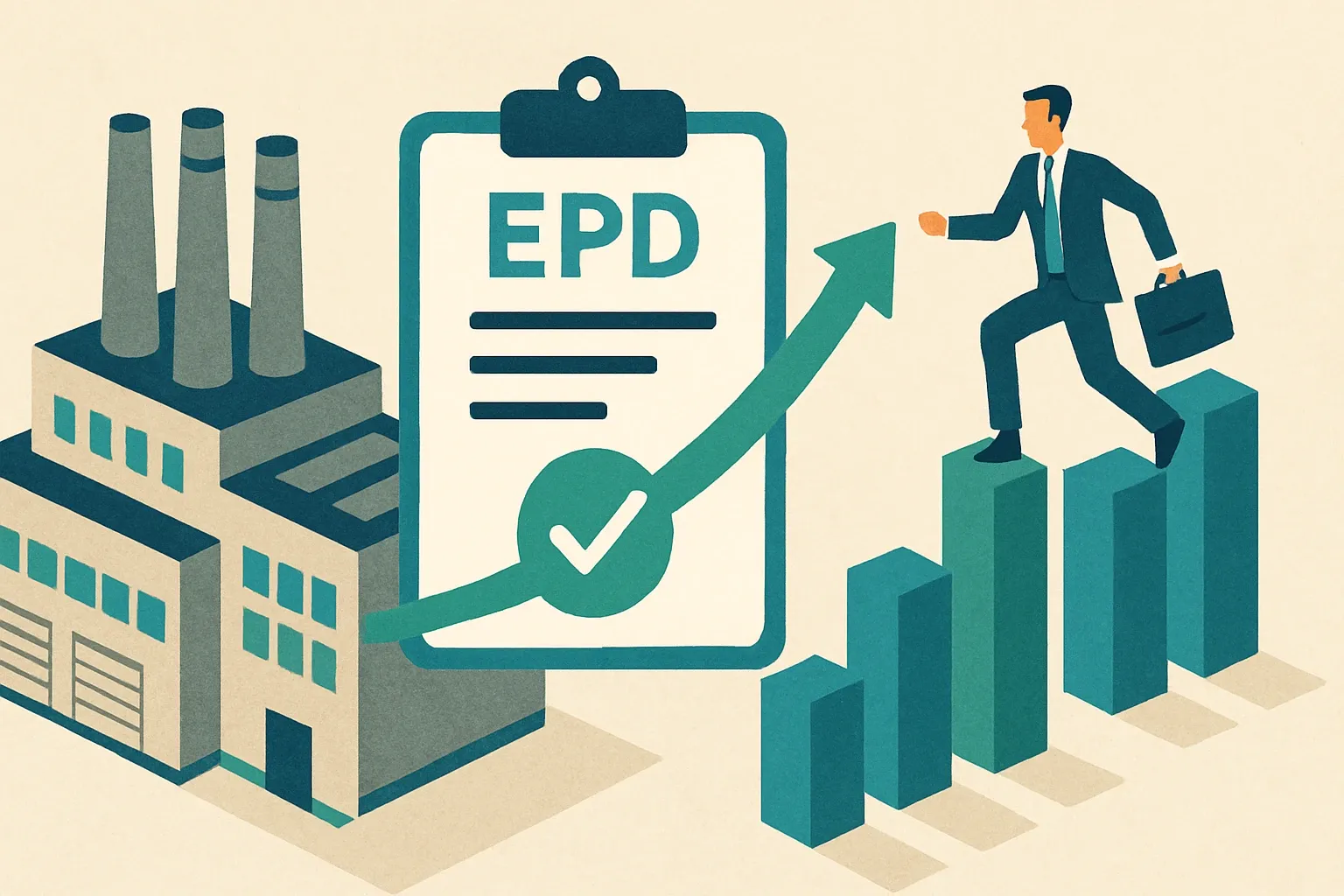
Speed plus verification changes the sales math. Verified, up‑to‑date EPDs reduce buyer friction and keep your product eligible when carbon accounting is strict. Reliable cost averages for creating EPDs vary by scope and operator, yet teams repeatedly find the payback arrives with a single mid‑size win when weighting rules apply and documentation is ready on time.