Global signal check
The International EPD System reports it surpassed 18,000 valid and registered EPDs in 2025, with 9,143 standard‑format EPDs and 252 digital ones added that year (EPD International, 2025) (EPD International, 2025). Think of the market as a streaming platform that just unlocked a bigger catalogue and better metadata. More declarations, more comparability, fewer excuses to sit out carbon accounting.
North America
LEED v5 continues its rollout. From July 1, 2026 it becomes the only version open for new registrations for most commercial systems, which is already shaping owner requirements for product disclosures in specs (USGBC, 2026) (USGBC, 2026). California kept its procurement spotlight on a few materials. The state’s published GWP limit for heavy‑density mineral wool board is 6.82 kg CO2e per square meter at RSI 1, an easy number to benchmark your insulation EPD against when bidding public work (California DGS, 2025) (California DGS, 2025). Washington’s Buy Clean and Buy Fair program continues phasing standards into state projects in 2026, increasing the practical value of having current, product‑specific EPDs ready to submit (Washington Commerce, 2026).
Layer in California’s 2025 Energy Code update that took effect January 1, 2026 and you get a one‑two combo where operational rules meet material transparency on the same jobs (California Energy Commission, 2026).
European Union and France
The revised Construction Products Regulation is now Regulation (EU) 2024/3110, setting the stage for Digital Product Passports that will reference EPD‑style data for construction products in the coming years. Translation for product teams: structured, verifiable data will travel further and faster across borders (European Parliament, 2024).
France’s INIES database shows the pace in hard numbers. As of April 24, 2026 it lists 5,707 FDES and 1,670 PEP, covering 324,045 commercial references. If you sell into RE2020 workflows, those are the shelves your declaration sits on (INIES, 2026) (INIES, 2026).
Join Parq Pulse!
Stay ahead with weekly insights on environmental data and industry trends to win more bids and stay competitive.
Germany and Central Europe
IBU indicates more than 700 single‑product EPDs were published through its program in 2025, a 33 percent year‑over‑year jump that mirrors buyer demand for verified A1–A3 data in tenders (Bauletter, 2026). That surge is a reminder that verification capacity is no longer the bottleneck it was two years ago. Teams that queue early get the publishing slots they want.
United Kingdom and Ireland
The RICS Whole Life Carbon Assessment standard 2nd edition has been in full effect since July 1, 2024, and it keeps tightening how project teams justify impacts across A1 to C4. That quietly raises the bar for EPD comparability in bids that reference WLCA deliverables (RICS, 2024). The UK Procurement Act 2023 brings fresh transparency duties into force from April 2026, which makes clean, third‑party‑verified product data a safer default for contracting authorities to score in tenders (UK Cabinet Office, 2026). If your EPDs are scattered or expired, bid writers feel it.
Nordics
Finland’s Construction Act requires climate reporting for new buildings with full application in 2026, increasing demand for consistent LCA inputs and EPD references in design models (IEA, 2026). In Sweden, Boverket has registered thousands of climate declarations since launch and published proposals for limit values, a policy arc that predictably lifts the value of EN 15804‑aligned EPDs over generic datasets in public work (Boverket, 2023).
Asia Pacific
Australia’s Green Star Buildings v1.1 becomes the required registration path starting May 1, 2026. The update aligns credits with national code changes and strengthens embodied‑carbon handling, which is pushing more design teams to request product‑specific EPDs early in documentation (GBCA, 2026) (GBCA, 2026). In New Zealand, industry guidance and rating updates in April kept momentum toward moving from counting to controlling embodied carbon in practice, a shift that rewards manufacturers with current, clearly scoped declarations (NZGBC, 2026). Japan’s EcoLeaf continues under SuMPO, giving exporters a recognized route for ISO 14025 declarations when selling into APAC buyers used to regional formats (JEMAI, 2026).
Middle East and Africa
The International EPD System highlighted the formation of EPD Tunisia and EPD Saudi Arabia in late 2025, signaling more local verification capacity for the region’s next wave of public and private builds (EPD International, 2025). On the ground in Africa, manufacturers keep adding declarations to compete in public and corporate projects. One recent example in April saw additional plasterboard EPDs announced in South Africa, a small but telling datapoint for submittal expectations across the region (Gyproc South Africa, 2026).
Latin America
Brazil’s EPD Brasil program operates as a regional hub under the International EPD System, which helps manufacturers publish in Portuguese while keeping EN 15804 alignment for exports to Europe. Trustworthy counts for April are not centrally published, but we see steady publishing cadence across cement, steel, and coatings categories. If you sell into Brazil and the EU, one well‑structured LCA can often underpin both routes so long as the PCR fit is confirmed.
What this means for product teams
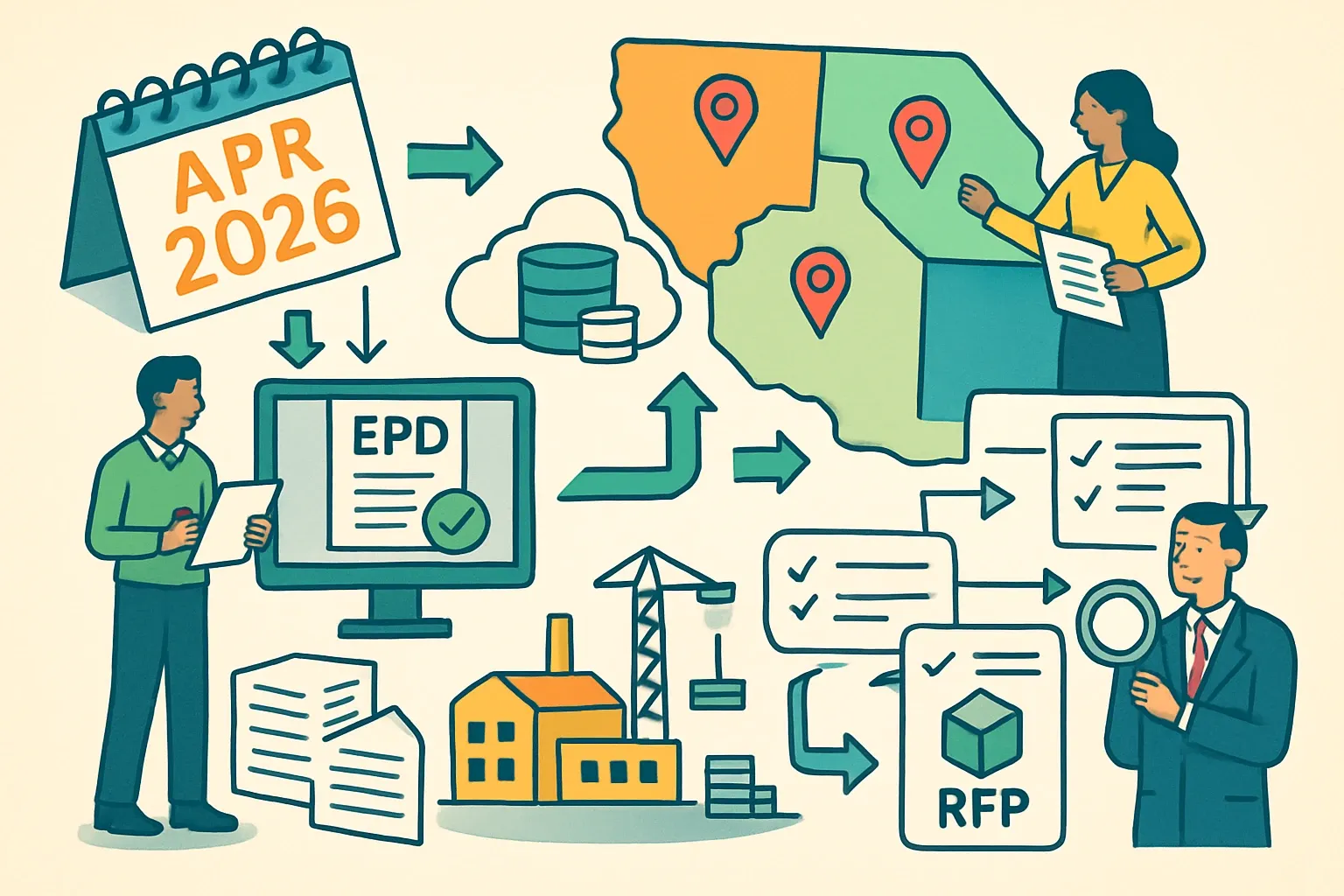
April’s theme is simple. Verification speed and data completeness are becoming the real moat. Specs are converging on structured, current EPDs that plug into rating tools, public databases, and procurement portals without hand‑holding. If your internal data collection still lives in inboxes, you will loose time and bids. Treat EPD workflows like a product launch: lock a recent 12‑month reference year, map top SKUs to the right PCR, and schedule verification windows before summer submittal season. Your future self will thank you.