What just launched
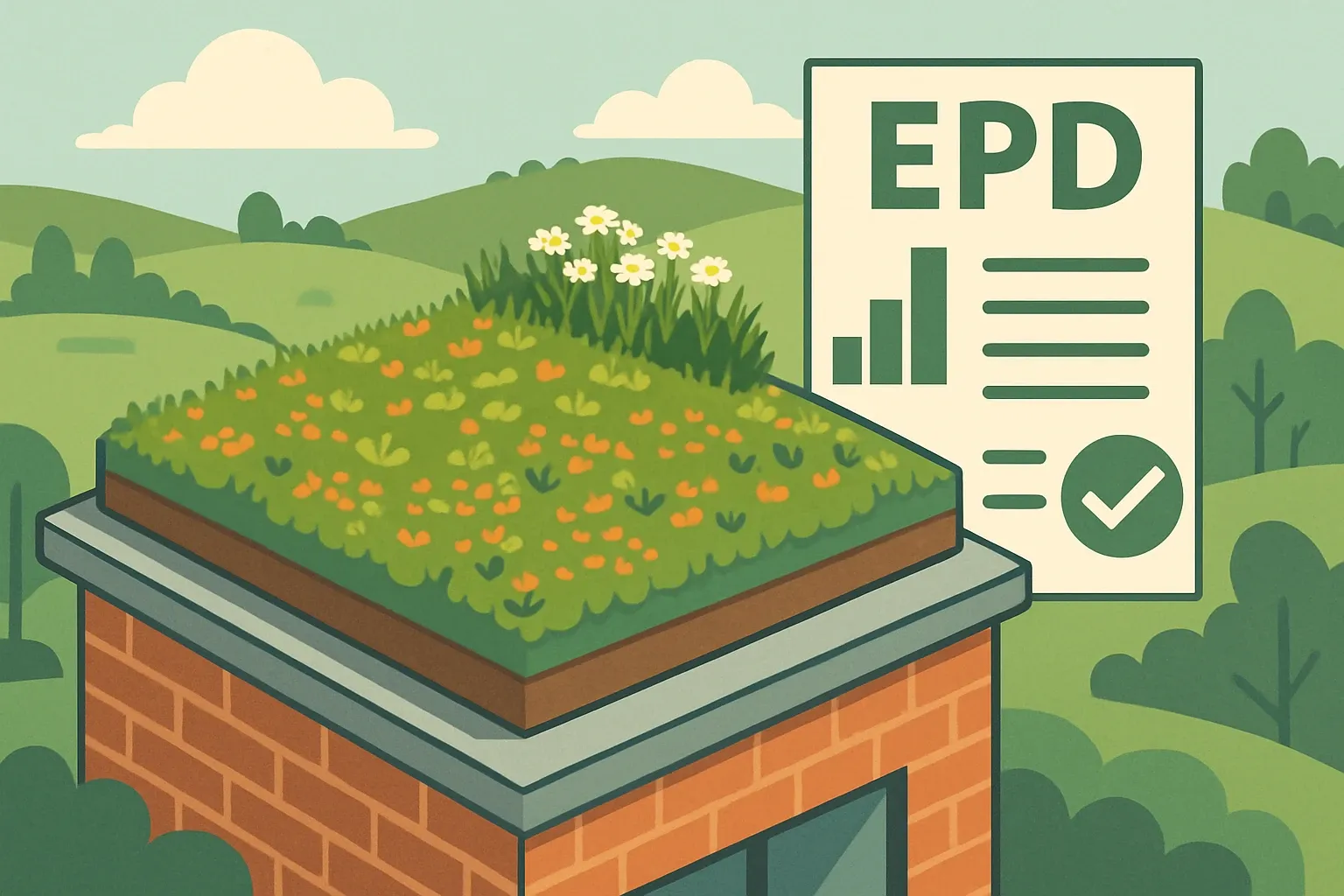
Svenska NaturTak’s first EPD covers sedum and meadow vegetation mats used on green roofs and ground cover. It is a third‑party verified declaration issued by EPD Hub under EN 15804+A2. Published August 3, 2025 and valid through August 3, 2030, the EPD declares a 1 m² unit with a mass of 21.5 kg (EPD Hub, 2025) (EPD Hub, 2025).
Scope-wise it reports cradle‑to‑gate with options A4–B1 and end‑of‑life modules C1–C4 plus D. The EPD lists Magnus Kemi as EPD author and Silvia Vilčeková as verifier, which signals a clean paper trail for procurement teams.
Why this matters in specs
Vegetation mats are often the only living, product‑specific layer in a green roof that can carry an EPD. When a mat has verified data, project teams avoid default penalties in whole‑building carbon tools and can compare like for like. That keeps Svenska NaturTak in the conversation on public tenders and private projects where EPDs are a go/no‑go filter.
The product story in one line
They grow sedum and meadow mats in Skåne for installers and builders who want local supply, and they distribute Optigreen system components in Sweden to round out complete roof build‑ups.
Work for Svenska NaturTak or competing with them?
Follow us for a product-by-product analysis of vegetation mats to see which EPDs win specs and where competitors like Veg Tech AB and Byggros stand.
Competitive snapshot
Veg Tech AB has current, product‑specific EPD coverage for sedum mats and pre‑planted tray systems, visible directly on product pages that link to declarations. Byggros publishes verified EPDs for both sedum mats and trays with validity through 2028, issued via Danish Technological Institute and listed in EPD Danmark’s database (EPD Danmark, 2023) (EPD Danmark, 2023).
The takeaway for buyers and specifiers
Svenska NaturTak has entered the transparency arena. In practical terms, this debut helps them meet peers who already show their homework on similar vegetation layers and it unlocks RFPs where a product‑specific EPD is table stakes. Price still matters, but with a verified declaration the product competes on performance, supply, and documented impact rather than discounting alone.
What’s next to build on momentum
Two quick plays are worth considering. First, extend coverage beyond mats to any pre‑planted trays or system variants that frequently appear in bids, since some owners want EPDs that match the installed option one‑to‑one. Second, keep the paperwork tidy by aligning future updates to PCR timelines and target markets, for example maintaining an EPD Hub path for Nordics and adding a second operator where project teams ask for it.
Visibility check on their website
We looked for the new EPD on Svenska NaturTak’s website and could not find a public download at the time of writing. Posting it in a clearly labeled “Downloads” or “Sustainability” section, and cross‑linking from the Sedummatta and Ängsmatta pages, typically increases spec hit‑rate and reduces back‑and‑forth for sales. It’s a simple win, dont delay.
A final nudge for manufacturers watching this move
If a single EPD can move a product line into more bids, a tightly managed data collection process and a predictable review cycle keep it there. The teams that win here minimize internal time spent, centralize plant and utility data, and let experienced LCA partners drive the publication with the program operator their market trusts.