

One declaration, one waterproofing membrane
The EPD in question is S-P-06399, Nanoflex Sin Límites / Nanoflex Sem Límites (registered at the International EPD System as EPD-IES-0006399). It is valid until 5 July 2027. The product is a waterproof, highly adhesive gel-membrane. Kerakoll describes it as breathable, alkaline-resistant and chlorine-resistant waterproofing for its Laminado Sin Límites large-format slabs, which are then laid with H40 Gel adhesive.
The declaration is filed under MasterFormat 07 10 00 (Dampproofing and Waterproofing). It was published through EPD International AB under PCR 2019:14 Construction products (EN 15804+A2), version 1.3.3, and Kerakoll developed it in house. The product names, in Spanish and Portuguese, point to the Iberian market, where Kerakoll Ibérica sells the system as a complete package of slab, membrane and adhesive.
A portfolio that renews on schedule
Kerakoll is not careless about EPDs. As of late November 2026, EC3 lists more than 200 current Kerakoll declarations. Many were published during 2026 and run to 2031: Geolite, Biocalce, Superflex, the H40 adhesive family and the Kerakover paints, among others.
The pattern is easy to see. The older H40 No Limits EPD (S-P-01073) expires in June 2027, yet new H40 No Limits Grigio and Bianco declarations, valid to September 2031, are already live. That is a relay handoff done right: the new runner takes the baton before the old one stops.
The gap: no successor for Nanoflex yet
Nanoflex Sin Límites does not have a successor yet. We searched Kerakoll's current listings and found no newer declaration for the membrane under the same or a revised PCR. The waterproofing category (07 1) holds this single Kerakoll declaration, and nine older ones in that category have already expired.
Kerakoll does have current EPDs for other waterproofing products, notably Nanodefense Eco (valid to December 2030) and Aquastop Indoor (valid to June 2031). Those cover different products, though. A project team that has chosen the full Sin Límites system cannot simply transfer one product's data to another, so this membrane would stop showing up in carbon accounting once the EPD expires.
Join Parq Pulse!
Our weekly newsletter for manufacturers mobilizing product and environmental insights to remain competitive and win more projects.
Who already has a current wet-area EPD
Tile waterproofing is a crowded field, and several direct rivals hold current EPDs under the same PCR family:
- Mapei SpA, Mapelastic Zero: a two-component cementitious waterproofing mortar for balconies, terraces, bathrooms and pools, valid to September 2028.
- Mapei, Mapegum WPS: a quick-drying flexible paste membrane for interior wet areas, valid to November 2028.
- Litokol S.p.A., Coverflex and Elastocem: two-component, chlorine-resistant cementitious systems classed CMO2P under EN 14891, valid to December 2028.
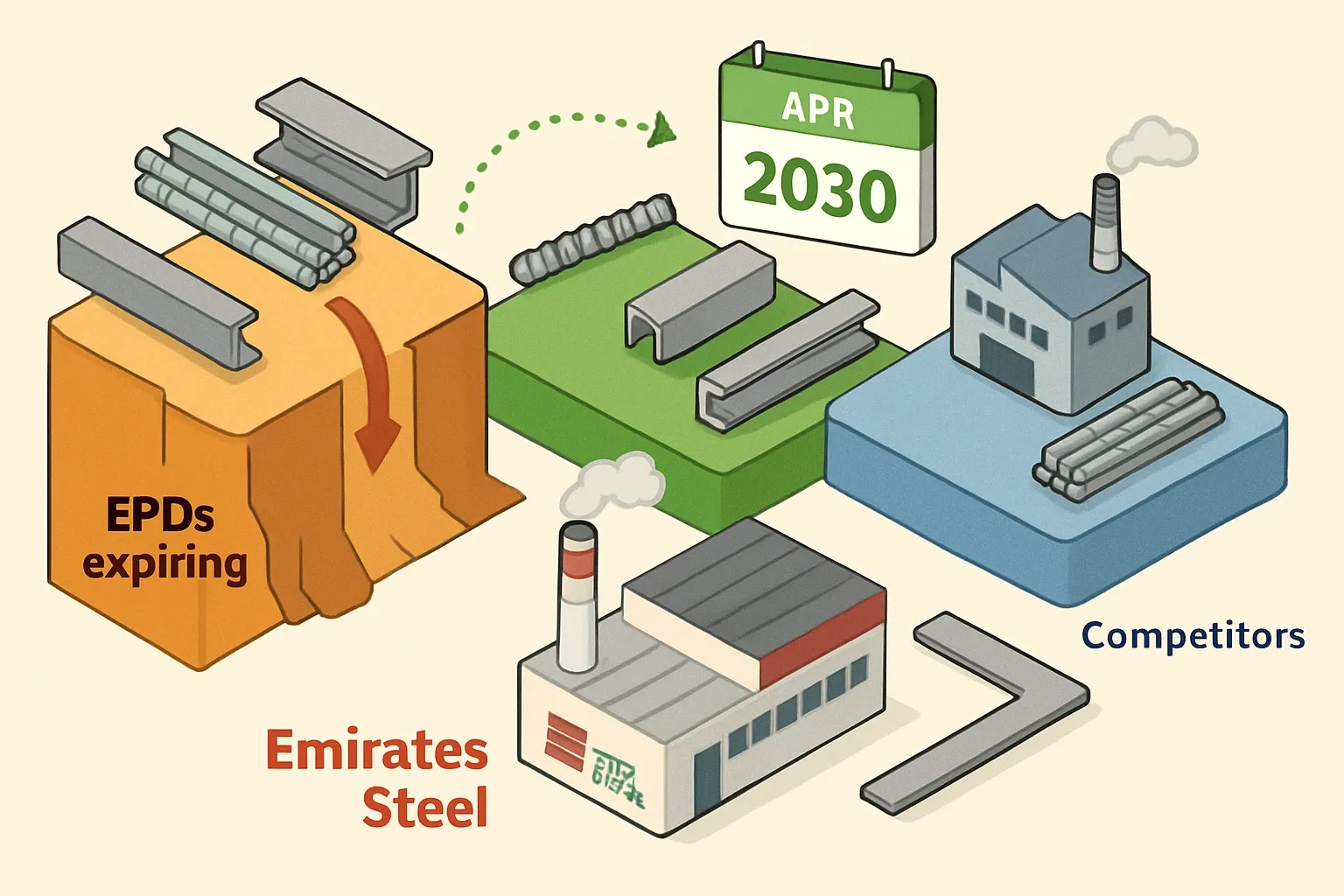
Saint-Gobain Weber's Turkish arm also holds a set of weberdry waterproofing EPDs valid to March 2028. Notably, every competitor declaration listed here expires in 2028. The advantage is real but has a time limit, and those clocks are already running.
Why an expired membrane EPD hurts the whole system
Waterproofing is a small share of a building's embodied carbon, but it is easy to swap out. When a whole-building LCA needs product-specific data, a product without a valid EPD usually gets conservative generic values, sometimes with an added penalty factor. Specifiers who are trying to hit a carbon target tend to choose the product with verified numbers.
Regulation adds pressure in Italy and beyond. Italy's CAM Edilizia criteria for public works (DM 256, in force from 4 December 2022) name Type III EPDs to EN 15804 and ISO 14025 as an accepted way to prove material requirements (Ministero dell'Ambiente, 2022). A membrane that falls out of a documented system can mean the specifcation gets rewritten around a rival's membrane. In some cases the adhesive goes with it.
Eight months is tighter than it sounds
A renewal under EN 15804+A2 needs a fresh reference year of plant data, an updated LCA, third-party verification and registration with the program operator. If the process is well organised, that fits inside eight months. If data collection drags across procurement, production and R&D, it does not.
The smart move is to get the new EPD registered before July 2027, not on the day the old one lapses. Projects being designed now will be procured in 2027 and 2028. Their LCAs are being built today, from whatever declarations are valid when the modeller opens the database.
What the Nanoflex case shows
Kerakoll has shown across its adhesive and paint lines that it can refresh EPDs well ahead of expiry, and H40 No Limits is the clearest example. Nanoflex Sin Límites is the exception for now. It is one membrane, sold as part of a system, and its replacement had not yet appeared in public listings as of November 2026.
If a renewal lands in the first half of 2027, specifiers will barely notice. If it does not, Mapelastic Zero, Mapegum WPS and Coverflex are ready to step in. For any manufacturer selling a product as part of a system, the takeaway is clear: an EPD that lapses on one component can cost the whole system its spec.