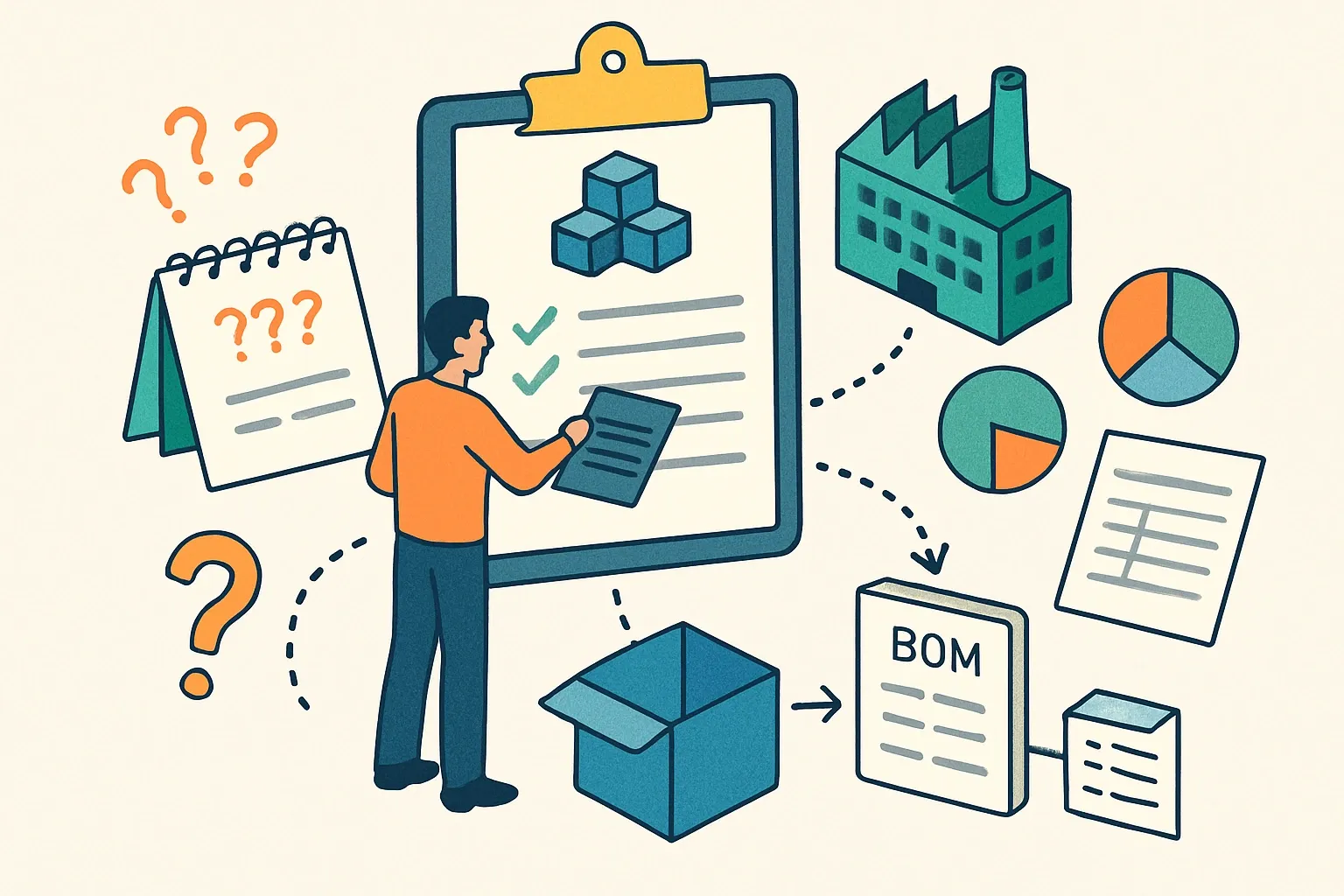
BOM for EPDs in one sentence
An EPD Bill of Materials is the product’s recipe with context. It lists every input that crosses your gate, plus the who, where, how much, and how it travels. Think cookbook meets shipping log.
Granularity beats guesswork
Two paints with the same color can carry very different impacts if one swaps a resin, changes solvents, or moves supplier locations. Detail is not paperwork for its own sake, it is what turns a model into something spec‑ready. When the playlist is missing tracks, the music stops.
The fields reviewers expect
A lean EPD BOM tracks what matters and skips noise. Capture for each distinct input:
- Material name and function, plus CAS when available
- Annual mass per declared unit, and unit of measure that matches production reality
- Supplier name, site, and country of origin
- Recycled or bio‑based content, and allocation notes
- Inbound transport mode, distance, and load factor if known
- Packaging used on arrival and packaging used at your gate
- Process yields, scrap rates, and internal recycling paths
- Substitutable inputs for variants, tied to SKUs or recipes
Ready to streamline your EPD process?
Follow us on LinkedIn for tips on creating an effective Bill of Materials that enhances your project specifications.
Data quality rules that carry weight
Cut‑off cannot hide the big stuff. Under EN 15804 A2, models must include at least 95 percent of total mass and energy, and anything excluded cannot exceed 5 percent in environmental significance (EN 15804, 2019). Most program operators set EPD validity to 5 years, which means your BOM should be robust enough to support updates without re‑chasing every number (EPD International GPI, 2024). If trustworthy figures are missing, say so and document a conservative assumption.
Tie the BOM to LCA modules
Your inputs map cleanly to modules. Raw materials and their transport feed A1 and A2. Energy, water, process additives, emissions controls, waste handling, and packaging at the plant feed A3. Downstream packaging and palletization at shipment leave with the product and should be accounted for consistently so the declared unit stays stable.
Multi‑plant products need BOM variants
One formula, three plants, three footprints. Electricity carbon intensity differs widely by grid region in the United States, with factors varying by more than three times depending on location (EPA eGRID, 2024). Keep a plant‑specific tab for energy, fuels, water source, and waste routes. Lock the recipe row order so QA can compare like for like.
Supplier outreach without the headache
Start with a tight template and define terms up front. Ask for recycled content using the same boundary your PCR uses. Request a site address, not a corporate HQ. Offer accepted unit options to avoid conversion errors. A good partner will handle NDAs, back‑and‑forth, and data vetting so engineers can stay on the line and not in spreadsheets.
Pitfalls that stall verification
- Double counting recycled content in both input and allocation notes
- Origin listed as “global” when shipments are traceable
- Units mixed within a line item, which quietly breaks the declared unit
- Scrap recorded but not routed to waste or internal recycle
- Transport left as TBD with no mode or distance
A simple flow to build your EPD BOM
- Fix the declared unit and production reference year, then freeze recipe versions by date.
- Pull ERP production volumes, yields, and scrap for that year, then reconcile to 100 percent of output.
- Collect supplier and transport data using one template, one owner, one deadline per input.
- Normalize everything into mass per declared unit, with a conversion log that auditors can follow.
- Run a mass and energy closure check, document cut‑offs, and tag any conservative assumptions for review.
Make the BOM pay for itself
A reusable, audited BOM turns updates into refreshes instead of reboots, which is why it speeds verification and shortens the wait to get spec’d. Sales stops losing quietly to products that already have third‑party declarations. The work is definately worth it when a single mid‑sized win covers the paperwork many times over.