The rulebook behind radiant floor EPDs
A PCR is the rulebook of Monopoly: ignore it and the game falls apart. For most building products in Europe and many global programs, the north star is EN 15804 under a program operator’s PCR. The International EPD System’s “PCR 2019:14 Construction Products” and IBU’s Part A plus product‑specific Part B documents are the common anchors.
Is there a dedicated PCR for a whole underfloor heating “system”?
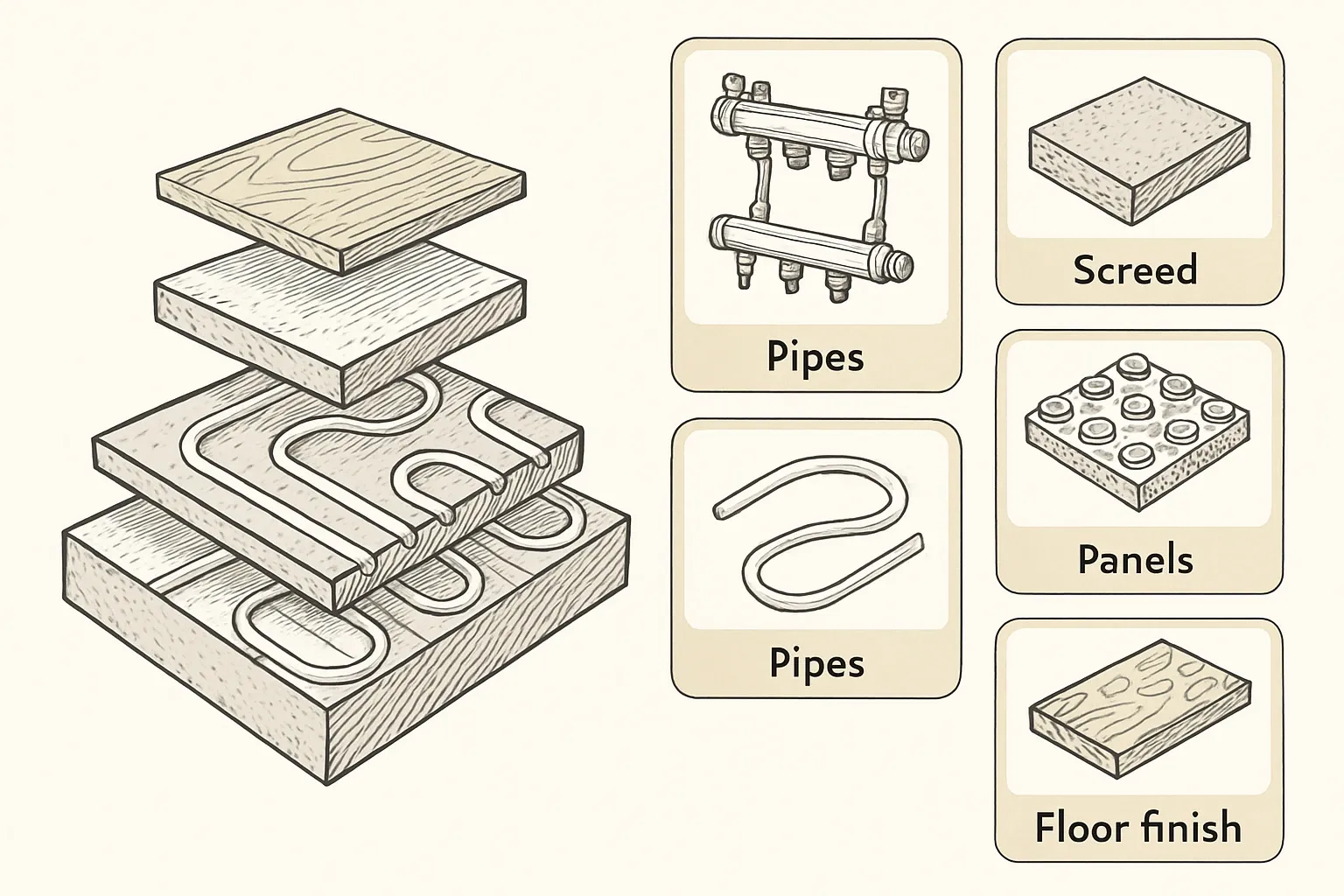
Usually not. Program operators rarely host a single PCR that covers the complete underfloor heating assembly as one product. Teams typically publish at the component level that makes up the system. Think of it like releasing solo tracks instead of a surprise album. It still gets you on the playlist buyers use.
The practical route most manufacturers take
Most radiant floor portfolios are well served by construction‑product PCRs that already exist for pipes, fittings, manifolds, insulation boards or panels, and auxiliary hardware. Under the International EPD System, the updated PCR 2019:14 v2.0.0 is live and the prior version was sunset on June 20, 2025, with the new version valid until 2030 (EPD International, 2025) (EPD International, 2025). If you were searching for “pcr for underfloor heating systems,” this is the door most teams actually walk through.
Operator choices by region, briefly
IBU is widely used for EN 15804 EPDs and refreshed its PCR Part A on April 30, 2024, with a six‑month transition window that closed October 29, 2024 (IBU, 2024) (IBU, 2024). The International EPD System updated its construction PCR and set a firm sunset of June 20, 2025, for the older 1.3.4 version (EPD International, 2025) (EPD International, 2025). Mutual recognition between operators is common, though details vary by country. If North America is part of your market plan, align early on the operator so you do not redo templates.
Want to streamline your EPD process for underfloor heating systems?
Follow us on LinkedIn for insights that help you navigate PCRs and maximize your project's value.
Component EPD building blocks that typically fit
Most underfloor heating offerings can publish EPDs for these elements within construction‑product PCRs:
- Pipes and multilayer pipes such as PEX, PE‑RT, or PEX‑Al‑PEX, plus EVOH barriers and adhesives
- Fittings and manifolds, often brass or stainless steel
- Preformed insulation or grooved panels, including EPS, XPS, or mineral wool based products
- Ancillary components such as distribution boxes or pre‑insulated pipe runs
If a Part B guidance exists at your chosen operator for a specific component, use it. If not, the general construction PCR paired with operator guidance still gets you to a compliant, verified EPD.
Version control, expiries, and timing
PCRs are time‑boxed. At the International EPD System the stated norm is that a PCR is normally valid for about four years before update, to keep methods current (EPD International FAQ, 2025). The construction PCR update cycle in 2024 and 2025 set a hard handover date, so check the exact version and cutover rules before verification. Getting this right early prevents rework when reviewers compare your LCA to the currently applicable version.
What to model for radiant floors
Model the bill of materials down to resins, metals, and adhesives. Confirm energy mixes and allocation for extrusion, molding, and assembly. Under EN 15804+A2 you must declare end‑of‑life modules C1 to C4 and Module D, even if routes are scenario‑based. Pick a clear reference year for plant utilities and scrap; prospective EPDs can start sooner but will need updating once a full year of production data exists. A crisp, centralized data pull saves weeks and frees engineering time we all need back.
Market pull in 2025
LEED v5 was ratified on March 28, 2025, and teams are now using the new materials framework across project types (USGBC, 2025) (USGBC, 2025). Product‑specific, third‑party verified EPDs remain a straightforward way to keep your product in consideration when carbon accounting is required. Sales cycles feel shorter when specifiers can reference a current, public EPD instead of modeling a substitute.
How to decide quickly
Start by mapping your catalog to available component PCRs. Check the operator’s current PCR version and any Part B that matches your materials. Review competitor EPDs to align on scope so buyers can compare apples to apples. Then lock a reference year and assign a single data owner per plant. The heavy lift is data collection across sites and suppliers, not the software. A partner that handles that wrangling will definately accelerate your timeline.
A short note on “system EPDs”
Some operators allow assembly or system declarations in limited cases. These require careful scoping and scenario rules and are usually slower to review. If time to market matters, component EPDs first, optional system EPD second, tends to be the low‑risk path.
Wrap‑up
If you make hydronic radiant floors, you probably will not find a one‑size “PCR for underfloor heating systems.” You will find dependable, well‑trod rules for the parts that make your system work. Use them. Publish quickly. Keep versions straight. Then iterate as your materials and markets evolve.