What a PCR really is for HVAC
A PCR is the rulebook of Monopoly. Ignore it and the game falls apart. For HVAC components it defines the declared unit, the life‑cycle stages to model, data quality, and what to do with service parts and replacements. Without a valid PCR, no program operator will publish your EPD.
Where HVAC sits in the standards maze
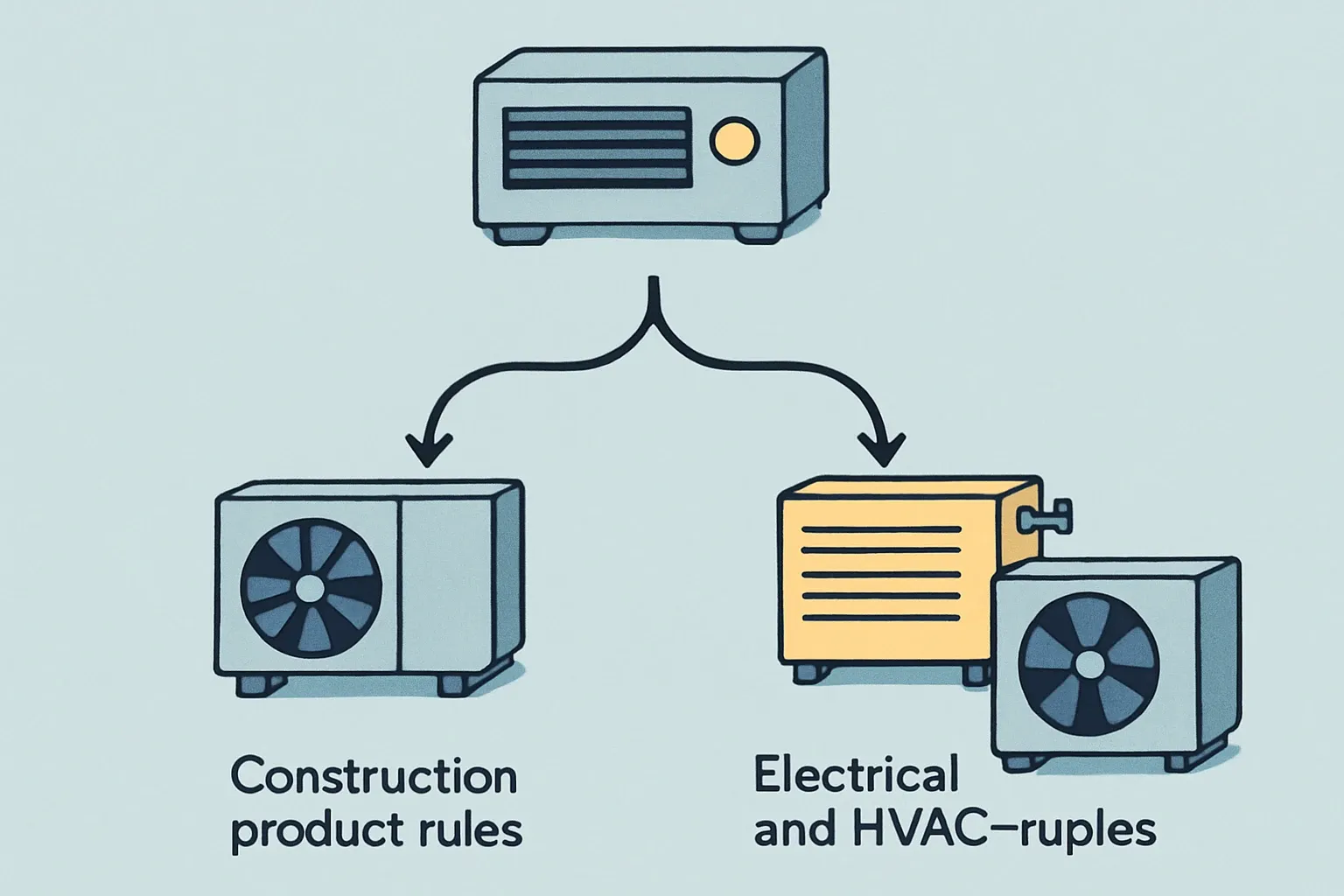
Two families show up most for building HVAC. Construction product PCRs built on EN 15804 or ISO 21930 cover mechanical items like air handling units, dampers, and ductwork. Electrical and HVAC‑R equipment often fit the PEP ecopassport framework based on ISO 14025 and EN 50693, which is designed for electrical and electronic products and has product‑specific rules for heat pumps and similar gear (PEP ecopassport, 2024). If your product has motors, drives, printed circuit boards, and refrigerant circuits, this split really matters.
The main PCRs you will actually use
In the International EPD System, the umbrella Construction products PCR 2019:14 is widely used, with component PCRs for ventilation parts and fan coils under it. That umbrella was updated to version 2.0 in April 2025, with a transition window noted by the operator (EPD International, 2025). PEP ecopassport offers PSR0013 for thermodynamic generators, which covers many heat pumps and packaged systems, and other PSRs for storage tanks and related items (PEP ecopassport, 2024). In North America, operators such as UL Solutions and Smart EPD commonly verify against ISO 21930 for construction products and will also accept PEP‑aligned work where appropriate.
Validity clocks you cannot ignore
EPDs are normally valid for five years under the International EPD System’s rules. Plan refresh work on that cadence so sales never faces a gap (EPD International FAQ, 2024). PCRs have their own clock. In IES, PCR validity is generally three to five years, with four years set as the default, so teams should track both timers in the roadmap (EPD International PCR Development, 2024). When a PCR expires, your published EPD stays valid until its own date, but any update must use the current PCR version (EPD International, 2024).
Want to unlock new markets with HVAC EPDs?
Follow us on LinkedIn for insights that help you navigate PCRs and win more tenders.
Picking the right rulebook, fast
Start with two filters. First, product type. Purely mechanical HVAC components usually align with construction product PCRs. Products that are clearly electrical or HVAC‑R, especially with significant electronics, may be a better fit under PEP. Second, market geography. If most revenue is in Europe, EN 15804 alignment and ECO Platform recognition help comparability. If sales skew to the U.S., check which operator your competitors used and whether mutual recognition exists between operators so your EPD shows up where buyers look.
Declared unit traps to avoid
Comparability hinges on the declared unit. Fan coils and air handling units are often declared per unit with defined duty and options. Heat pumps may be per unit or per kW of nominal capacity. Mixing per unit with per kW makes side‑by‑side comparisons meaningless. Set the declared unit exactly as the PCR or PSR prescribes, then mirror it in datasheets so sales and specifiers see the same story.
Life‑cycle scope for HVAC gear
Most HVAC component EPDs require A1 to A3 at minimum. Replacement cycles for filters, belts, and fans may drive B modules when the PCR requires it. End of life is not an afterthought, since steel and aluminum dominate mass in many assemblies, and module D credits must follow the operator’s rules. Refrigerant leakage sits in use stage models for building assessments, yet your product EPD may only cover embodied impacts unless the PCR says otherwise. Write that boundary clearly.
Why this matters commercially
MEP systems can represent a material share of embodied carbon on projects, which means HVAC declarations move the needle for whole‑building targets. Recent guidance indicates building services can be in the order of at least 30 percent of embodied carbon in new buildings, and much higher in retrofits, so having robust, comparable HVAC EPDs is no longer optional (CIBSE Journal, 2024). LEED v5 was ratified on March 28, 2025 and heightens attention on embodied and refrigerant impacts, which keeps product‑specific Type III EPDs in the conversation (USGBC, 2025).
A simple decision path for your first HVAC EPD
Answer three questions. Which operator does your buyer trust in your core markets. Which PCR or PSR do leading competitors use for the same product family. Which validity date lands closest to a big bid window so your five‑year cycle covers it. If any answer is unclear, pick the operator with published mutual recognitions and the PCR that maximizes comparability for your category. Dont overcomplicate it.
Close the loop without losing time
Map data owners for materials, purchased subassemblies, and factory utilities to a single reference year. Lock the declared unit from day one. Confirm the PCR version and its expiry in writing, then schedule verification and publication inside the five‑year EPD window. That rhythm keeps sales in the spec, and it keeps you out of the rewrite spiral when rules shift.