Start with the rulebook for coatings
Architectural coatings usually rely on a dedicated PCR that spells out what can be grouped. The ACA Architectural Coatings PCR managed by NSF is active today and currently extended through June 30, 2026 while a revision is in progress (NSF, 2025) (NSF, 2025). That PCR anchors how close your sheens or tint bases must be to count as one product family.
When one EPD can cover several sheens
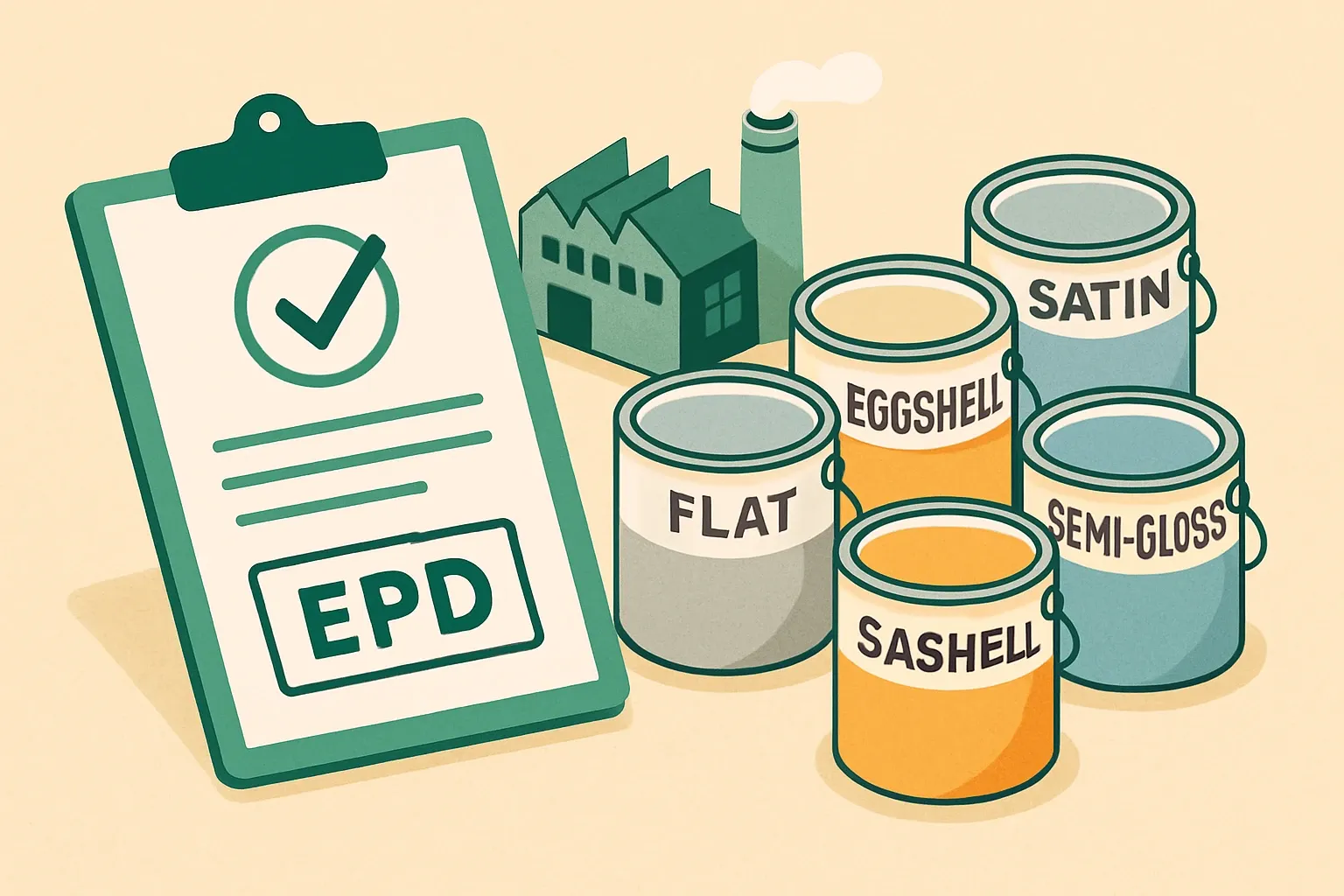
If the resin system, manufacturing process, and declared use are equivalent, sheens that differ by gloss agents or minor additive packages often qualify. Think of it like picking a playlist version that is remastered, not remixed. The coverage rate, solids profile, and durability claims should align so specifiers are not comparing apples to airbrushed oranges.
The variance threshold most operators use
A practical test appears in ISO 21930 aligned programs and is reflected in the International EPD System guidance. If grouping multiple similar products, none of the declared impact indicators should differ by more than about 10 percent across the included products when aggregated over A to C modules, or the EPD must disclose the variation and justify the choice (EPD International, 2024) (EPD International, 2024). That 10 percent yardstick keeps “one EPD for many SKUs” credible rather than optimistic.
What to bundle together
Sheens made from the same base formula with small changes in matting agents or defoamers. Tint bases that only shift pigment volume within the PCR’s content rules. Private label clones that are literally the same batch and plant, just a different label. This save time.
Want to master EPD grouping for coatings?
Follow us on LinkedIn for insights that streamline your EPDs and maximize project success.
What to split out
Primers versus topcoats belong in separate declarations because function and use differ. Multi‑layer systems that only perform as a package should be modeled as a system, not hidden inside a single topcoat EPD. Large solids or coverage swings that change declared consumption per square meter push results beyond “minor tweak” territory and usually trigger a separate EPD.
Declared unit discipline prevents surprises
Coatings PCRs typically declare results per mass or per coated area at a stated spread rate and dry film thickness. If the satin needs more liters to hit the same film build than the eggshell, the LCA must reflect the higher consumption. That is often where a harmless sheen tweak becomes a different product for EPD purposes.
Three defensible ways to model a family
You can publish an average EPD for the group, a representative product EPD, or a worst‑case EPD that stands in for the family, each with clear labeling in the document header, provided the grouping rules are met and any variation is disclosed per operator guidance (EPD International, 2024) (EPD International, 2024). Pick the method that best fits your range width and the questions buyers actually ask.
Renewal math favors smart grouping
Most construction EPDs run on a five year validity clock under major program operators, which means every extra document is another renewal to budget and schedule (EPD International, 2024) (EPD International, 2024). Grouping close variants reduces that maintenance load without sacrificing transparency when the variance stays within the tolerance mentioned above.
A quick workflow we trust
- Map the family by resin, plant, solids, spread rate, and performance claims.
- Model low sheen and high sheen as bookends, then check every indicator against the 10 percent screen.
- Confirm the declared unit and consumption are identical across the grouped SKUs. If not, recalc or split.
- Choose average, representative, or worst‑case presentation and label it clearly in the EPD.
- Lock a lightweight plan for annual data updates so future renewals are a breeze.
The bottom line for coating portfolios
Group sheens and tint bases when chemistry, process, and declared use match, and when the LCA variation stays tight. Split when function shifts or when consumption changes move the needle. Do that, and you accelerate coverage across a paint line without creating a filing cabinet of near‑duplicate EPDs that are harder to keep current than a vinyl collection.