Cement choices now swing EPD results
Portland‑limestone cement (PLC, ASTM C595 Type IL) is approved by every state DOT in the U.S., with an emissions footprint up to 10 percent lower than traditional portland cement used one‑for‑one in mixes (PCA, 2024) (PCA, 2024). That means common strength classes of ready‑mix and CMU can drop GWP without changing finish or cure times. Calcined‑clay blends promise deeper cuts where available, especially as public buyers normalize higher clinker substitution rates (ACEEE, 2024).
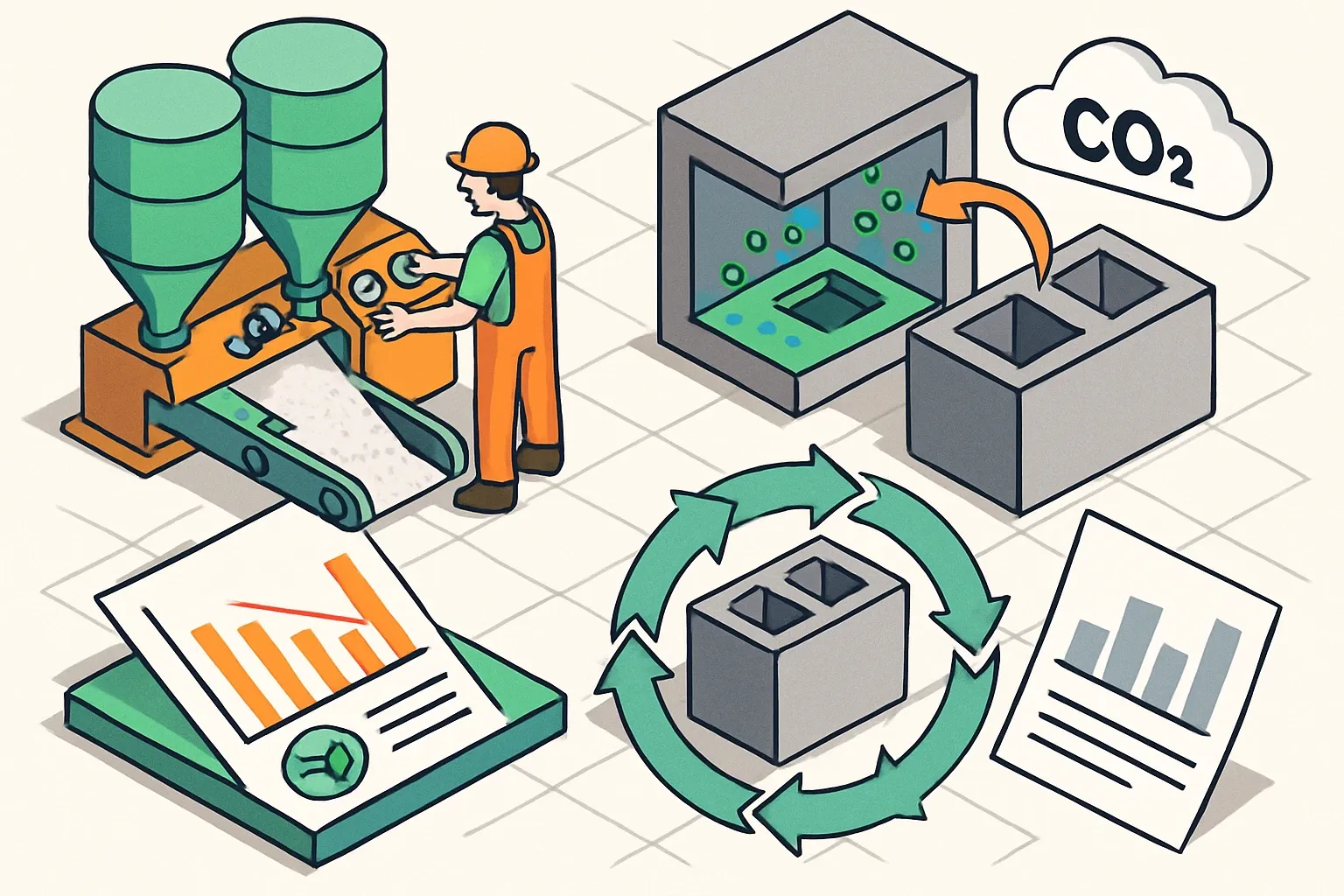
CMU’s quiet weapon: CO2‑curing and post‑life carbonation
Concrete masonry units offer a large surface area and controlled curing environments. That mix of geometry and process can enable measurable carbon uptake during production and over service life. Global accounting literature now tracks annual cement carbonation uptake on the order of several hundred million tonnes of CO2, a signal that reporting rules need to capture it clearly (ESSD, 2025) (ESSD, 2025).
PCR updates are changing what “counts” in the model
The European c‑PCR for concrete, EN 16757, treats carbonation as a real mechanism and allows reporting absorption during use and end‑of‑life, with the option to account for induced carbonation during production when justified by evidence (EN 16757, 2022) (EN 16757, 2022). Several North American PCRs for manufactured concrete products have been refreshed in the last cycle, aligning with EN 15804+A2 conventions. Translation for manufacturers is simple. If your CMU line uses CO2‑curing or your concrete mix design now relies on PLC or LC3, a current PCR may recognize benefits your old EPD could not.
Policy is locking in mix‑level numbers
California’s CALGreen update made embodied‑carbon compliance mandatory on large non‑residential and school projects starting July 1, 2024. The prescriptive path sets product GWP ceilings at 175 percent of regional averages and publishes concrete limits by strength class. For example, ready‑mix at 3500–4499 psi is capped at 566 kg CO2e per m3, and 4500–5499 psi at 661 kg CO2e per m3, with Tier 2 voluntary targets cutting those to 323 and 378 respectively (CBSC, 2024) (CBSC, 2024). Caltrans also requires EPD submittals for concrete and hot‑mix asphalt on projects bid on or after February 1, 2025, which is pushing producers to keep declarations current and plant‑specific (Caltrans, 2025).
Private owners are following suit. Data‑center and institutional specs increasingly ask for concrete mixes that beat regional baselines, not just any product‑specific EPD. A facility‑specific declaration can be the difference between preferred and passthrough.
Want to stay ahead in low-carbon concrete specifications?
Follow us on LinkedIn for insights that help you align EPDs with evolving PCRs and capture more project opportunities.
Vertical integration and logistics can outrun chemistry alone
A plant that controls its aggregate supply, keeps hauls short, and balances rail with truck often posts lower A2 impacts than competitors using the same binder. Electricity mix matters too. Capturing a cleaner utility profile or on‑site generation in A3 can shift the GWP mean. This is where complete data collection wins. If a verifier must fall back to generic transport or energy datasets, those conservative assumptions erase your hard‑won operational gains.
When to update an EPD before the five‑year mark
Two signals justify an early refresh. First, a PCR revision that newly recognizes carbonation or clarifies allocation rules for blended binders. Second, a material process change such as a switch to PLC across all mixes, adoption of calcined‑clay cements, or commissioning a CO2‑curing line for CMU. If your average mix moved from Type I/II toward Type IL, or your curing step now mineralizes CO2, the current EPD likely understates performance. That is a commercial problem where Buy Clean or a hyperscaler’s procurement portal filters by GWP thresholds.
Modeling details that make or break low‑carbon CMU and concrete
- Confirm the cement type and replacement rates in each declared mix. Document PLC or LC3 usage with mill certs and monthly blend logs.
- For CMU CO2‑curing, record gas source, injection rate, cure time, and measured uptake. Align with the PCR’s evidence requirements so absorption is creditable in the right module.
- Capture real transport. Quarry‑to‑plant miles by mode, cement terminal distances, and interplant transfers often shift totals more than admixture tweaks.
- Use plant‑level electricity and fuels for the reference year. Note any on‑site generation. Verify emission factors are current for the grid region.
- Match the PCR’s declared unit choices and strength classes to the policy targets you sell into, so numbers map cleanly to CALGreen tables and owner dashboards.
What this means for EPD strategy
Blended cements lower the floor. CO2‑curing and validated carbonation move the ceiling. PCRs are catching up to both. In regions with aggressive codes, the mix that wins is the one with a product‑specific EPD that reflects today’s binder, today’s curing line, and today’s logistics. If that requires revising an EPD early, do it. The cost is dwarfed by the projects you will otherwise never see, and the time savings from a partner who can wrangle multi‑site data quickly is definately worth it.
Quick ROI reality check for specs and bids
- CALGreen’s prescriptive caps give buyers a simple pass‑fail. If your 4000 psi mixes land near 284–352 kg CO2e per m3 today, you already track within common public thresholds used by large owners and agencies (GSA, 2025). Getting that verified in a fresh EPD shortens review cycles.
- PLC adoption is universal across DOTs and is credited for up to 10 percent CO2 cuts at the cement stage. If your EPD still assumes ASTM C150 as the default binder, you are leaving value on the table (PCA, 2024) (PCA, 2024).
We dont need heroics. We need up‑to‑date PCRs, complete plant data, and fast, third‑party‑verified numbers that map to what owners now ask for in black and white.