What just launched
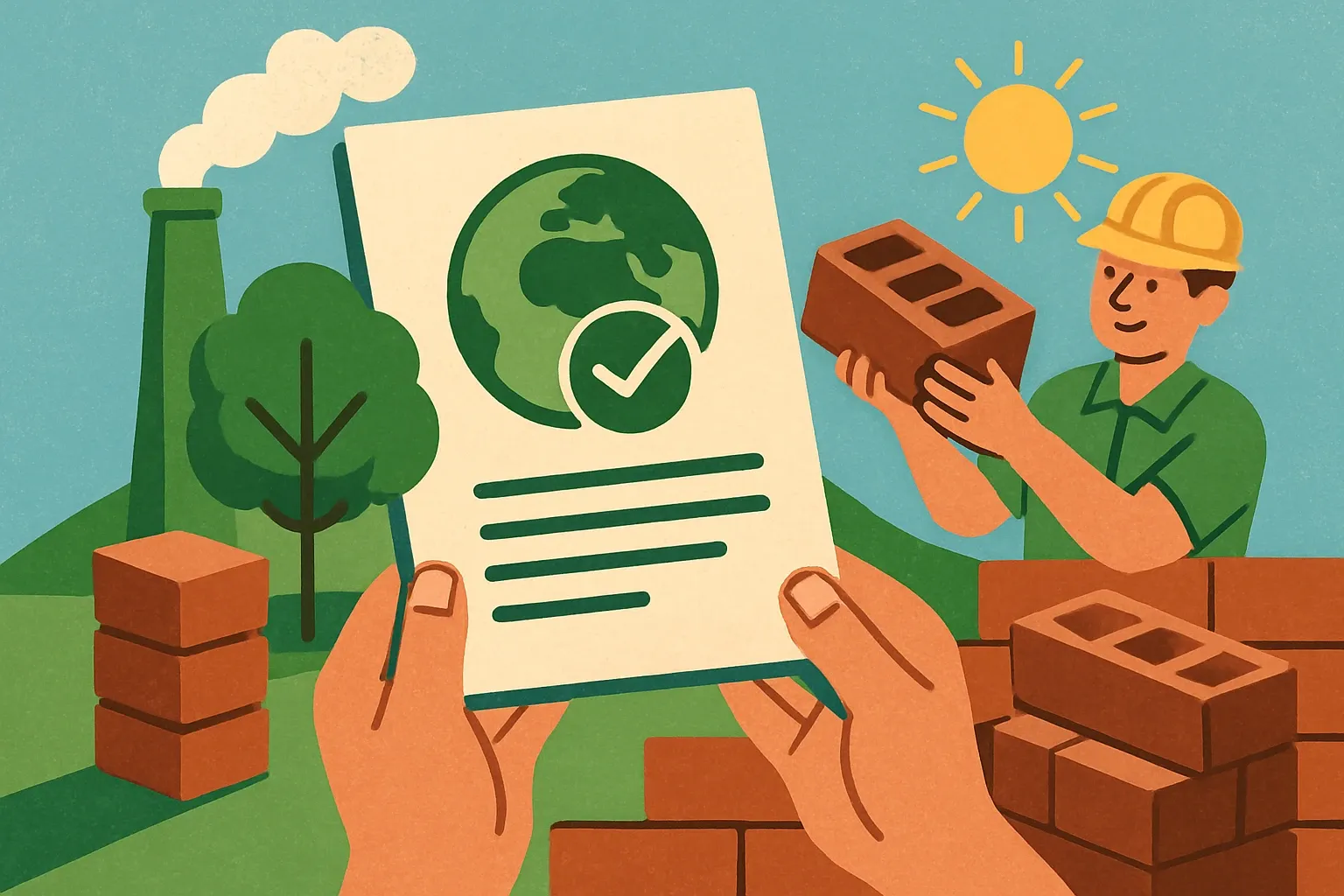
Earth4Earth has published its first Environmental Product Declarations for two brick lines. The N10 Negative carbon brick landed in August 2025, followed by the L10 Low carbon brick in December 2025. Both declarations are verified and published by EPD Hub, aligned to EN 15804 A2 and ISO 14025.
Scope matters. The N10 EPD covers the 10% e4E binder formulation that absorbs CO₂ in use, while the L10 EPD documents a 10% conventional lime variant designed for lower‑carbon manufacture. Both reference EN 771‑1 performance, which keeps submittals tidy in masonry specs.
Who they are, and why now
Earth4Earth develops earth‑based, lime‑stabilized bricks that absorb CO₂ across their life cycle. The company targets mainstream building envelopes and interiors where durability, thermal mass, and a natural aesthetic are valued. Manufacturing is currently in Wuhan with UK production planned in 2026, signaling supply that can sit closer to European projects.
For project teams facing LEED v5‑style carbon accounting, a product without a product‑specific EPD often triggers conservative defaults. These EPDs is the antidote, letting modelers use verified values instead of estimates.
How the declarations were verified
Program operator: EPD Hub. Rulesets: EN 15804 A2 and ISO 14025, with brick performance referenced to EN 771‑1. The EPD records do not list an external LCA developer by name, which is common when modeling is authored in‑house or directly within an operator’s workflow.
Work for earth4Earth or competing brands?
Follow us for a product-by-product analysis that reveals which brick lines get spec'd and how your EPDs stack up against industry leaders.
Category snapshot: where the bar sits today
Bricks are a crowded field. Transparency is increasingly the norm among UK and EU incumbents, which frames how earth4Earth’s new EPDs will compete.
- Forterra: multiple current brick EPDs published in late 2025 with EPD Hub. Coverage spans wirecut and soft mud groups, which aligns with mainstream UK masonry schedules.
- Ibstock: several current declarations including product‑group bricks verified by EPD Hub in 2023–2024. That breadth keeps large distributors comfortable on mixed brick packages.
- Egernsund Wienerberger: a wide slate of clay brick EPDs verified via Danish Technological Institute. Deep portfolio coverage means spec teams can stay within one brand and still keep EPDs current.
The takeaway is simple. Earth4Earth has entered the transparency arena and can now be compared side‑by‑side with established brick names on third‑party numbers, not just narrative. On projects that penalize missing EPDs, that shift can be the difference between being shortlisted or sidelined.
What this means commercially
- Earlier in design, a verified EPD removes conservative penalties that otherwise inflate whole‑building impacts for masonry. That can keep a brick option viable when owners set tight carbon thresholds.
- In bid cycles, verified documents reduce back‑and‑forth and RFIs. Submittals move faster, which helps GCs hit schedule and keeps substitutions in check.
Pick partners who streamline data collection across plants and suppliers. The right workflow saves teams weeks and protects launch timelines, which is definately where the ROI shows up.
Where to find the documents
Earth4Earth acknowledges the N10 EPD on its FAQs and directs readers to the program operator listing. See the company page here: https://earth4earth.co.uk/faqs. The N10 EPD is visible on EPD Hub: https://manage.epdhub.com/declarations/any-other-construction-product/earth4earth-technology-ltd/4466/n10-negative-carbon-brick/.
If these are not yet linked from individual product pages, add a prominent “Environmental Product Declaration” link. Visibility matters because many specifiers look on the product page first during submittals.
What to watch next
Three moves would build on this launch. Extend EPD coverage to the planned N20 and N30 binder levels so higher‑absorbency variants are immediately spec‑ready. Add a brick slips EPD for façade systems that require them. Keep publication pages mirrored on the website so estimators and sustainability teams can grab files in one click.
Earth4Earth’s numbers are now in the ring. We read this as a fast, credible start that lets their carbon‑capture story compete on the same scoreboard as the big brick brands.