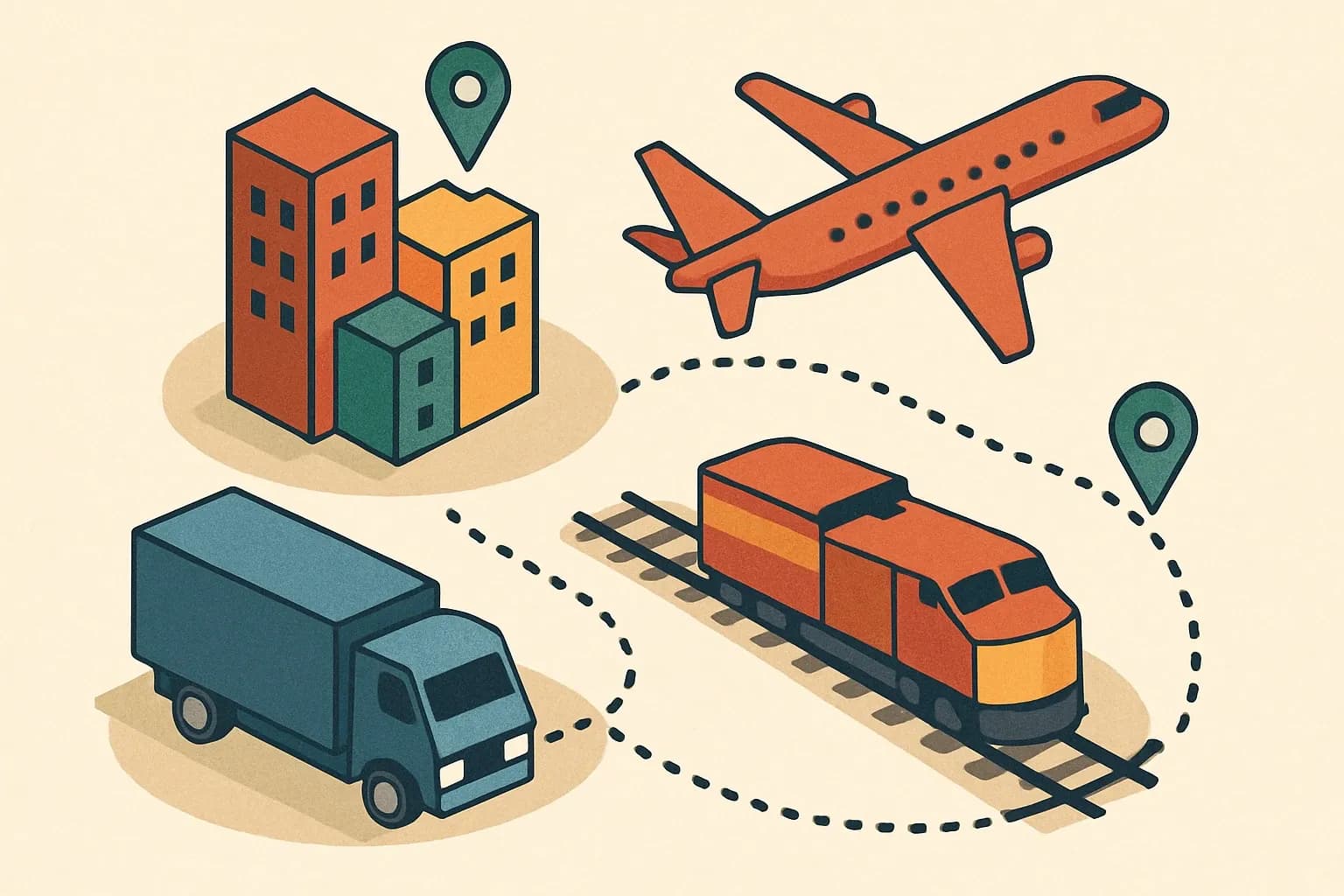
Why transport modeling matters for specs
A4 is where many bids get won or quietly lost. Most U.S. freight journeys are shorter than 250 miles, which is why trucks dominate the near‑to‑market legs that show up in your EPDs (CRS R48594, 2025). By weight roughly 65 percent of freight moves by truck in the United States, and trucks generate about 44 percent of ton‑miles, so road assumptions need to be sharp (CRS R48594, 2025).
Start with cities, not street addresses
Pick plant or DC cities as fixed origins. Pick representative destination cities for each sales region. Modern LCA tools can calculate network or great‑circle distances from these city pairs, then scale by your annual sales mix. It is like setting home stadiums before the season so every game has a clear map.
Choose modes using evidence, not hope
Default to truck where you have regular lanes and short hauls. Use rail or water where volumes, lead time, and access justify it, then keep the last mile by truck. Document why each lane uses its mode mix and link it to actual service constraints, not aspirational modal shifts.
Distances that hold up in verification
Use one consistent method for all lanes, preferably road network distance for truck. If a PCR allows reasonable defaults, state the rule and the exception path. Record whether distances are round trip or one way, and whether fuel, payload, or refrigerant impacts are modeled separately.
Multimodal without the migraine
Break routes into legs. Truck to rail terminal. Rail line‑haul. Truck from terminal to jobsite. Assign distance and payload to each leg, then sum impacts. If containers or pallets sit in cold storage between legs, account for that energy use in the correct module so verifers do not bounce it back.
Want to improve your EPD transport modeling?
Follow us on LinkedIn for insights that help you streamline documentation and unlock project specifications.
Payload, backhaul, and temperature control
Set a standard payload by product family and vehicle class, then keep it stable unless you have better data. If you cannot prove backhaul, assume empty return only where the PCR requires it and say so plainly. Refrigerated or heated loads should flag added fuel or electricity with a short note on duty cycle.
When fuel records beat miles
If you have reliable diesel purchases tied to a lane, convert fuel to CO2 directly using 10.21 kg CO2 per gallon of diesel and skip distance math for that period (EPA Emission Factors Hub, 2025). Keep miles for activity tracking, fuel for emissions accounting, and reconcile the two quarterly.
Defaults you can defend
When raw data is thin, borrow from respected public sources and mark them as defaults. For example, keep a reference set that cites mode shares by distance band and updates annually to reflect national trends, then note where your operations differ in reality (CRS R48594, 2025). This is boring, which is exactly why auditors trust it.
Documentation that speeds verification
Write one page per product family that lists origins, destination cities, lane distances, mode splits, payloads, and any cold‑chain or special handling. Add a short change log. Review it each reference year. Teams new to EPDs will thank you, and seasoned reviewers will move faster because everything is in one place.
A quick lane‑building checklist
- Define origin and destination cities mapped to sales regions.
- Assign mode by leg with a short rationale and payload.
- Choose a single distance method and stick to it.
- Record fuel factors and any temperature control adders.
- Save calculations and assumptions in an auditable workbook.
The practical payoff
Consistent transport modeling removes guesswork and rework, so verification cycles shrink and sales can quote cleaner numbers. It also makes updates painless. Once the city list and lane logic are set, new products just plug in and recieve the same defensible treatment.