What end‑of‑life actually covers
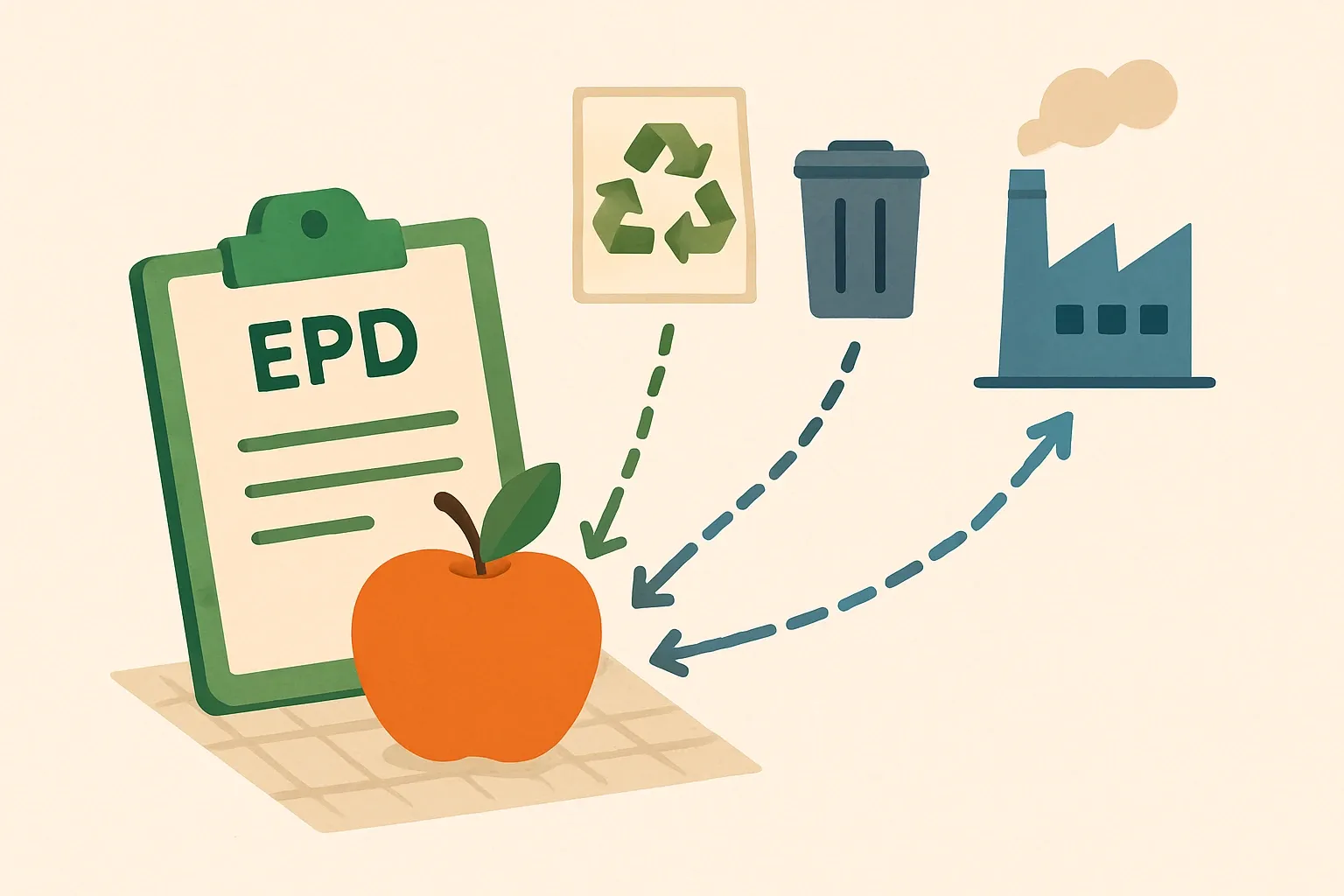
End‑of‑life in EN 15804+A2 spans collection and deconstruction (C1), transport to treatment (C2), processing like sorting and recylcing or energy recovery (C3), and final disposal such as landfill or incineration with no energy recovery (C4). Module D reports benefits or burdens from reusable materials or recovered energy that leave the system boundary. Treat these as parameters, not afterthoughts, because they are part of the declared scope.
Harmonization across a portfolio beats one‑off tweaks
If each product line uses a different end‑of‑life recipe, the numbers stop talking to each other. Sales teams cannot explain differences cleanly and reviewers start questioning comparability. Harmonizing the treatment logic across similar products builds trust, shortens reviews, and makes portfolio refreshes faster when rules change.
PCRs set the floor, operators add house rules
Product Category Rules interpret EN 15804+A2 for a product family, then program operators add format and verification guidance. That is why two compliant EPDs can still make slightly different choices for collection rates, sorting efficiencies, or transport distances. The key is to record which assumptions come from the PCR, which come from the operator’s templates, and which are your company conventions.
National guidance like NMD changes the modeling weather
The Dutch National Environmental Database (NMD) publishes default end‑of‑life scenarios as percentage splits by material type so LCA authors start from the same page. The list was updated in May 2024 and is under further consultation in 2025, which shows how countries tune assumptions to local practice. Across the EU, recovery rates for construction and demolition waste range from less than 10% to over 90%, a spread that explains why national guidance matters (European Commission, 2025) (European Commission, 2025).
Want to improve your EPD credibility?
Follow us on LinkedIn for insights on harmonizing end-of-life assumptions that help you win more tenders.
Why results shift between EPD versions
When you align to new PCR language or national defaults, your end‑of‑life module balances can move. That can raise or lower impacts even when the product recipe is identical. The stakes are real at market scale. The United States generated about 600 million tons of construction and demolition debris in 2018, with roughly 144 million tons landfilled, so treatment assumptions are not rounding errors (US EPA, 2025) (US EPA, 2025).
Governance and change control that hold up in reviews
Once an EPD is verified and published, changing end‑of‑life assumptions usually means updating the LCA model, re‑verification, and re‑publication, since these parameters are in the system boundary. Plan updates with your validity window in mind. EPDs are normally valid for five years, and many operators require earlier updates if a published indicator worsens beyond a defined threshold, for example more than 10% under the International EPD System (EPD International FAQ, 2025) (EPD International FAQ, 2025).
A one‑page assumptions table that travels well
Make your end‑of‑life policy portable. Publish a simple table with:
- Scenario name and version tied to the PCR or national guidance
- Collection rate, sorting losses, recycling yield, energy recovery share, landfill share
- Transport distances and modes to each treatment step
- Data sources, geography, and reference year
- Notes on Module D credits or burdens and any cut‑off rules
Downstream teams can then reuse the same inputs in LCAs, databases, and sustainability reports without guesswork.
Portfolio playbook for consistent choices
Start with the PCR and operator template. Layer in national defaults like NMD where relevant to your sales markets. For global portfolios, set regional variants that reflect actual waste infrastructure and keep them versioned. Use the same logic for like‑for‑like products so differences in results come from the product, not from modeling drift.
What to do before your next renewal
Treat end‑of‑life like a checklist item with owners and dates. Confirm which PCR version and operator guidance apply today. Compare your current table to any newly issued national defaults. If the shifts are material, schedule a model update and verification well before the printed validity date. That small project management habit protects credibility and keeps your EPDs bid‑ready.