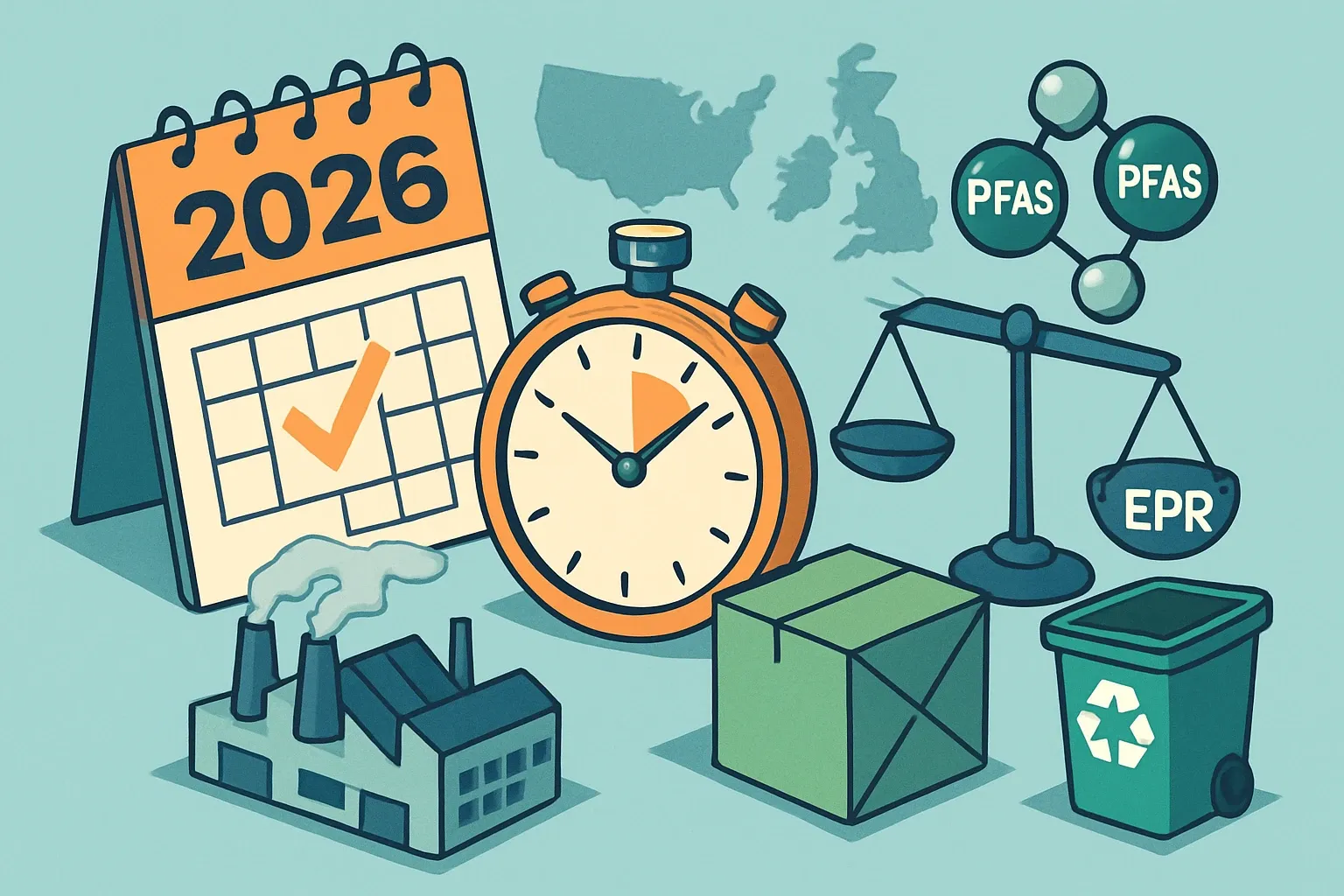
The 2026 landscape in one glance
Packaging rules got sharper, PFAS restrictions widened, and public buyers leaned harder on EPDs. Treat this as a playbook, not a panic button. Your goals are simple, keep products compliant, keep EPDs current, and keep submittals fast.
U.S. packaging EPR milestones that bite in 2026
Colorado’s packaging EPR starts collecting annual producer dues in January 2026, with the approved program plan moving into implementation by June 2026 (CDPHE, 2026). Maine’s program schedules producer registration and first invoices across May to September 2026, ahead of full operations in 2027 (Maine DEP, 2026). Minnesota requires producers to register with its PRO by July 1, 2026, then ramps toward cost coverage beginning 2029 (MPCA, 2025).
What this means commercially is straightforward. If your packaging data house is messy, fees and filings will stall, and sales teams lose time they can’t afford.
PFAS prohibitions tighten, category by category
States moved from general concern to product lists. Maine’s 2026 prohibitions hit cleaning products, cookware, cosmetics, juvenile products, textile articles, ski wax, and upholstered furniture, among others (Maine DEP, 2025). Minnesota blocks registration of pesticide products in 11 categories if they contain intentionally added PFAS starting January 1, 2026, unless a currently unavoidable use applies (MDA, 2025) (MPCA, 2025). The signal is clear, plan reformulations early and document changes in your EPD and HPD pipelines so the paperwork matches the product.
EU PPWR applies from August 12, 2026
The EU’s Packaging and Packaging Waste Regulation enters its application phase on August 12, 2026, after entering into force in February 2025. Expect new design and volume efficiency rules, recycled content thresholds over time, and labelling standardization that affects e‑commerce parcels too (European Commission, 2025). If you ship into the EU, treat this summer as your go‑live for packaging spec reviews and supplier attestations.
UK packaging EPR moves from data to money
The UK keeps tightening EPR. 2026 brings material‑by‑material recycling targets, for example 77 percent for paper and 57 percent for plastic, applied through PRN evidence and fees set by the regulator (DEFRA, 2025). Large producers had to register for 2026 by October 2025, and nation data for 2025 is due by April 1, 2026 (DEFRA, 2025). Budget the fees and tune packaging design toward the recyclability methodology to reduce modulation charges.
Want to stay ahead of 2026 regulations in construction?
Follow us on LinkedIn for updates that help you navigate compliance and boost your chances of winning projects.
Construction buyers are still the deciders, and they want EPDs
State procurement keeps raising the floor. Colorado’s Office of the State Architect will review maximum GWP limits by January 1, 2026 then at least every four years, with EPDs required for seven material families and A4 transport recorded when specified (Colorado OSA, 2025). If your EPD’s GWP sits above the limit, you are asking the project team to chase waivers while a competitor glides in.
For California work, watch insulation and other categories under updated eligibility in public purchasing. Start with our plain‑English breakdown of SB 1207 and Colorado’s Buy Clean Colorado rules to see what submittals actually pass.
The regs that link directly to your EPD playbook
LEED is not a law, yet owners use it to decide. LEED v5 keeps product EPDs in scope and shifts more weight to embodied carbon outcomes. If you are resetting your material roadmap, start with LEED v4 to v5: Your EPD Playbook. Selling into Europe, anchor your roadmap to the recast EU Construction Products Regulation. Reporting teams juggling supply chain asks should bookmark our EU CSRD guide since procurement keeps asking for aligned product data.
What to prioritize in Q1 and Q2, without boiling the ocean
- Map packaging data owners, then lock a single source of truth for weights, materials, and formats. Tie it to producer registrations for states and the UK.
- Pre‑flight PFAS exposure by product family. Where alternatives exist, schedule switchovers and update declarations so specs do not drift.
- Triage EPD coverage. Flag expiring declarations and high‑volume SKUs first. Align your next PCR choice to what competitors use so the numbers compare cleanly.
- Pick your program operator path early so verification slots do not bottleneck.
- Build a light SOP for transport data since many buyers now request A4 details alongside the EPD.
Signals to watch through 2026
California’s SB 54 packaging rulemaking continues, with statutory deadlines unchanged and producer funding mechanics set to ramp from 2027. Oregon’s Recycling Modernization Act advances through additional rule updates into 2027, which will refine PRO obligations and reporting cadence (Oregon DEQ, 2025). At the EU level, PFAS restriction work proceeds in committees, so keep formulations documented and alternatives vetted as dossiers evolve (ECHA, 2025).
Why this matters for sales, not just compliance
Public buyers often assign penalties to products without current, product‑specific EPDs, which pushes you out of contention before price enters the chat. The cost of a well executed EPD is typically dwarfed by a single mid‑sized project win, and clean documentation shortens submittal cycles. Getting the data right also frees your R&D and plant teams to focus on production instead of paper chases. That is the commercial math, and it is definately worth doing.
A smarter path through 2026
Treat packaging EPR, PFAS rules, and construction procurement as one connected workflow. Keep a living register of packaging specs, a monthly PFAS reformulation check, and an EPD calendar tied to sales seasons. When regulations shift, you will already have the numbers, the narratives, and the PDFs ready.