What the law covers, and when it applies
State public projects that issue solicitations on or after January 1, 2024 and cost at least 500,000 dollars must meet Buy Clean Colorado requirements. The Office of the State Architect administers buildings and higher ed projects, while CDOT handles horizontal work separately (OSA Buy Clean Colorado Act, 2025) (OSA Buy Clean Colorado Act, 2025).
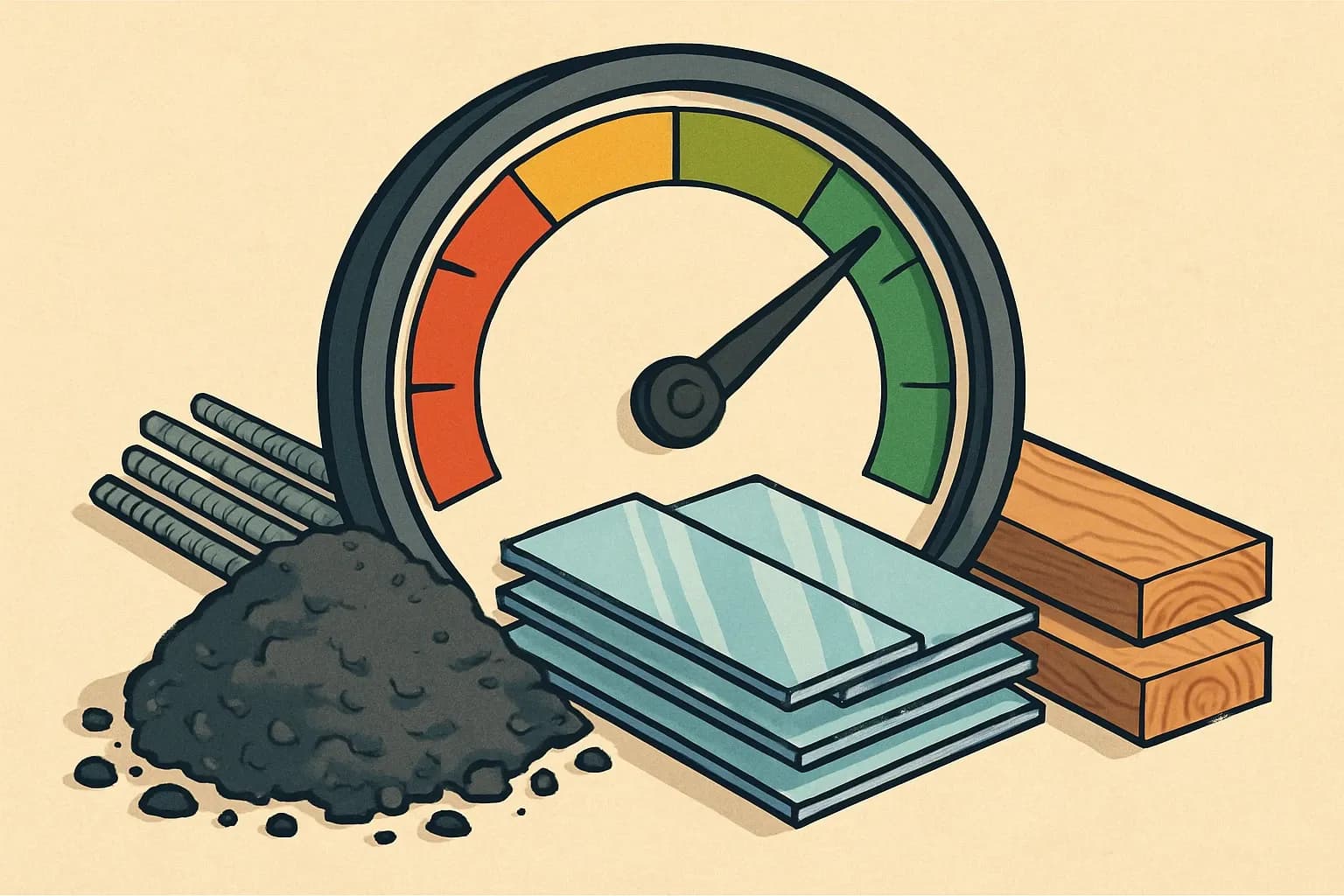
Eligible materials are targeted for carbon and volume impact:
- Asphalt and asphalt mixtures
- Cement and concrete mixtures
- Glass
- Post‑tension steel
- Reinforcing steel
- Structural steel
- Wood structural elements
Only permanently installed materials count (OSA Max GWP Limits, 2025) (OSA Max GWP Limits, 2025).
The number that decides your bid
The state sets a maximum acceptable GWP for each category. Your product’s EPD GWP must be less than or equal to that limit at the time of solicitation. Example limits updated January 2025 include asphalt mixtures at 85 kg CO2e per metric ton, fabricated hot‑rolled structural steel at 1,220 kg CO2e per metric ton, and flat glass at 1,510 kg CO2e per metric ton (OSA Max GWP Limits, 2025) (OSA Max GWP Limits, 2025).
For ready‑mix concrete, limits are set by strength class. Meeting the mix’s limit means you also meet the associated cement limit. For instance, 4,000 psi concrete is capped at 301 kg CO2e per cubic meter, while 6,000 psi is 379 kg CO2e per cubic meter (OSA Max GWP Limits, 2025).
Want to capitalize on Buy Clean Colorado regulations?
Follow us on LinkedIn for insights that help you navigate compliance and unlock new business opportunities.
EPDs that qualify, without surprises
To be accepted, EPDs must be current, product‑specific Type III, reference ISO 14025, 14040, 14044, and 21930, and align to the correct PCR. Industry‑wide EPDs generally will not substitute for product‑specific documents here. EPDs expire after five years, so inventory management matters as much as mix design (OSA Policy, 2025) (OSA Policy, 2025).
Reporting details that trip teams up
Transportation must be recorded for eligible materials shipped more than 100 miles to the site, including load weight, vehicle type, and distance or zip codes. Keep that A4 data with your submittal package to avoid back‑and‑forth later (OSA Policy, 2025).
The state will review limits by January 1, 2026 and at least every four years. Expect adjustments as new EPDs roll in and background datasets evolve. Plan your re‑testing and re‑publishing cycles accordingly (OSA Policy, 2025).
How to get compliant fast
Start with a product list mapped to the seven categories. Confirm which EPDs exist, which expire within 12 months, and which lines lack coverage. For concrete, align local strength classes to the correct limit. For steel, match your fabrication route to the subcategory so the right number is checked.
Pick the PCR most competitors use so specifiers can compare apples to apples. A strong LCA partner will handle data wrangling across plants and ERP, propose the right program operator, and publish efficiently. We care most about speed and completeness because delay equals missed specification windows.
Common traps we see
EPDs submitted after installation can be rejected. Ensure contractors furnish EPDs prior to install and keep PDFs organized for the EE‑5.2 submittal. Assemblies that include eligible materials still need product‑specific EPDs for each component that is covered by the law.
Concrete submittals sometimes cite a strength that does not match the mix actually delivered. Cross‑check batch tickets, strength class on drawings, and the EPD’s declared unit. Small mismatch, big headache.
If you dont have EPDs ready, waivers are possible but slow. Treat them as a contingency, not a plan.
A tax perk worth noting
Products that meet the OSA limits can qualify as “eligible decarbonizing building materials” for sales and use tax exemption. The state updates its SUTS list monthly, typically the first Monday, based on verified EPDs submitted by manufacturers (OSA Sales & Use Tax Exemption, 2025).
What winning teams do next
Audit your portfolio against the current limits, prioritize high‑volume lines, and slot EPD creation in waves so sales can pursue state work without pause. Keep transport data tight, monitor expiries, and be ready for the 2026 review cycle. With clean EPDs and clear documentation, you turn Buy Clean from barrier into bid advantage.