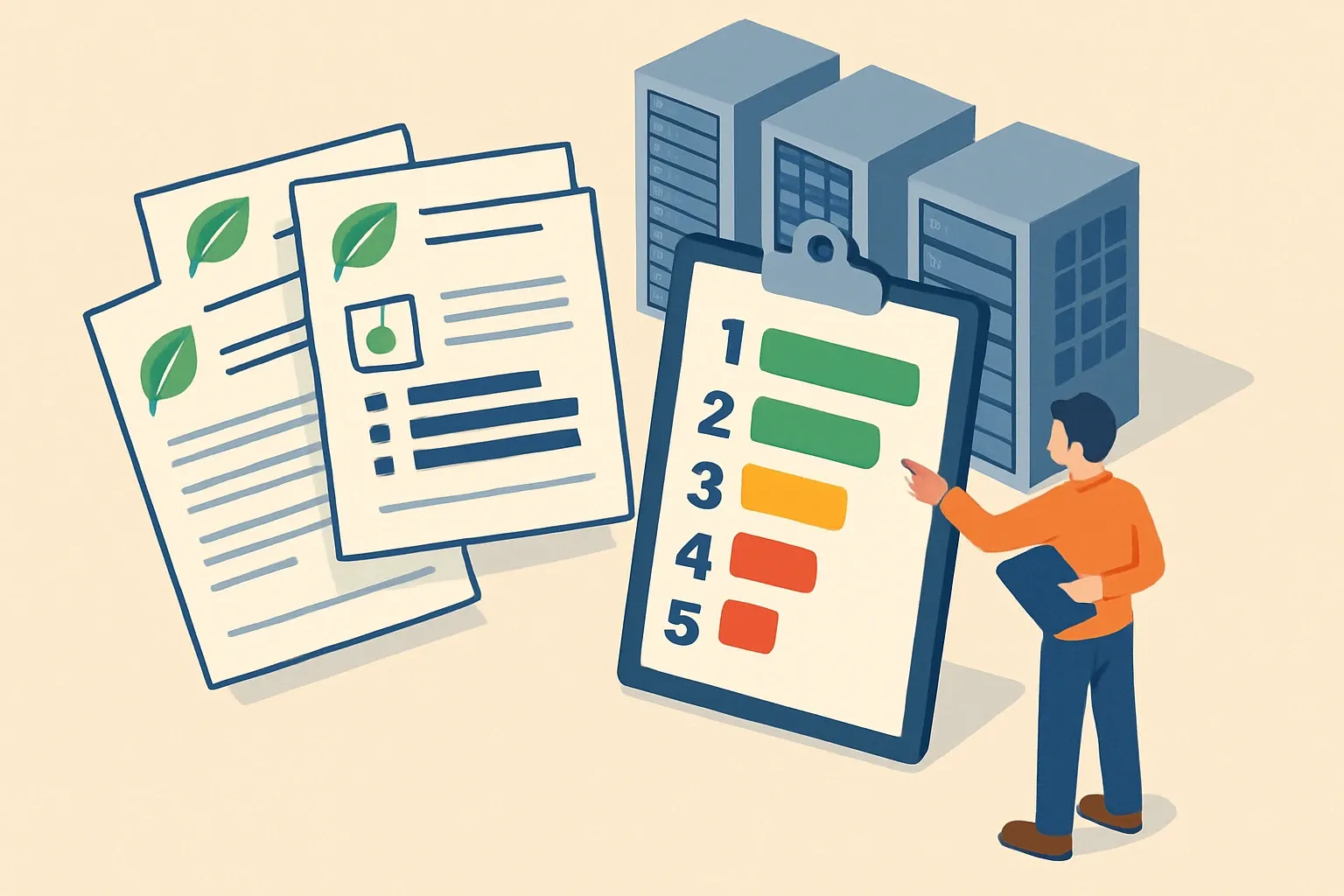
The new shortlist filter
In connectivity, power, cooling, and pathways, EPDs act like turnstiles at a stadium. If the ticket does not scan, you do not enter. Hyperscalers and major operators are aligning on embodied carbon disclosure for materials and equipment, and they explicitly call for standardized reporting to handle Scope 3, which can represent 38 to 69 percent of a data center footprint (iMasons Climate Accord Open Letter, 2024).
What specifiers actually score
Procurement teams run a clear order of operations. First pass removes any offer that fails a code or documentation check. Second pass compares the survivors on performance and risk.
- Standards compliance and safety: UL, IEEE, IEC, EN 15804 or ISO 21930 for the EPD, and the right PCR.
- Form factor and integration: footprint, thermal limits, cable routing, mounting, and software hooks.
- Availability: lead times, multi plant redundancy, and distributor depth.
- EPD coverage and clarity: product specific, third party verified, plant or region identified, PCR match, and public access.
EPDs that move the score
Buyers reward product specific declarations because they are decision ready. Under LEED v4.1, a product specific Type III EPD with external verification is valued as 1.5 products toward the BPDO EPD path, which is a concrete signal for many owners and GCs (USGBC, 2024). In mixed portfolios, a single well documented SKU can tip the whole package across a project threshold.
Want to win more data center specs?
Follow us on LinkedIn for insights on EPD coverage that can help you unlock opportunities and improve your ROI.
Documentation that de risks submittals
Great enviromental paperwork is boring in the best way. It is easy to download, matches a commonly used PCR for the category, names the plant or geography, and lists the verifier. Include the declared unit, system boundary, data vintage, and module coverage on one readable summary page. Make sure the PDF is public. Hidden or paywalled files stall submital reviews.
Availability still wins ties
Racks are getting hotter, and supply chains remain bumpy. Uptime Institute notes most adoption sits in the 10 to 30 kilowatt per rack range, and 45 percent of IT workloads still live in corporate facilities, which keeps enterprise campuses very relevant (Uptime Institute, 2025). When two offers look equal on performance and EPDs, the one with inventory and a credible ship date takes the lane.
Regional scoring can flip decisions
Some regions apply conservative default factors when a project lacks product specific data. In the Netherlands, generic Category 3 data in the National Environmental Database carries a 30 percent uplift, so a product without a brand specific entry can look worse on paper than it performs in reality (NMD, 2025). The lesson travels. Even when a market does not publish an explicit multiplier, owners often treat missing EPDs as higher risk in their internal carbon ledgers.
A practical EPD coverage plan for data center products
Start with the SKUs that drive revenue or get swapped most often during value engineering. Verify the PCR competitors use, then match it to keep comparisons clean. Publish a product specific EPD for each form factor that shows up in the same schedules, not just the flagship size. Stage publication in waves so renewals never cluster in a single quarter, and avoid having key declarations within a few months of expiring during a major bid season. Pick an LCA partner who handles data collection and program operator coordination so plant and R&D teams keep their focus on production, not spreadsheets.
What great buyer facing EPDs include
Think of the EPD as the API for your environmental data. It should answer the obvious questions without a follow up call.
- Correct standard and PCR reference, with version and date.
- Declared unit and system boundary aligned to peers.
- Plant or regional scope, with clear electricity profile and transport assumptions.
- Third party verifier name and contact.
- A stable public URL that your sales team can drop into submittals.
The quiet edge
Technical performance gets you invited. Availability and form factor keep you in the conversation. EPDs decide whether the specifier can say yes without chasing clarifications. When your documentation is clear, current, and comparable, procurement stops treating sustainability as a box to tick and starts using it as a reason to award.