Start with the rulebooks, not the templates
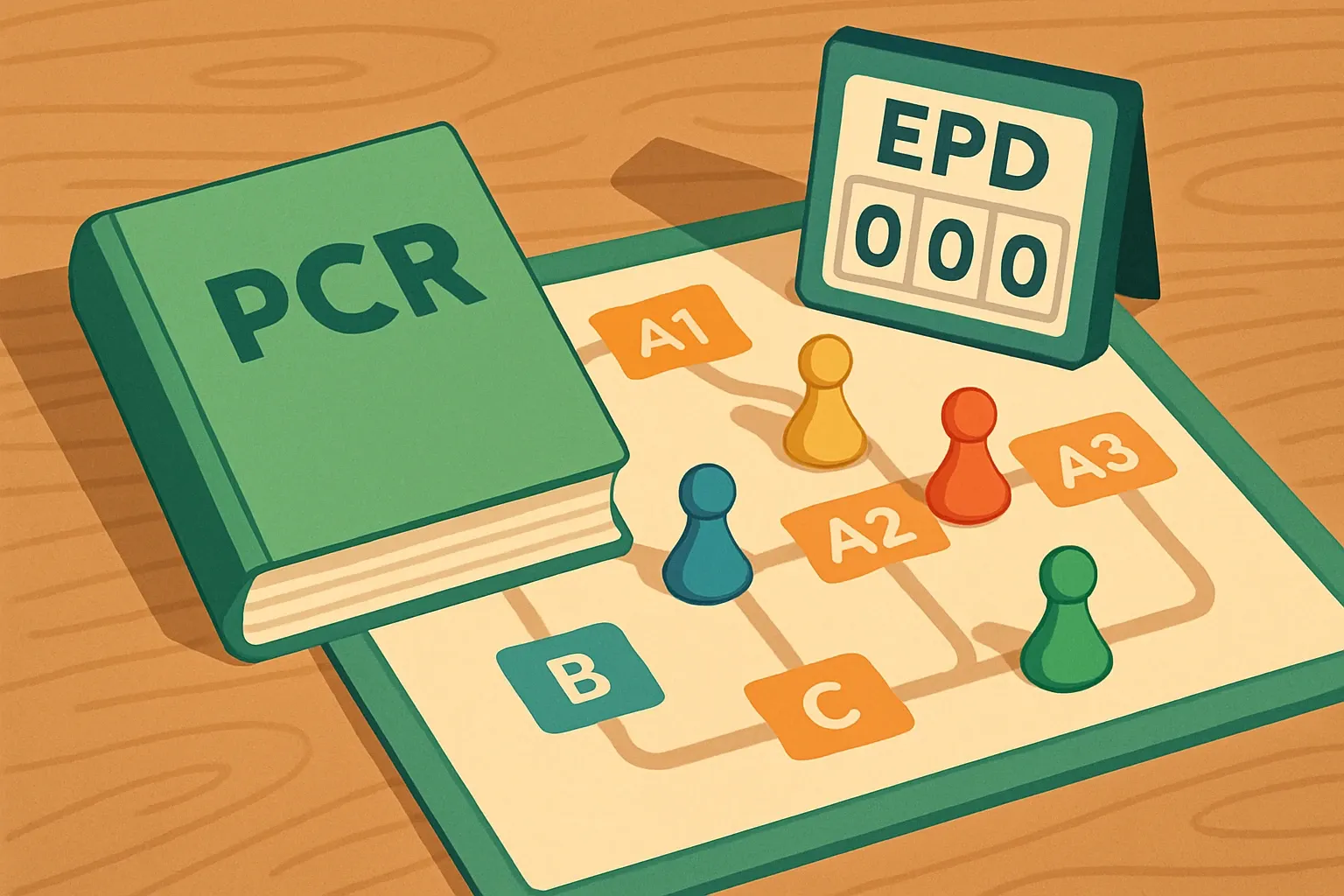
An EPD in construction is a Type III environmental declaration built on a life cycle assessment, anchored by a Product Category Rule. Think Monopoly. The PCR is the rulebook, the LCA is the gameplay, the EPD is the scorecard everyone can audit. In practice you will follow EN 15804 for building products, or ISO 21930 where that is the regional norm, with ISO 14025 setting the overall declaration framework.
The non negotiables inside every credible EPD
Before debating layouts, make sure these elements are present and consistent with the governing PCR and standard:
- Clear product identification and a declared unit that matches how buyers specify the product.
- System boundaries that state which life cycle modules are included, typically at minimum A1 to A3 for production.
- Transparent LCA methods and data sources, including dataset vintages and data quality.
- Impact results reported per module, with required indicators and supplemental resource and waste flows.
- A verification statement from an independent verifier and a validity date. EPDs are typically valid for five years under ISO 14025, after which they must be renewed to remain current (ISO 14025, 2010) (ISO 14025, 2010).
Picking the right PCR without guesswork
Most categories already have an active PCR. The fastest path is to study which PCR competitors use, then evaluate publication date, scope fit, and when it expires. If the PCR expires next quarter, the EPD you publish is still valid for its full term, you will simply migrate to the updated PCR at renewal.
What “product specific” really means
Buyers and rating systems tend to reward product specific, third party verified EPDs over industry averages. That label signals the results come from your bill of materials, your energy mix, and your factories, not a consortium blend. It also reduces the penalty many project teams face when they must estimate embodied carbon without a verified declaration.
Confused by EPD standards and requirements?
Follow us on LinkedIn for straightforward insights that help you navigate compliance and win more projects.
Verification and where to publish
Type III EPDs require independent verification. Common construction program operators include IBU in Germany, UL, NSF, EPD International, and Smart EPD. Operators apply the same core standards, but their templates, reviewer pools, and portal workflows differ. Choose the one your market and customers recognize, and confirm whether they accept the PCR you plan to use.
United States, European Union, and United Kingdom nuances
In the European Union, the Corporate Sustainability Reporting Directive expands mandatory sustainability reporting to about 50,000 companies, phased in from 2024 to 2028. That ripple is pushing procurement teams to ask for product level evidence like EPDs sooner rather than later (European Commission, 2024) (European Commission, 2024). In the United States, federal policy is in flux in 2025, so most momentum sits with state and city buyers, as well as private owners, who specify third party verified EPDs in bid documents. In the UK, clients referencing PAS 2080 for carbon management often expect product specific data aligned to EN 15804.
How much of the life cycle you need to model
A1 to A3 is the common minimum for construction EPDs, since it captures material extraction and manufacturing. Many buyers now ask for A4 transport and A5 installation to understand upfront carbon on a specific job. If the use phase changes performance, such as energy using products, you will model B modules. End of life modules C and benefits beyond system boundary, often called module D, are requested when recycling or reuse is material to the story.
Data windows, prospective EPDs, and version control
Most LCAs use a single reference year for utilities, volumes, and waste. For brand new products with limited production history, some operators allow a prospective EPD based on a shorter data window, then require an update once twelve months of production data exists. Keep version control tight so BOM changes, supplier shifts, and efficiency projects are reflected without surprises.
Avoid the pitfalls buyers notice
Mismatched declared units break comparability. Scope gaps between your brochure and the EPD make reviewers pause. A PCR that few peers use can raise eyebrows during submittals. Data older than the PCR allows can force rework. There is two ways to check fit quickly, review the competitor set, and pre clear choices with the program operator.
What “good” looks like on process and partner selection
Speed comes from ruthless data collection logistics, not cutting corners on the LCA. The right partner brings structured requests that your team can answer in hours, not weeks, and manages reviews with the operator so you are not stuck in email loops. Look for deep experience in your product family, the ability to align the PCR to how your product is sold, and a plan to refresh the EPD before it expires.
A quick reality check on costs and ROI
Publishing an EPD is a cost center on day one, yet it becomes a sales enabler once your product is considered on projects that require verified declarations. Quantified ROI varies by firm and pipeline. Public, comparable cost benchmarks are scarce and often outdated, so treat generic price tags with caution.
The short path from interest to approval
Confirm the applicable PCR and operator, define scope and modules, lock the data window, then collect primary data only once with clear owners and deadlines. Align the declared unit with how specifiers actually buy. Pre brief the verifier to reduce comment rounds. Keep a renewal reminder on the calendar five years from publication, or sooner if your product changes materially (ISO 14025, 2010).
Quick glossary for common search terms
If you landed here after searching epd requirements or “what is needed for an EPD”, keep these in mind. PCR equals the rulebook. Declared unit equals the yardstick. A1 to A3 equals production. Verification equals an independent check. Program operator equals where the EPD lives and can be found.