Two standards, one workable plan
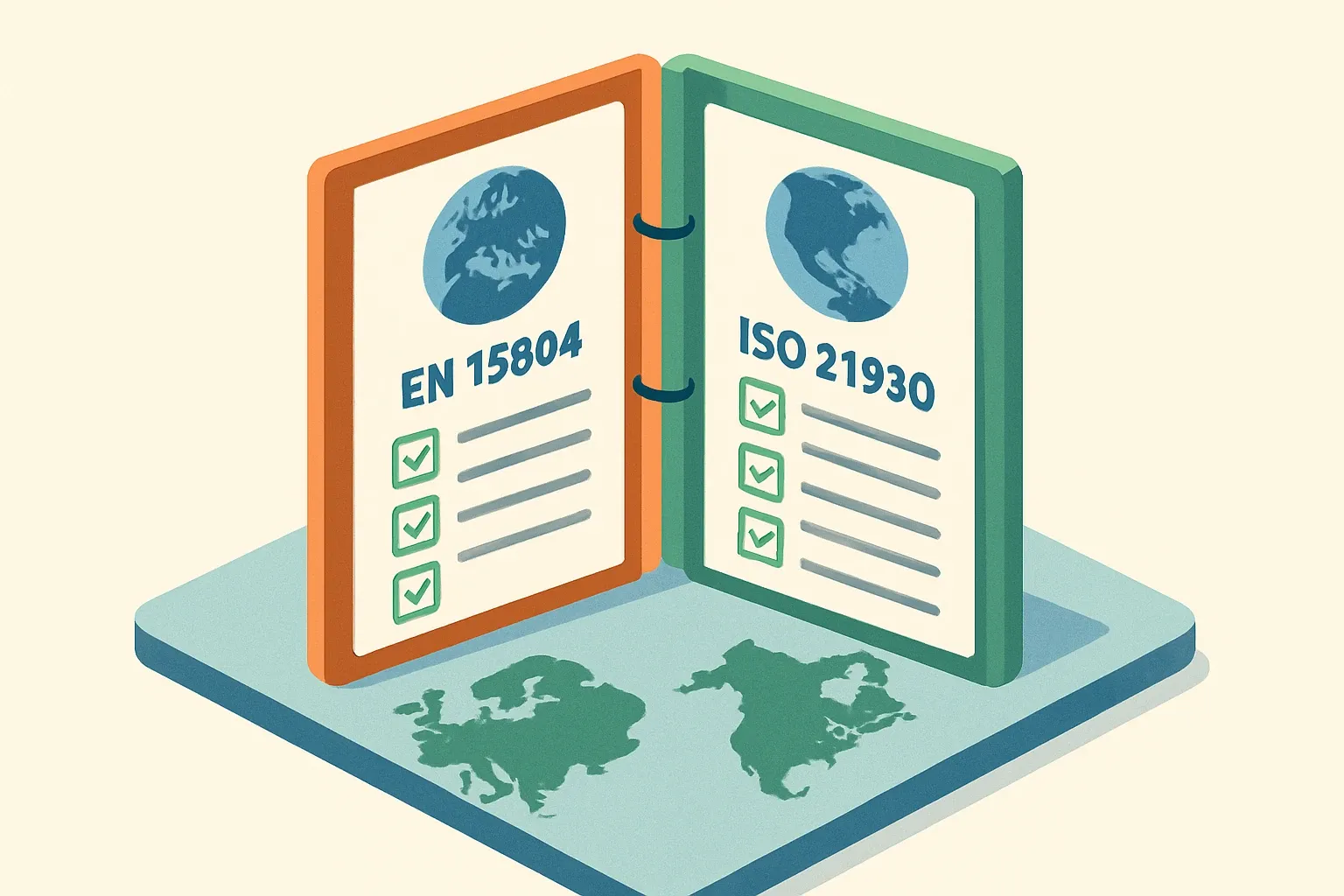
EN 15804 and ISO 21930 describe how construction product EPDs are built and verified. They overlap far more than they conflict. A single LCA can feed both, as long as you are explicit about system boundaries, the declared or functional unit, and the impact assessment method reported in the tables.
Where they diverge, and how to bridge
Think of impact methods like camera filters. EN 15804 +A2 expects results characterized with the EU’s Environmental Footprint factors, commonly EF 3.1 for many operators since late 2024 (EPD International, 2024). North American EPDs often show TRACI results because many local PCRs and specs read TRACI by default, with the latest method posted as TRACI 2.2 and last updated on December 12, 2025 (US EPA TRACI, 2025). Bridging is simple in practice. Run both LCIA methods on the same LCA model, label them clearly, and include method versions so reviewers do not guess.
PCRs decide comparability
A PCR is the rulebook of Monopoly. Ignore it and the game falls apart. In Europe, many programs rely on PCRs built on EN 15804 +A2. In North America, PCRs under operators like UL Solutions or ASTM may point to ISO 21930 and TRACI. Teams usually scan competitor EPDs, confirm the prevailing PCR, then align. If a PCR is sunsetting during your work window, document that and plan the upgrade path. EF 3.0 to EF 3.1 transitions were time‑boxed for new IES EPDs starting 2024‑09‑01 (EPD International, 2024).
Mutual recognition is your shortcut to market
Several program operators have formal Mutual Recognition Agreements so an EPD verified in one scheme can be listed in another with limited rework. IBU lists MRAs with both Smart EPD and UL Solutions for North America, plus several European peers, with France noted as currently suspended (IBU, 2025). For IBU to Smart EPD, the listing requires integrating ISO 21930 statements and a TRACI 2.1 results table, and carries a published administrative fee of 540 USD (IBU, 2025). The net effect is reach. One verification round, multiple listings, higher findability for specs.
Want to navigate EPD standards effectively?
Follow us on LinkedIn for insights that help you align with EN 15804 and ISO 21930, unlocking new project opportunities.
When one EPD is enough, and when to issue two
One dual‑aligned EPD works when the product, plant, and scenarios are consistent across regions, and when you can add a second LCIA method and the extra disclosures your receiving program expects. Issue two regional EPDs when national rules require distinct scenarios, datasets, or label formats that would clutter a single document. Examples include country templates or database requirements for France or the Netherlands, which many programs flag during mutual recognition intake (IBU, 2025).
Set up your LCA once to serve both worlds
Treat dual alignment like recording two language tracks on the same film. Keep one foreground dataset and reference year, then output two method views.
- Declare alignment to ISO 14025 and cite EN 15804 +A2 and ISO 21930 in the conformity section.
- Report EF 3.1 indicators for the EN 15804 view, and TRACI results for the North American view, each labeled with the exact method version (EPD International, 2024) (US EPA TRACI, 2025).
- Mirror module coverage. If you include A4 and A5 in one, include them in the other or explain why not. Keep transport and installation assumptions consistent, or transparently region‑specific. This setup lets a verifier sign off once, then you recieve dual listings through MRAs with only light formatting and table additions.
Procurement signals that reward dual alignment
Public owners are normalizing EPD submittals. Caltrans requires EPDs for asphalt, concrete, and CMU on projects with bid openings from February 1, 2025, with defined thresholds and timelines (Caltrans, 2025). Signals like this make dual alignment practical. A contractor in California can use your North American listing, while a designer in Germany can pull the same product under an EN 15804 record.
Renewal timing without the scramble
Most programs confirm a five‑year EPD validity window with annual internal follow‑up to keep results current during that period (EPD International, 2025). Plan renewals to coincide with PCR transitions and MRA expansions so you avoid back‑to‑back updates. If a PCR refresh lands mid‑cycle, your current EPD generally stays valid until its date, then the renewal adopts the new ruleset (EPD International, 2025).
The simple rule of thumb
Build once, report twice. One high‑quality LCA, two method views, and a program operator that participates in mutual recognition. That combination covers EN 15804 and ISO 21930 cleanly and keeps sales teams out of the standards weeds while specs move forward.