First things first: what a PCR does for vinyl
A Product Category Rule is the rulebook of Monopoly. Ignore it and the game falls apart. For vinyl flooring, the PCR tells you which impacts to report, which scenarios to model, and how to compare apples with apples across competitors.
The current European path under EN 15804
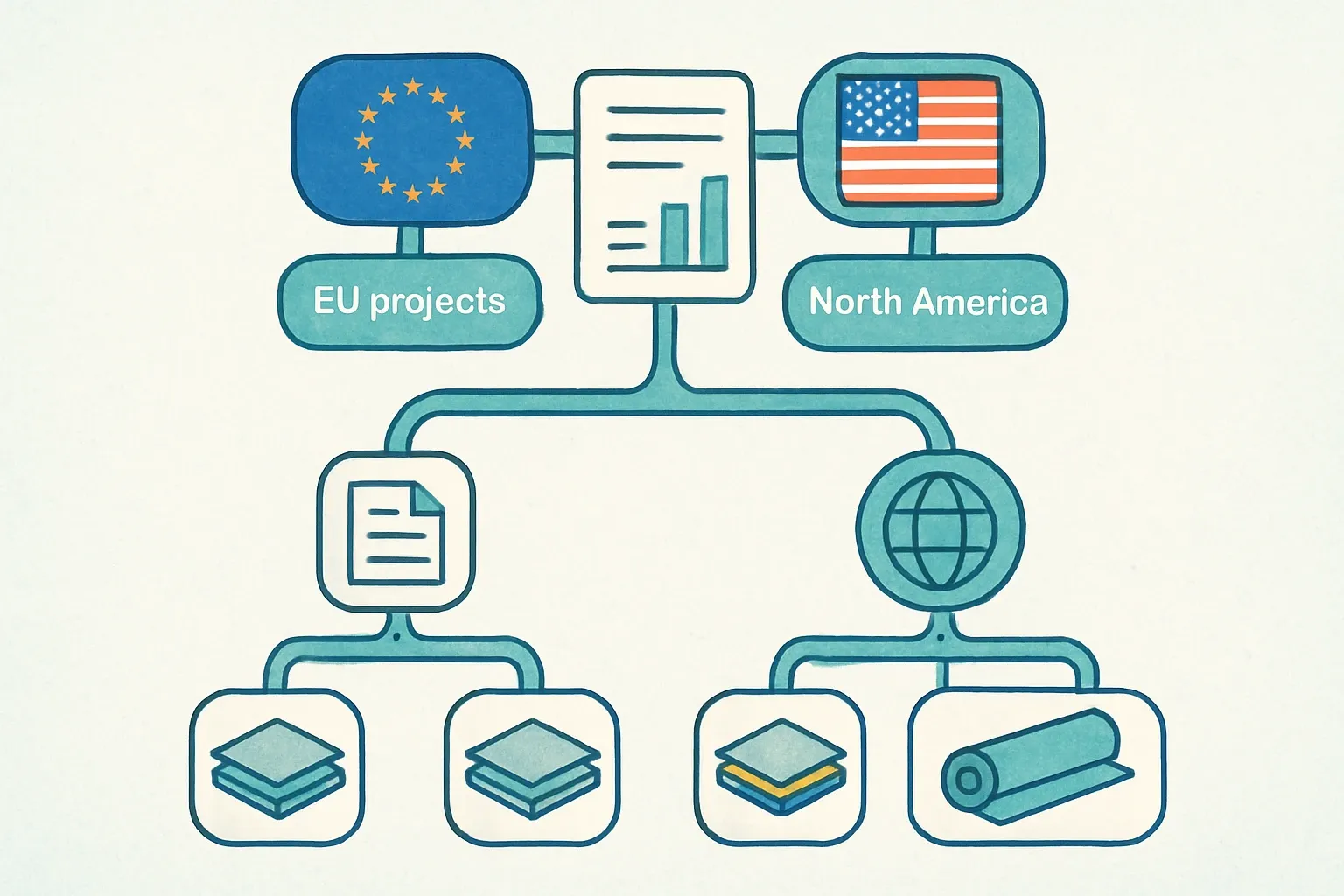
In the International EPD System, construction products use main PCR 2019:14 that implements EN 15804+A2. The complementary document for floor coverings, c‑PCR‑004, reached its stated validity end on December 20, 2024 and is being updated, while the main PCR remains the anchor (EPD International, 2024) (EPD International, 2024). Program operators continue to register vinyl EPDs under 2019:14 while noting the c‑PCR update status, so work does not stall.
What that looks like in practice
Recent vinyl EPDs list validity windows that run five years, for example SPC and LVT EPDs published in 2025 with expiry in 2030, while referencing PCR 2019:14 and flagging the c‑PCR as being updated (EPD International, 2025) (EPD International, 2025 and EPD International, 2025). That is a useful signal if your team is mid‑project and worried an expiring c‑PCR will derail timelines.
North America: two common routes
Many flooring EPDs in North America follow ISO 21930 with operator specific Part B documents, such as UL Solutions Part B for Flooring, or they align to EN 15804 when targeting EU buyers. NSF’s public EPD search confirms both options appear in current drop‑downs for flooring EPDs, alongside EN 15804+A2 and ULE Part B entries, which reflects real market practice in 2025 (NSF, 2025).
Vinyl is not one product, and PCR choice reflects that
Spec writers look for precision. The Resilient Floor Covering Institute lists nine resilient types used in industry‑wide EPDs, including heterogeneous and homogeneous sheet vinyl, LVT gluedown and looselay, VCT, SVT, rubber, and rigid core SPC and WPC, which shows how sub‑families matter for data and comparability (RFCI, 2025) (RFCI, 2025). Bring that granularity to your bill of materials and modeling plan.
Navigating PCRs for vinyl flooring?
Follow us on LinkedIn for clear insights that help you meet specifications and enhance your project competitiveness.
If you typed “PCR for vinyl flooring” this is the short answer
Publish to the operator and rule set your customers expect. For EU projects use EN 15804+A2 under the valid main PCR 2019:14. For North America use ISO 21930 with the operator’s Part B for flooring, or EN 15804 if you sell into both regions.
Data scope that avoids headaches later
Cradle to gate with options works for many commercial vinyl lines and keeps modeling focused. Cradle to grave increases credibility for facilities and education projects where use and end‑of‑life questions are hot topics. Either way, match scenarios found in competitor EPDs so specifiers can compare like for like.
The product definition will drive your inventory
Rigid core lines put attention on polymer core, limestone content, wear layer thickness, and backings like IXPE or cork. Sheet lines push you to capture paste and print chemistry, stabilizers, and energy profiles for calendering. A good LCA partner will chase utility data, waste, and transport for one clean reference year so your team is not drowning in spreadsheets.
Program operator selection
Common homes for vinyl EPDs include EPD International for EN 15804 projects, IBU in Europe for EN 15804, and several North American operators for ISO 21930 with Part B documents. Choose the operator your buyers already trust, then work backward to align PCR language, verification type, and file format. We suggest picking one path and sticking to it across a family to keep comparisons tight.
Timelines, expiries, and version shifts
Plan for five years of declared validity, then budget a refresh so you roll onto the updated PCR without scrambling. The fact that 2025 vinyl EPDs are valid through 2030 while the c‑PCR update proceeds is a practical precedent your legal and sales teams can rely on when planning launches (EPD International, 2025) (EPD International, 2025). If trustworthy averages for update cycle time exist, we have not seen a single source publish them in 2025.
ROI in plain sight
A verified, current EPD removes the penalty that some project teams must apply when a product lacks third‑party data. That keeps you in the conversation on performance and design, not only price. The cost of getting there is usually dwarfed by a single mid‑sized spec win, which teams often miss because the project never calls back.
Your next move
Pick the market pathway, confirm the sub‑category, and lock the operator. Then line up one reference year of utilities, materials, waste, and packaging across your plants. We like partners who do the heavy lifting on data and project management so R&D and operations can stay focused on making great product, not emailing spreadsheets. It sounds simple, and it is, but only if someone owns the wrnagling.