PCRs for this family in a nutshell
A Product Category Rule is the rulebook of Monopoly. Ignore it and the game falls apart. For adhesives and sealants, PCRs translate EN 15804 or ISO 21930 into product‑family specifics like functional unit, cut‑off rules, and data sources. Most PCRs are reviewed on 5‑year cycles, so versions and expiry dates matter for your schedule and sales collateral (UL Solutions, 2025) (UL Solutions, 2025).
North America today
Two titles dominate recent projects. First, Sealants Part B under UL Solutions covered building and construction sealants for the region, yet it reached its expiry on April 30, 2025. That aging matters for comparability and for some spec reviewers who check the PCR line on submittals (UL Solutions, 2025) (UL Solutions, 2025). Second, cement‑based grout, adhesive mortar, and self‑leveling underlayment are handled by a dedicated Part B used across several EPDs, with current listings showing 2023 to 2028 validity windows (NSF, 2024).
Europe and global operators
In Europe, IBU and the International EPD System publish Part A and product‑family Part B documents aligned to EN 15804+A2. IBU states that EN 15804+A2 is the basis for its program and that A1 is no longer used, which helps buyers trust cross‑border comparisons (IBU, 2025) (IBU, 2025). The International EPD System confirms that new GPI versions do not invalidate existing PCRs or published EPDs, which keeps your earlier work usable while updates are underway (EPD International, 2025) (EPD International, 2025).
What falls under “sealants” vs “adhesives” here
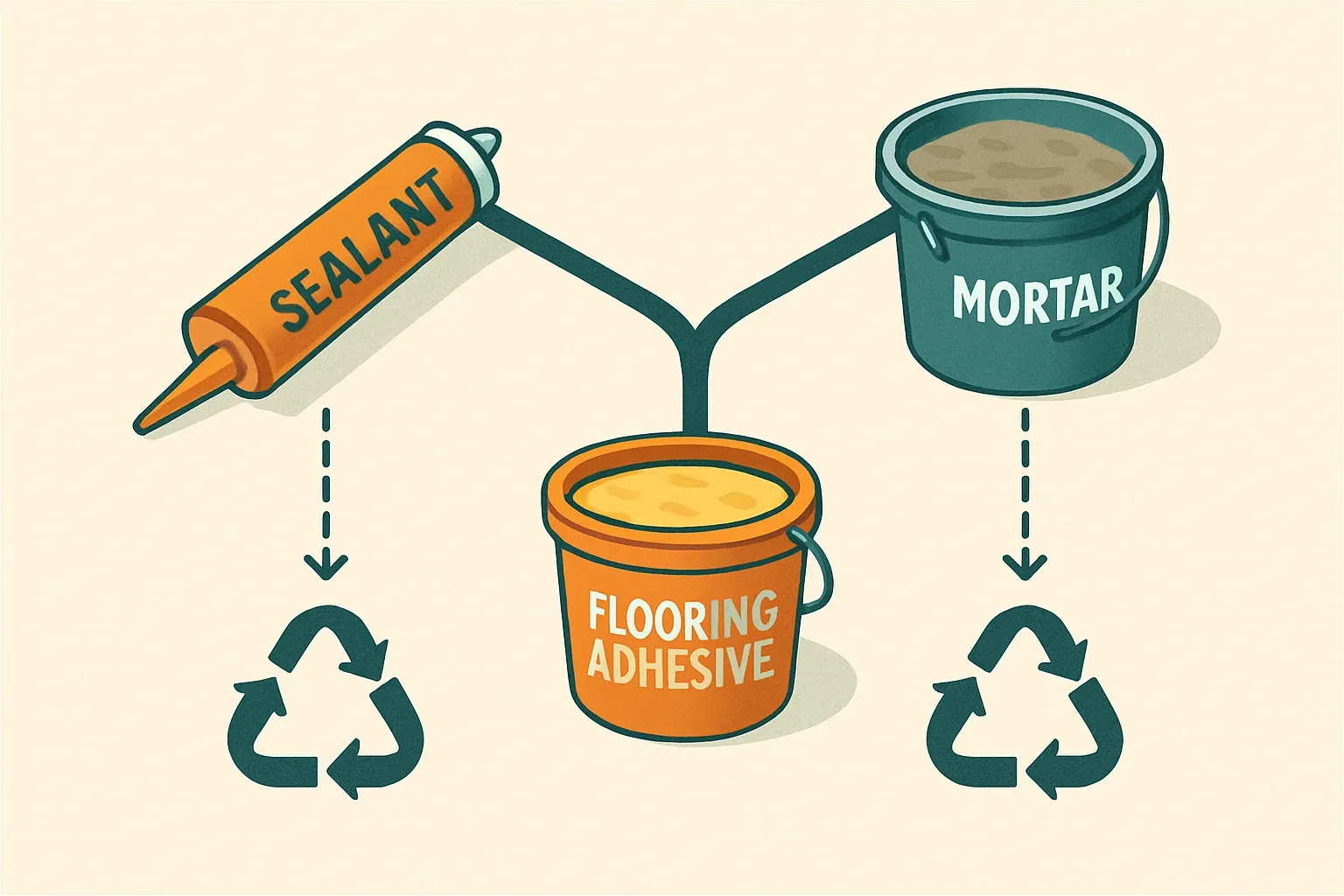
Tube‑grade construction sealants like silicones and hybrids typically sit under a sealants Part B. Cementitious products such as tile adhesive mortars or SLUs follow their own mortar‑focused Part B, not the tube‑sealant one. Flooring dispersion adhesives, primers, and pressure‑sensitive tapes are often handled under flooring‑specific Part B texts in Europe. Mixing these buckets leads to apples vs oranges LCAs.
System boundary and units you will see
Many sealants PCRs use cradle‑to‑gate as the required boundary for the declared unit, while allowing optional modules for end‑of‑life if justified for the application. Some titles fix a mass‑based declared unit, others permit a performance‑based unit like a linear meter of sealed joint at a defined geometry. Read the Part B carefully so the functional unit matches how customers actually buy and install the product. The North American sealants Part B explicitly specified cradle‑to‑gate as its scope (Adhesive and Sealant Council, 2025).
Work for a sealant or adhesive manufacturer?
Follow us for product-by-product analysis of PCRs and EPDs to identify which products get spec'd and where gaps exist against competitors.
Expiry does not usually kill your EPD
When a PCR expires during your EPD’s lifetime, the declaration generally remains valid until its own end date. Updates to the program’s GPI do not retroactively invalidate your EPD either, which avoids sudden rework during tenders. The International EPD System clarifies that EPDs retain their original validity, and surveillance follows the same PCR and GPI versions used at verification (EPD International, 2025) (EPD International, 2025). Most programs set EPD validity at about five years, with updates required if results change beyond defined thresholds (EPD International, 2025).
Picking the right PCR when options overlap
Start with where you sell. If most volume is in the US and Canada, check whether an active UL Solutions Part B exists for your product family or whether an alternative route, such as publishing with an operator aligned to EN 15804+A2, will be accepted by key specifiers. For cementitious adhesives or underlayments, the mortar‑focused Part B is typically the cleaner path for North American submittals, as evidenced by current listings on NSF (NSF, 2024). In the EU, IBU Part B titles for dispersion adhesives or building sealants are a common baseline for comparability in bids (IBU, 2025).
Data that usually moves the needle
Bring a full production year of site‑level data if possible. That means electricity by source, fuels, production volumes by SKU, fillers and plasticizer shares, packaging, internal scrap, and transport splits for bulk raw materials. If a product is brand new, prospective data can be acceptable with a commitment to update once a full year exists. Clear primer rules help too, since primers can quietly swing GWP when solvents or specialty resins are involved.
Timing and verification reality
Plan your calendar, not just the model. IBU notes current verification queues around six months, which can be the long pole if you leave submittals to the last minute (IBU, 2025) (IBU, 2025). In North America, timing varies by operator and verifier availability. A partner who shoulders data wrangling across plants and ERP instances will often save weeks, since internal experts can stay focused on production rather than chasing meter reads and supplier attestations. Small delays compound, so shave friction wherever you can.
Common tripwires to avoid
Do not force a tube‑sealant into a mortar PCR or vice versa. Keep declared unit and packaging aligned, for example mass vs kit, and document any water addition at jobsite for mortars. Track biobased content and fillers consistently across batches. Verify that secondary packaging and pail liners are in scope if they ship with every unit. One more: confirm that the PCR version on your EPD cover page matches the operator’s current registry, reviewers do catch mis‑matches.
Quick answers to search‑style questions
Yes, a “pcr for adhesives and sealants” exists, but it splits by chemistry and region. The North American sealants Part B expired on April 30, 2025, and a mortar‑focused Part B still supports cement‑based adhesives and SLUs via active EPD listings (UL Solutions, 2025; NSF, 2024). EPDs are typically valid for five years under program rules, even when the underlying PCR updates later in that window (EPD International, 2025). That gives you room to publish now, then align to the next revision at renewal.
Where this leaves your roadmap
Pick the exact Part B that mirrors how your product is used on site. Confirm operator, validity window, and declared unit on day one. Line up a verification slot early. Then make the data collection painless, so modeling and review run clean. Do that and your EPD will land on time, read clearly, and help teams win more specs without extra drama. Easy wins beat heroic rescues, every time. And yes, we can definately make that easier.