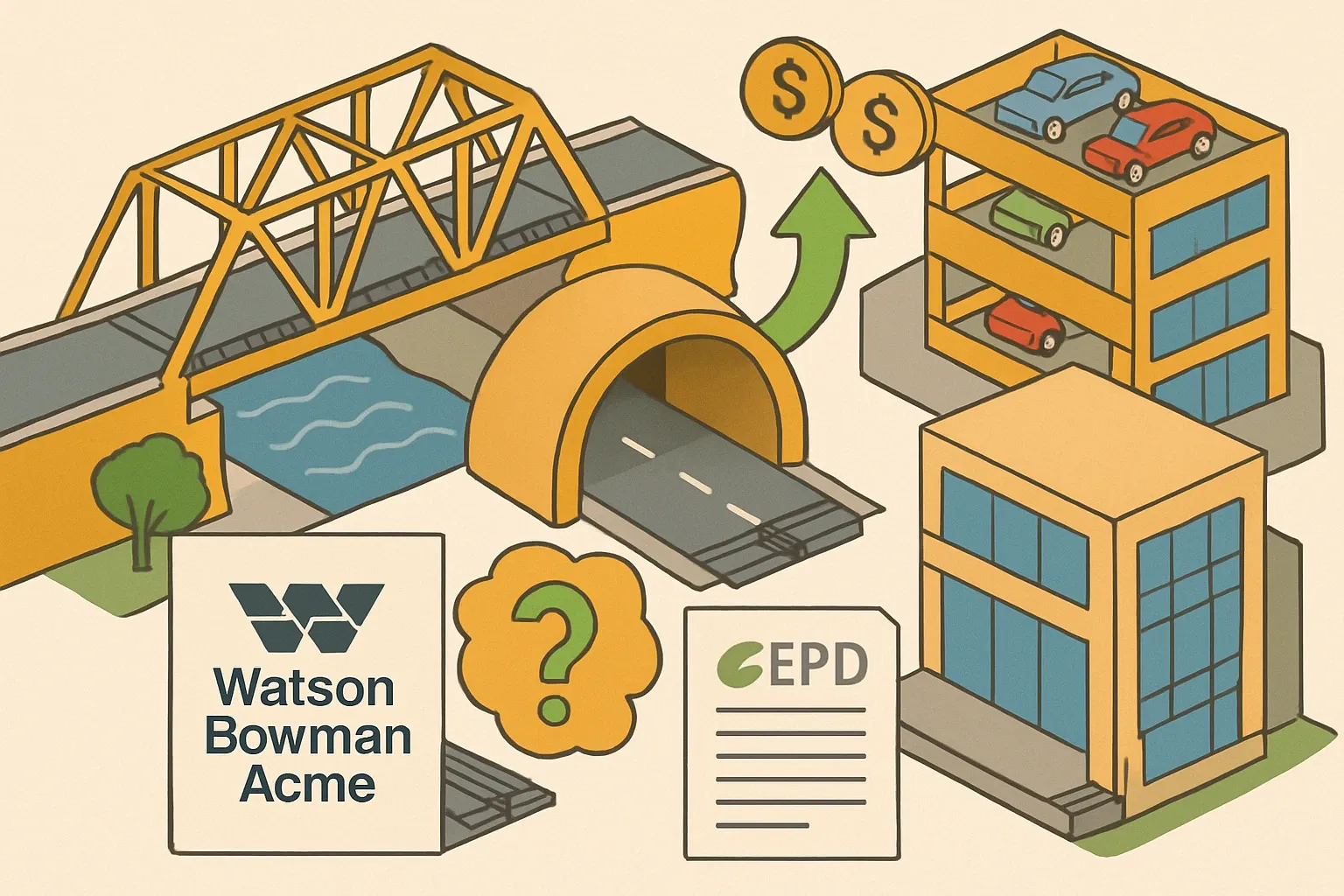
Who they are and where they play
Watson Bowman Acme (WBA) is a specialist in expansion control. The company sits inside Sika following the 2023 acquisition of MBCC assets and states a global footprint through Sika with CHF 11.76 billion in 2024 sales and roughly 130 employees at WBA’s Amherst, New York headquarters (WBA About Us, 2025). The portfolio leans civil and heavy‑duty building interfaces.
Product range at a glance
Think movement, sealed and managed. WBA’s Wabo line covers bridge strip‑seals, finger joints, modular joints, preformed silicone and compression seals, elastomeric nosings, and the Omega‑shaped tunnel sealing system. Parking and stadium joints round it out, plus seismic wall panels like QuakeWall and heavy‑duty systems such as BusTuff for bus lanes. The catalog spans several categories with dozens of SKUs and configuration options. For commercial building joints, Sika channels many offerings alongside Sika Emseal, giving specifiers a single door to transportation, tunnel, and building transitions in one family (Emseal site, 2025).
Where EPD coverage stands today
Our review did not find published, product‑specific EPDs for WBA’s core expansion‑joint systems as of December 19, 2025. That makes coverage low relative to peers in adjacent or overlapping scopes. Some competitors in bridge joints have begun publishing product‑specific declarations, particularly for modular systems used on large spans. The takeaway is simple. When a project team is counting qualifying products for materials credits or owner policies, a missing EPD introduces friction that can steer a spec elsewhere.
A likely best‑seller without an EPD
Consider Wabo StripSeal, a workhorse on bridges and parking structures. It appears widely on DOT QPLs and is promoted for watertight performance and freeze‑thaw durability, which makes it a frequent baseline choice on rehab and new work. Without an EPD, it risks being de‑prioritized on jobs that standardize submittals around verified declarations, even when performance is strong.
The competitor picture on typical bids
Expansion control is a competitive club. Depending on project type, teams often evaluate:
- mageba for bridge modular and finger‑plate joints where very large movements drive the design. Several of these systems are marketed with third‑party documentation that owners recognize.
- Sika Emseal in buildings for precompressed hybrid seals and fire‑rated assemblies across the envelope and interiors.
- Construction Specialties, Balco, MM Systems, Inpro JointMaster, and Nystrom for architectural covers and parking series.
These are not one‑to‑one swaps on every detail. They are the names most likely to appear on the same drawing set, which is why missing paperwork can tilt a decision at the last minute.
Work for Watson Bowman Acme or competing against them?
Follow us for product-by-product EPD analysis to uncover which expansion joint systems get spec'd and where EPD gaps could impact your sales.
Why the missing EPD matters commercially
LEED v5 was ratified by USGBC members on March 28, 2025, and continues to recognize product‑specific, externally verified EPDs in materials scoring, with a growing emphasis on embodied‑carbon performance across the bill of materials (USGBC, 2025). When owners and GCs standardize on products with verifiable disclosures, teams without EPDs often face a penalty in the accounting model rather than a clean comparison. You can be the technical equal and still lose momentum at submittal. That hurts spec stickiness and forces more price‑only conversations.
Where WBA already signals sustainability
WBA calls out product, packaging, and building‑level sustainability themes on its site, including recycled and recyclable content targets and circular packaging aims. Linking those narratives to verified LCAs and EPDs would turn intent into specification currency. See Product Sustainability and Packaging Sustainability for their current stance (WBA Sustainability: Product, 2025, WBA Sustainability: Packaging, 2025).
Fast wins: which products to prioritize for EPDs
Start with the high‑volume civil staples and the crossover systems that show up in both transportation and building scopes.
- Strip‑seal and compression‑seal families used on state DOT work and parking. These are frequent line items and ideal for product‑specific EPDs using construction‑product PCRs.
- Modular bridge joints for large movements. Publishing one or two anchor EPDs here positions the brand against global peers that already disclose.
- Preformed silicone systems used on both bridges and buildings. The dual‑market presence increases payback because they appear in mixed project portfolios.
Proof of scale and relevance
WBA’s systems are specified on marquee infrastructure, including a 7‑mile effluent outfall tunnel in Los Angeles County that carries a reported project value of about 630 million dollars, with construction slated 2021 to 2027 (WBA Project Gallery, 2025). Publishing EPDs for the joint families used on these big jobs would align the brand’s engineering reputation with enviromental disclosure expectations on public works.
How to execute with less pain
The heavy lift is not modeling alone. It is wrangling utility data, material recipes, transport, yields, scrap, and QA across plants for a clear reference year. A good LCA partner will shoulder the cross‑functional data chase, map the right PCRs by competitive precedent, and steer publication with a program operator your markets already accept. That white‑glove collection step is what compresses timelines and keeps senior engineers focused on design rather than spreadsheets.
What to watch next
Two threads matter. First, LEED v5 guidance will keep sharpening embodied‑carbon outcomes, which rewards brands that publish early and update on schedule (USGBC, 2025). Second, civil owners are publishing clearer material disclosure expectations in procurement portals. When that becomes the norm in your region, having product‑specific EPDs in hand turns compliance into a check‑box rather than a scramble.
Closing thought
WBA is a movement specialist with a deep bench of joint systems and impressive infrastructure references. The catalog already sells on performance. A focused EPD program for the top three joint families would convert that performance story into submittal‑ready proof and protect specs when sustainability rules quietly decide the tie.