Who Tensa is, in one minute
Tensa is an Italian engineering manufacturer formed from Tensacciai, Tesit and TIS, now active worldwide in structural systems for transport and buildings. Their sites outline a full lifecycle offer from design support to production, testing and installation, with references across Europe, the Middle East and the Americas (Tensa, Who We Are).
What they sell
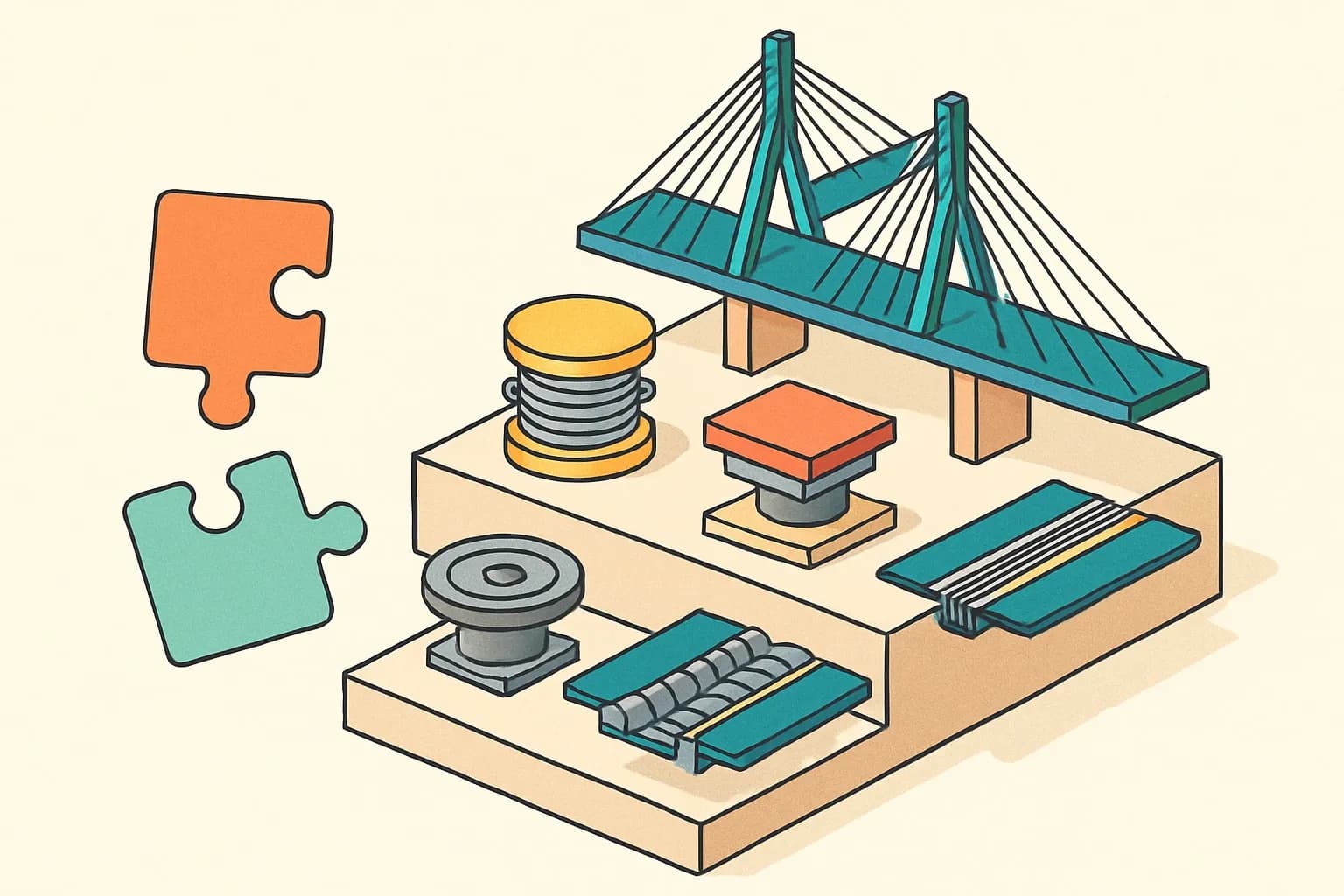
Tensa markets six core families: stay cables, post tensioning, ground anchors, structural bearings, seismic devices (isolators, dampers, rigid and displacement‑dependent systems), and expansion joints (Tensa, Technologies). Within each family are multiple sub‑systems and options. In practice that translates to dozens of configurable SKUs, likely stretching to the low hundreds once sizes and materials are counted.
Are Tensa’s products covered by EPDs today
We did not find publicly listed, third‑party verified EPDs for Tensa’s flagship lines as of December 19, 2025. That does not mean none exist privately, but it does mean a typical specifier searching operator registries and public libraries will likely come up empty. For teams chasing projects with EPD preferences or requirements, absence in public registries can slow down selection.
Where competitors are already visible on EPDs
Post‑tensioning is a good bellwether. VSL publishes product‑specific EPDs for multi‑strand post‑tensioning kits, valid until November 30, 2028 (EPD International, 2025) (EPD International, 2025; EPD International, 2025). Expansion joints are also moving toward more formalized declarations, and leading brands openly document performance certifications such as European Technical Assessments for modular joints (EOTA, 2024) (EOTA, 2024).
Why this matters commercially
On many public and private jobs, picking a product without a product‑specific EPD forces design teams to use conservative defaults in whole‑building carbon accounting. That can nudge otherwise qualified products out of shortlists. With LEED v5 on the horizon, product‑specific documentation is becoming a simple yes/no checkbox in bid rooms rather than a nice‑to‑have. You dont want procurement to choose for you.
At Tensa or competing against them?
Follow us for a product-by-product analysis of EPD gaps and competitive positioning to know which post-tensioning systems and expansion joints get spec'd or VE'd out.
Likely best sellers without a public EPD (and the risk)
Two high‑spec lines stand out: post tensioning systems and modular expansion joints. Both are frequent line items on bridges, rail and complex podiums. When a competing post‑tensioning kit arrives with a live EPD number, it removes carbon reporting friction and builds trust with the design team. The net effect is fewer back‑and‑forths and a higher chance to stay specified.
The competitor set Tensa meets most often
Depending on geography and owner standards, Tensa will often face mageba and MAURER on expansion joints and bearings, and VSL, DYWIDAG and Freyssinet on post‑tensioning and stay cable scopes. D.S. Brown and regional specialists also appear frequently on North American transport work. Interchangeability varies by approval and detailing, yet on many projects these brands are the shortlist.
Fastest path to credible coverage
Think like a product manager, not a catalog owner. Start with two or three high‑volume, high‑visibility SKUs per family and publish product‑specific EPDs, then roll coverage outward.
- Pick the rulebook carefully. A PCR is the rulebook of Monopoly (ignore it and the game falls apart). Match the PCR that peers already use for the same application to keep comparisons apples‑to‑apples.
- Prioritize where EPDs are already influencing shortlists: post‑tensioning kits, spherical or pot bearings with standard configurations, and modular expansion joints.
- Make data collection painless. The right LCA partner should pull utility, material and process data from ERP, QA and test records with minimal disruption, rather than handing your team a spreadsheet and walking away.
- Stage the portfolio. Representative EPDs can cover near‑identical variants initially, then you add the outliers. That balances speed with completeness.
How many SKUs to expect in scope
A focused first wave usually touches the dozens. For example, one post‑tensioning kit EPD can document the anchorages, ducting and strand options likely used across many projects. Bearings and joints often need a few size‑class exemplars to feel complete for specifiers.
What “good” looks like from a specifier’s chair
Clear declarations, current validity, and alignment with common operator formats in your target markets. Bonus points for a short technical brief that maps your EPDs to typical bridge or podium details and shows maintenance and replacement assumptions. Keep marketing flourishes light; engineers will skim for impact numbers, declared unit and scenarios first.
Bottom line for Tensa
The product range is broad and competitive, but the public EPD footprint appears light. That is fixable. Start where specifications concentrate revenue, mirror the PCR choices of visible competitors, and make data collection ruthlessly efficient so engineering keeps building instead of chasing spreadsheets. The price of a few high‑leverage EPDs is often dwarfed by a single mid‑sized win in transport or mixed‑use podium work.