
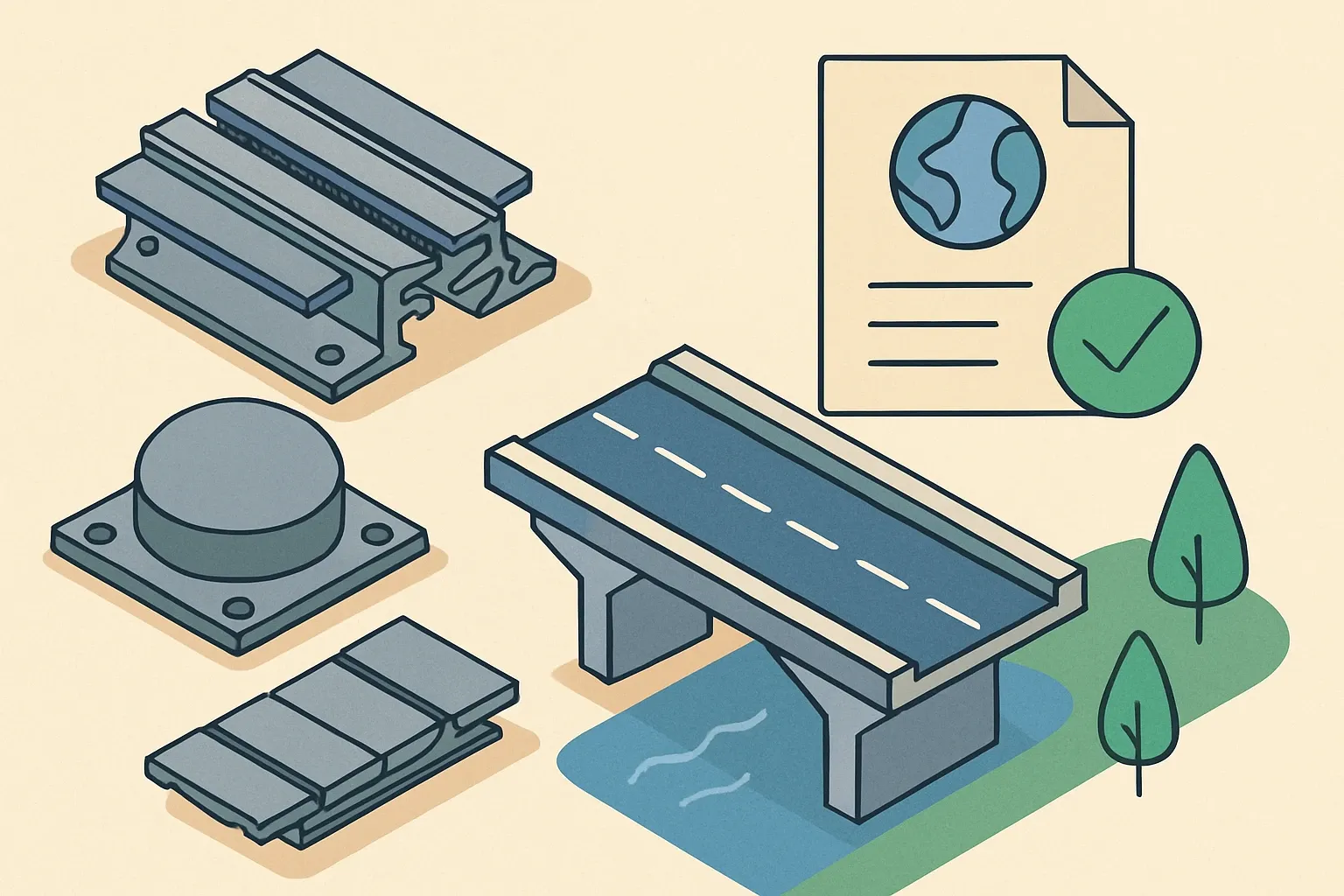
What TENSA Bridge does
TENSA is a bridge movement and protection specialist. Its catalog spans expansion joints for roads and rail, structural bearings, and seismic devices for buildings and infrastructure (mageba product pages). citeturn2search6turn2search7turn2search4
Within expansion joints, the range covers single gap, modular, finger, and rail joints. For bearings, engineers will encounter pot, spherical, elastomeric, and sliding variants. Movement capacities run from modest thermal gaps to very large ranges on modular systems, with published values around 120 to 2500 mm for TENSA MODULAR joints (mageba, 2025). citeturn2search6
How broad the portfolio appears
Across transport and building applications, the brand shows three core families that repeatedly appear in bridge specs. Expansion joints, bearings, and seismic devices. Each family branches into several models, resulting in dozens of SKUs rather than hundreds on public product pages. That breadth means project teams can standardize on one supplier from abutment to midspan.
EPD coverage today
Evidence of product-specific EPDs for this category is sparse in public operator libraries. mageba, the company behind the TENSA brand, maintains an EPDs and Certificates page where verified declarations are aggregated for select products (mageba sustainability, 2025). We did not find comprehensive, product-specific EPDs for every TENSA joint family or bearing type in the major operator portals checked as of December 19, 2025. That suggests partial coverage rather than a full-line approach. citeturn8search1
One signal that the space is moving. An EN 15804 product-specific EPD exists for rail expansion joints in Europe with validity into mid 2028 (EPD International, 2023). While not a like-for-like road joint, it shows the bar for disclosure is rising in movement hardware. citeturn4search1
Where gaps risk lost specs
Consider a steel finger joint. It is a likely volume item on long spans and interchanges. If a project team is tallying qualifying disclosures, a joint without a product-specific, third-party verified EPD can face a penalty in materials accounting, which nudges buyers toward alternatives that keep the paperwork clean. LEED v5 was ratified on March 28, 2025 and continues to emphasize disclosure quality across materials (USGBC, 2025). That direction makes EPD visiibility a commercial requirement, not a nice-to-have. citeturn5search0
Competitive landscape on typical bridge jobs
In North America and Europe, owners and designers frequently evaluate a short list for movement and bearing packages. Common names include Watson Bowman Acme, D.S. Brown, RJ Watson, Maurer, and regionally focused suppliers for elastomeric bearings and finger joints. In segments touching post-tensioning or stay cables on the same structures, firms like VSL appear more often, and they already publish product-specific EPDs in their lane (EPD International, 2028). citeturn1commentary2
What better EPD coverage unlocks
More bids let product-specific EPDs count toward materials credits and internal carbon policies. When the joint, the bearing, and the seismic device all show up with verified declarations, submittals move faster. Teams avoid fallback assumptions that inflate carbon numbers, and the spec stays intact longer.
A practical path to catch up
If coverage is partial, start with modular and finger joints. They anchor many bridge packages and carry high visibility in pre-bid RFIs. Follow with pot and spherical bearings, then seismic devices. Pick a partner who can lighten data collection across plants and publish with the operator that fits your market best, whether Smart EPD in the US or IBU in Europe. The fastest programs keep data wrangling off your engineering floor and keep reviews predictable.
Bottom line for manufacturers watching TENSA Bridge
The product story is strong. Movement control, bearings, and seismic devices under one roof. The disclosure story is getting there. Round out EPDs on the highest-volume joints and bearings and the specabiliity lift shows up quickly in your win rate.


