Who Steeler is in the market
Steeler manufactures light‑gauge steel framing and distributes drywall and accessories across the Western U.S. and Canada. The company reports 13 branches serving projects year‑round, positioning it as a regional mainstay for cold‑formed steel supply (Steeler, 2025](https://www.steeler.com/)).
What they make, at a glance
Core manufactured lines cover studs and track, slotted and deflection details, shaftwall, floor joists, channels, clips, custom brake shapes, and resilient channel. They also stock gypsum, fasteners, and tools for a one‑stop submittal stack. That translates to multiple product families and, realistically, hundreds of SKUs once sizes and gauges are counted.
Specification support that plays nice with CSI
Steeler publishes editable spec templates for MasterFormat 05 40 00 Cold‑Formed Metal Framing and 09 22 16 Non‑Structural Metal Framing, which helps their products show up correctly in Division 05 and Division 09 documents. Good spec hygiene shortens the path from drawing to buyout.
Their EPD posture today
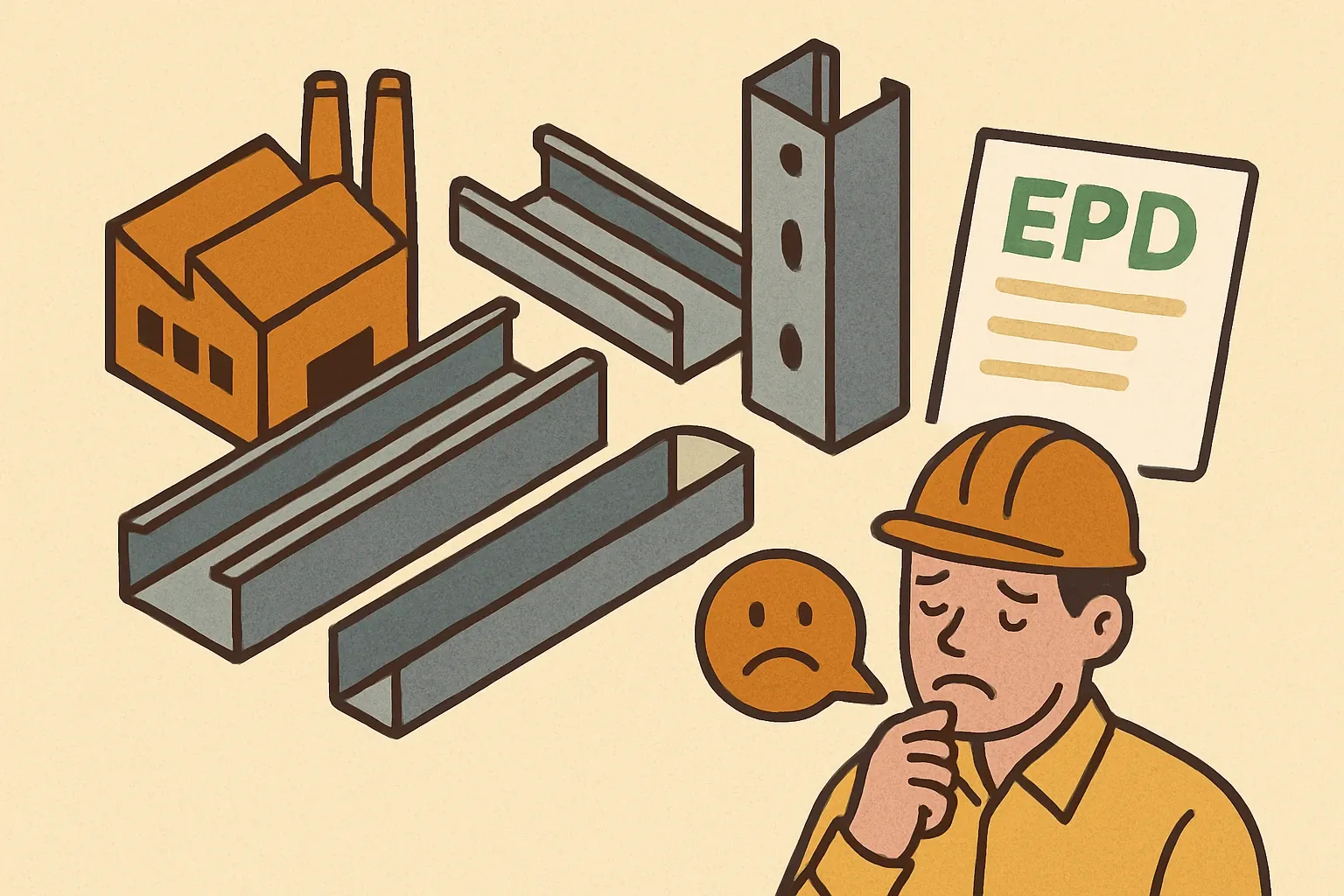
We did not find product‑specific, Type III EPDs attributed to Steeler as of December 19, 2025. Their site points project teams to the Steel Framing Industry Association’s industry‑wide EPD for cold‑formed steel framing, verified by SCS Global Services and valid through May 27, 2026 (SCS Global Services, 2022](https://www.steeler.com/uploads/pdf/scs-epd-07103_sfia_012522.pdf)). That document is useful for general transparency, yet it is not product‑specific to Steeler’s own SKUs.
Work for Steeler or competing against them?
Follow us for a product-by-product analysis of EPD gaps and insights on which cold-formed framing products get spec'd or VE'd out against ClarkDietrich, CEMCO, and others.
Why that nuance matters on projects
Industry‑wide EPDs are accepted in LEED, but product‑specific EPDs are typically valued higher in credit accounting and preferred by owner standards. When a spec calls for product‑specific EPDs, submittals built on an industry‑wide declaration can trigger substitutions, or default accounting that hurts your chance to stay in scope.
Products likely to be scrutinized first
Interior non‑structural studs and track and the Elite Steel Framing System are common line items during design and buyout. These show up early in Division 09 packages and are compared side‑by‑side with competitors’ declared products. A product‑specific EPD for these workhorses would cover a large slice of Steeler’s recurring revenue and reduce swap risk.
Who they’re up against most often
On like‑kind cold‑formed framing, ClarkDietrich, CEMCO, Marino\WARE, and SCAFCO frequently appear on project lists. These peers publish product‑specific EPDs through program operators such as UL and SCS Global Services, and several promote low‑embodied‑carbon lines. In Western markets, SCAFCO and CEMCO show up often for studs and track, while ClarkDietrich has national pull for both interior and structural framing.
Commercial impact, stated plainly
If a project team must document embodied carbon for LEED or internal ESG rules, a product without a product‑specific EPD means extra work and sometimes a conservative penalty in the carbon model. That makes an otherwise competitive quote easier to replace. One well‑targeted EPD can keep Steeler in the running without a race to the bottom on price. It’s the classic “be easy to buy” move.
Quick win playbook for Steeler’s catalog
Prioritize a product‑specific EPD for non‑structural studs and track, then extend coverage to shaftwall and common channels. Use the same PCR as leading competitors so reviewers can compare apples to apples, and keep the data pull simple for plant teams so timelines stay predictable. Publish with a mainstream operator and push the documentation into your spec templates and submittal kits.
Helpful link for teams doing the homework
Steeler maintains a LEED Support page with basic guidance and a link to the SFIA EPD. It is a good central place to park future product‑specific EPDs so estimators and sustainability managers can find them fast (Steeler LEED Support, 2025).
What good looks like for the next 90 days
Pick one plant and a reference year, scope studs and track first, and line up the program operator and PCR. Lock collection templates for utilities, coil sourcing, scrap, and yields. Dont forget to pre‑wire spec language so the new EPD shows up in Division 01 and your 05 40 00 and 09 22 16 sections the day it goes live.