Who Keystone Group is
Keystone Group is a diversified manufacturer with brands across steel, light and environmental, and timber. The group spans roughly 17 brands and operates with about 2,000 employees across 27 sites by their own count (Keyfix, 2025). Their portfolio covers residential and commercial builds in the UK, Ireland and beyond.
What they sell, at a glance
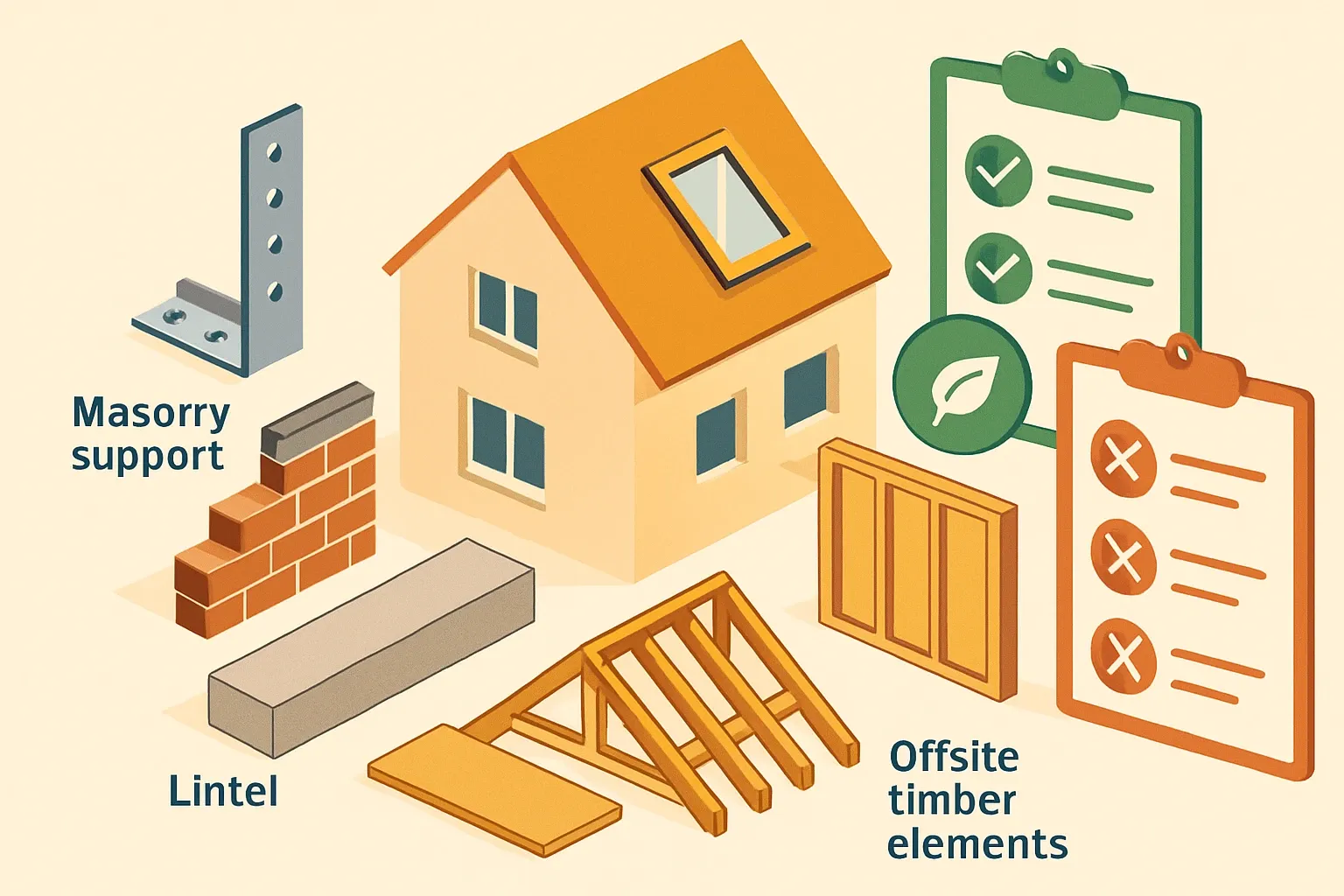
Across the group you’ll find steel lintels and accessories (Keystone Lintels, IG Lintels), masonry support and brick slip systems (IG Masonry Support), non‑combustible cavity trays and lintels (Keyfix), roof windows and blinds (Keylite), plus offsite timber systems, trusses and SIPs (Smartroof, Crendon, Glosford). That translates to a dozen plus product families and hundreds of SKUs when you consider sizes, load classes and glazing variants.
EPDs already in play
Two brands stand out for published, third‑party verified EPDs. IG Masonry Support lists multiple BRE‑registered EPDs covering products such as Brick on Soffit Systems, welded masonry support and brick slip lintels (IG Masonry Support, 2022). Keyfix announced an EPD for its Non‑Combustible Cavity Tray under the BRE GreenBook Live system (Keyfix, 2023). These help on projects where product‑specific declarations are preferred for whole‑building carbon accounting in LEED v5‑aligned specs.
Where coverage looks thin
We could not locate public, third‑party EPDs for the core steel lintel ranges at Keystone Lintels or IG Lintels as of December 20, 2025. Keylite’s roof windows also appear without a readily downloadable EPD on public operator registers. That does not mean none exist, but it suggests a visibility gap versus several close competitors.
Work for Keystone Group or a competitor?
Follow us for a product-by-product EPD and spec analysis to identify which lintels and roof windows get VE'd out against Catnic and VELUX.
The spec risk in two common categories
Steel lintels are a volume, everyday line. Catnic publishes several product‑specific lintel EPDs and even offers a tool to generate product environmental datasheets for additional sizes, which can be a tie‑breaker where EPDs are preferred in procurement (Tata Steel UK, 2025). In roof windows, both VELUX and Roto provide EPDs you can download, with recent entries verified by IBU and ift Rosenheim and valid into the 2027 to 2030 window (VELUX, 2025) (Roto Frank, 2025). When a project team must document embodied carbon, a like‑for‑like competitor that surfaces an EPD often becomes the safer pick.
Likely best seller without an EPD and a ready alternative
A standard cavity wall steel lintel is a likely high runner for the group’s steel brands. If that lintel lacks a product‑specific EPD, a specifier can swap to a Catnic equivalent that does publish one, without re‑designing the opening or the program logic (Tata Steel UK, 2025). That swap avoids using generic database values with penalties and can keep the carbon model on target. It is a quiet, commercial hit.
Competitors Keystone brands most often face
- Lintels and masonry support: Catnic, Leviat (Ancon and Halfen), Birtley, Stressline.
- Roof windows: VELUX, Roto, Fakro.
- Room‑in‑roof and timber offsite: Roofspace Solutions, regional truss and panel specialists.
What to do next if you own Keystone‑type products
Prioritise EPDs where volume meets specification risk. That usually means everyday lintels first, then marquee masonry support systems, then top‑selling roof windows. Pick the PCR your competitors already use so your results are comparable and publication is straightforward. The real time sink is data wrangling across plants and variants, so choose an LCA partner that makes internal data collection painless and keeps scheduling predictable for your teams.
Sustainability signals worth noting
Keystone has a published sustainability strategy and net‑zero ambition that coordinates actions across brands. If that roadmap turns into broader EPD coverage, it will remove friction for sales and specification across the portfolio (Keystone Group Sustainability, 2025). The market is watching for that momentum.
The takeaway for manufacturer teams
Keystone Group is diversified with strong market reach. EPD coverage is material for IG Masonry Support and Keyfix today, and appears limited for mainstream lintels and roof windows. Closing those gaps can raise win rates in bids that ask for enviromental disclosures. The fastest path is to start with the highest volume SKUs and align to the PCRs used by the current spec favorites in each category.
(IG Masonry Support, 2022) (Keyfix, 2023) (Tata Steel UK, 2025) (VELUX, 2025) (Roto Frank, 2025)