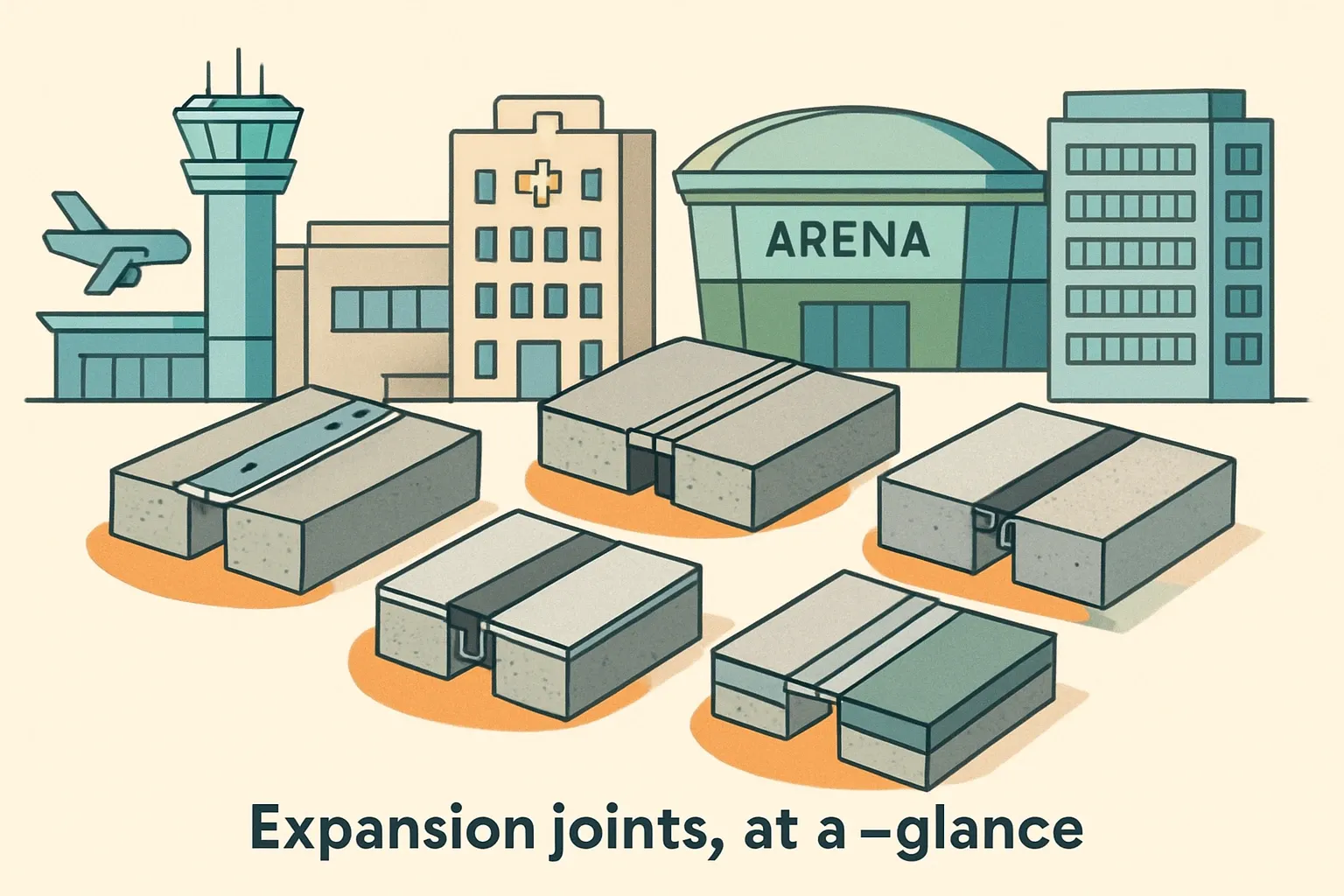
Where JointMaster plays
JointMaster focuses on expansion joint solutions that bridge building movement at floors, walls, ceilings and exterior envelopes. The lineup spans cover-plate systems, compression and foam seals, wide seismic systems, and life‑safety add‑ons like fire and moisture barriers. It shows up wherever traffic, thermal drift or seismic design requires controlled, durable movement joints.
Product range in plain English
Across the catalog you will find floor systems such as the 151, 221, 401 and 516 series, heavy‑duty vehicular options like the 721 family, plus reinforced vapor barriers and related life‑safety components. Taken together the range covers several application categories, with series counts in the dozens and resulting size and finish permutations comfortably in the hundreds. That breadth fits healthcare, aviation, higher‑ed, stadiums and parking structures.
EPD coverage, today
Based on a current scan of public EPD listings, we could not find product‑specific EPDs for JointMaster expansion joint cover assemblies as of December 19, 2025. The same is largely true for close competitors in this niche, which suggests a category‑wide gap rather than a single laggard. Translation, a first mover can set the reference point specifiers use.
Why this matters in specifications
When a project team must account for embodied carbon, picking a product with a third‑party verified EPD avoids defaulting to conservative database factors that can make a solution look worse on paper than it performs in reality. Under evolving owner policies and rating systems like LEED v5, product‑specific EPDs keep options open in tight material screens and reduce the risk of being value‑engineered out late in design.
At JointMaster or competing with them?
Follow us for product-by-product EPD analysis to uncover which expansion joint systems win specs and where EPD gaps could cost you projects.
A likely best seller without an EPD
Consider bread‑and‑butter floor systems such as the 151 Series or 221 Series. These are common choices in corridors and lobbies with movement in the 25 to 50 percent range, yet we do not see public, product‑specific EPDs for these assemblies today. On projects with strict transparency lists, that absence can push a team toward a competing solution that brings verified data, even if performance is similar.
Who JointMaster competes with on projects
Expect to see MM Systems, Balco, Nystrom, Sika EMSEAL, Watson Bowman Acme and the expansion joint group at Construction Specialties on the same bid lists. Many of these firms mirror JointMaster’s breadth across floor, wall and exterior covers, seismic options and fire or moisture barriers. The EPD gap appears industry‑wide for cover assemblies, which turns an EPD program into a simple differentiator.
The fast path to an EPD here
Expansion joint covers are multi‑material assemblies that combine extruded aluminum or stainless steel, elastomeric seals and sometimes mineral wool, intumescent or textile fire modules. There is no single, universally dominant Part B PCR for this exact assembly in North America right now, so teams typically choose an accepted construction products rule that peers have used for analogous systems, then document bill‑of‑materials, regional sourcing, and plant energy as the reference year. A partner who handles internal data wrangling across purchasing, machining and assembly lines makes this painless and quicker than most expect.
Sustainability signal from the parent brand
While product EPDs for JointMaster covers are scarce, the corporate sustainability footing behind the brand is notable. Inpro’s Muskego facility achieved an independently verified 63.99 percent waste diversion for 2023 under the SCS Global Services Zero Waste Program, with a published certificate code SCS‑ZW‑0030 (SCS Global Services, 2025) (SCS Global Services, 2025). The company also received a 2025 Recycling Excellence Award from the Wisconsin DNR for its overall program, reinforcing a culture that can support credible product transparency at scale (Wisconsin DNR, 2025).
If you are mapping a roadmap, start with high‑runner series in floors and exterior conditions, then extend to seismic and fire‑rated variants. The first published EPDs in this category will become the yardstick others must match. Dont wait for competitors to set your benchmark.
Helpful link
See Inpro’s sustainability note on waste diversion for context and a contact doorway into their transparency efforts, plus facility‑level progress updates: Waste Diversion.