
Who they are and what they sell
James Hardie centers on exterior fiber‑cement cladding for residential and light commercial work. In North America that means lap, panel, shingle, trim and soffit plus tile backer boards. In Europe, the fermacell range adds gypsum fibre boards and flooring elements. They are not a pure play in just one SKU family, but a portfolio spanning exterior facades and interior boards.
Across regions this equates to several product families and, very roughly, dozens of individual SKUs before colors and finishes multiply that choice.
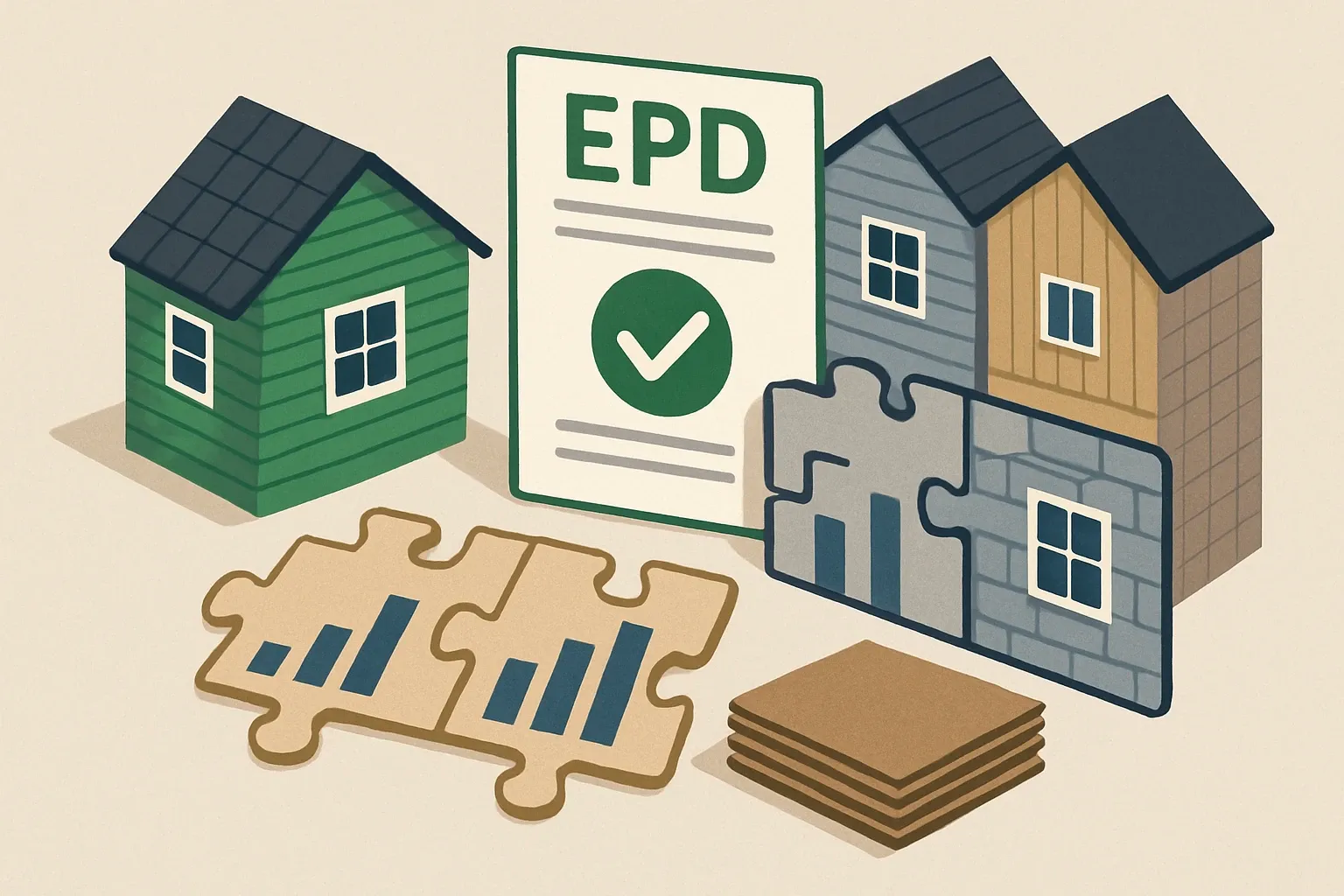
EPD footprint at a glance
Hardie has a verified Environmental Product Declaration for external cladding covering the U.S. The EPD is registered in the International EPD System and is valid through December 21, 2027, with a geographic scope listed as USA (EPD International, 2025) (EPD International, 2025).
In Europe, fermacell gypsum fibre boards carry product‑specific EPDs published by IBU, valid to October 17, 2027, and Hardie® Plank and Hardie® Panel claddings have EN 15804 EPDs published in European registries during 2027 and 2028 respectively (IBU, 2025) (IBU via NBS, 2025).
The company also highlights sustainability and EPD work in recent communications, including its 2025 sustainability update and European sustainability pages that emphasize EPD‑verified products (James Hardie, 2025).
Where coverage is strong
For fiber‑cement cladding in the U.S., having a product‑specific, third‑party verified EPD in a major registry removes friction on projects pursuing LEED v5 points or internal corporate procurement screens. It also keeps Hardie competitive in public and institutional work where EPDs are increasingly required rather than merely welcomed.
At James Hardie or competing against them?
Follow us for product-by-product analysis to see which fiber-cement SKUs win specs and where EPD gaps could cost you projects.
The notable gap
We do not find a current U.S. program‑operator EPD for HardieBacker tile backer board as of December 20, 2025. In wet rooms and healthcare fit‑outs, backer board often rides along with the tile package. Rival systems like USG Durock publish EPDs that specifiers can grab directly from product pages, which can tilt decisions when a compliant document is required on submittal day (USG, 2025) (USG, 2025). If your catalog is missing the one sheet a GC needs to clear a sustainability review, you risk getting swapped late in design. It’s that simple.
Competitive set and how they show up
Hardie meets a mixed field on jobs.
- Like‑kind fiber‑cement claddings from Nichiha increasingly come with EPDs registered in the International EPD System, covering U.S. production lines according to their 2024 announcement (Nichiha, 2024).
- Engineered wood alternatives from LP often sit across the table on value‑engineering conversations. LP SmartSide has ASTM‑validated, product‑specific EPDs across its siding portfolio, widely promoted since 2023, which many procurement teams treat as the default documentation packet (LP, 2024) (LP, 2024).
- Allura maintains a broad fiber‑cement offer in North America. Public operator‑hosted EPDs were not readily located at the time of writing. If they exist, they are hard to find and therefore not helping in the heat of a submittal.
- In tile backer, USG Durock’s EPD presence is visible and current, which can win tie‑breakers on interiors packages (USG, 2025) (USG, 2025).
Commercial implications on spec‑driven work
Many owners now prefer or require product‑specific EPDs. Without one, design teams have to model carbon with conservative defaults that raise red flags. That penalty makes products without a recent, easy‑to‑download EPD less attractive, especially on education, healthcare and multifamily projects. The price of an EPD is frequently recouped by a single mid‑sized project win, yet teams often do not see the projects they never recieve a shot at because of missing paperwork.
If we were mapping next moves
Prioritize the U.S. backer board family for product‑specific EPDs first, then refresh cladding EPDs six to twelve months before expiry. Keep the PCR choice aligned with what competitors use, so reviewers can compare apples to apples. Make the data pull painless for plant and procurement teams. The fastest programs fix the messy middle of data wrangling, keep calendars tight, and publish with the operator your customers already trust.
Bottom line for Hardie watchers
Coverage on cladding is real and useful in both the U.S. and Europe today, and that helps win specs. Extending that rigor to backer boards would close an obvious gap and blunt a rival’s edge. On projects chasing LEED v5 and firm‑wide carbon targets, the brand that shows up with the right EPD at the right time tends to get kept on the drawing set.
For deeper reading on their initiatives, Hardie’s sustainability pages are a good start (James Hardie Europe sustainability).


