Who they are and what they make
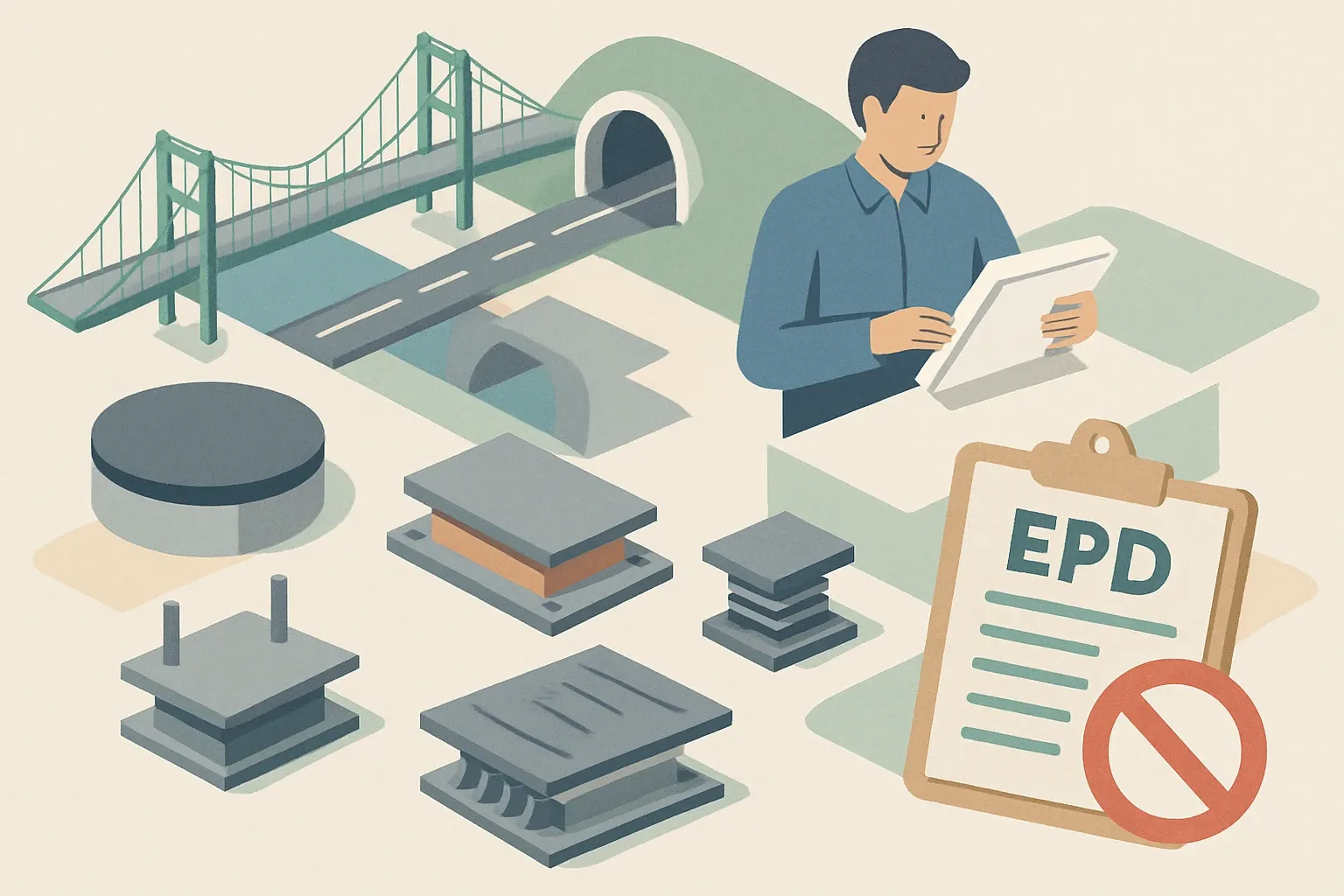
Operating under FIP MEC S.r.l., FIP Industriale focuses on structural movement and load‑transfer solutions for civil works. The product families span structural bearings, modular and single‑gap expansion joints, anti‑seismic devices such as dampers and shock transmitters, and fittings for tunnel segments (FIP MEC site). Each line offers multiple sub‑types and sizes, usually customized to project loads and movements.
In practical terms, that means several categories and dozens of configurable SKUs per family, easily adding up to hundreds across the whole catalog. The business is not a pure play in one component. It sells a system of components that keep bridges and large buildings moving safely.
What we see on EPD coverage today
We looked for public, product‑specific EPDs for FIP’s core lines and did not find any in major registries or on the company site as of December 19, 2025. If one exists behind a portal or paywall, it was not readily discoverable. EPDs typically carry a five‑year validity once published, so even a single declaration can work across many bids in that window (EPD International, 2025).
Why that matters commercially
On projects that score or report embodied carbon, teams prefer products with third‑party verified EPDs because they avoid default penalties and simplify documentation. Without a published EPD, even a strong technical spec risks getting swapped for a comparable product that is easier to quantify on carbon.
Competitors are starting to show receipts
In the structural bearings lane, mageba has announced an externally verified EPD for its RESTON spherical bearings, positioning its bearings for low‑friction specification on carbon‑aware jobs (mageba, 2025). In adjacent structural hardware, VSL has valid EPDs for multi‑strand post‑tensioning systems in the International EPD System, which signals how infrastructure suppliers are moving toward verified disclosures in civil works contexts (EPD International, 2025).
Main competitors FIP frequently meets on large civil or mobility projects include mageba, MAURER, Freyssinet and VSL for structure‑borne systems, plus elastomer and joint specialists that sometimes substitute into car parks, terminals, rail, or tunnel applications. The overlap varies by country and project type, yet the trend is clear. More of them show up with EPDs in hand.
Work for FIP Industriale or a competitor?
Follow us for a product-by-product EPD analysis to uncover which structural components get spec'd and where EPD gaps hinder winning projects.
Likely gaps in FIP’s portfolio
Based on the current public record, we see the biggest opportunity in the highest‑volume lines: pot bearings, spherical bearings, elastomeric bearings, and modular expansion joints. These are the everyday heroes of bridge and rail jobs. One representative EPD per family can unlock more specs than a dozen datasheets, because it removes the extra carbon accounting work from design teams.
A fast, low‑drama path to EPDs
Publishing EPDs is less about LCA math wizardry and more about wrangling plant data that already exists. The choke‑point is internal coordination. A white‑glove partner can collect utility, material, and yield data directly from manufacturing and QA so engineering time stays on core work while the EPD moves forward.
A pragmatic roadmap for FIP’s mix:
- Start with a representative pot bearing and a representative spherical bearing. Choose SKUs with mature supply chains and steady volumes for clean data.
- Add a modular expansion joint EPD. If needed, use a representative configuration to cover the family then expand later.
- Queue an anti‑seismic device, such as a viscous damper, to address seismic‑region bids.
PCR and operator choices that fit civil products
Most civil components can sit under the Construction Products PCR that registries maintain. The current transition away from PCR 2019:14 version 1.3.4 reached a June 20, 2025 sunset, with version 2.0.x now live. That change matters only for which template and rules you cite, not whether an EPD is feasible for bearings or joints (EPD International, 2025). EPDs are normally valid five years, with annual internal follow‑up to keep data fresh, which is a manageable cadence for manufacturing teams (EPD International, 2025).
Where FIP loses out today, and how to flip it
Take spherical bearings. If a project team compares two equal performers and only one has a current EPD, the EPD holder is more likely to be selected because the carbon math is plug‑and‑play. The same dynamic holds for modular joints and elastomeric bearings. Publish once, use across many bids, and the documentation load disappears for specifiers. That is real commercial leverage, not just a green badge.
The bottom line for spec‑readiness
FIP Industriale already checks the engineering boxes. To convert more bids where verified environmental data is required, they need clear, searchable EPDs for the top families first, then extend coverage. Do that and the brand competes on performance and availability, not paperwork. It is time to turn the quiet gap into a visible advantage, fast. We can help make the data collection painless and the timeline short, so teams keep thier focus on delivery.