Who elZinc is
elZinc is the brand of Asturiana de Laminados, a Spanish producer of rolled titanium‑zinc used on building envelopes worldwide. They play in architectural metals where reliability, patina behavior, and installer craft matter as much as price.
What they sell
The portfolio centers on coils and sheets that become standing‑seam roofs, wall cladding, and rainscreen façades. Finishes span the grey Alkimi family, colorized Rainbow, and technical options like Advance for added surface protection. They also offer rainwater goods, tiles, prefabricated panels and related accessories. In practice that means several product categories and, counting thicknesses, widths, finishes and system parts, likely hundreds of SKUs.
EPD status today
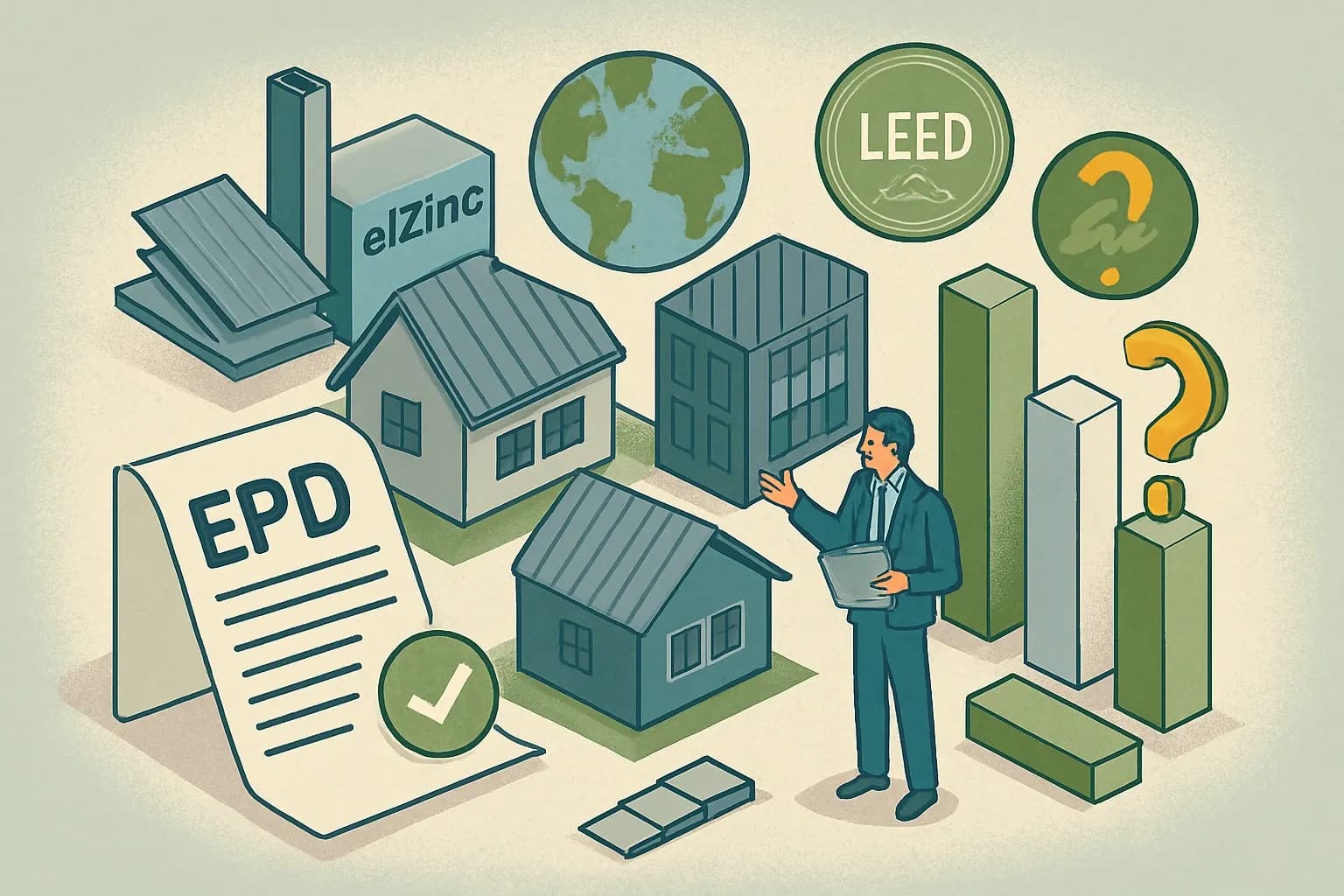
Historically, elZinc published EPDs covering elZinc Natural and the Alkimi range under AENOR’s GlobalEPD. Those declarations show expiry on March 27, 2025, and we could not locate renewed entries live in AENOR’s “in force” list as of December 18, 2025 (AENOR GlobalEPD, 2025).
If those EPDs remain expired, design teams will default to conservative datasets for embodied carbon accounting. That adds friction in bid rooms that score material choices and can nudge a switch to a competitor with an active, product‑specific declaration.
Coverage by product range
A base flat‑rolled zinc EPD normally supports multiple applications because roofing and façade systems are fabricated from the same coils. That means one renewed, A2‑compliant EPD could cover a big share of elZinc’s portfolio in one move. Colored and coated variants like Rainbow may still warrant a distinct declaration if coatings change inventories or impacts meaningfully.
Work for elZinc or competing with them?
Follow us for a product-by-product EPD analysis to uncover which zinc lines get spec'd or VE'd out against RHEINZINK and VMZINC.
Notable gaps that could sting commercially
If Rainbow lacks a current EPD, it is a prime risk. Colored zinc is a frequent short‑list finish on education, cultural, and office projects. When requirements say “product‑specific EPD preferred,” specifiers can reach for functionally similar colored zinc from rivals who keep their declarations current. It is a quiet way to lose a line in the schedule without realizing why.
Who they meet in the spec arena
Frequent likekind competitors include RHEINZINK, VMZINC, NedZink and Zintek. All market product‑specific EPDs for rolled titanium‑zinc families, commonly verified in European programs aligned to EN 15804. Substitute materials in the same design conversations include prefinished aluminum panels and copper sheet, though these change aesthetics and detailing.
A quick word on PCRs and programs
For architectural metals in Europe, EN 15804+A2 rules and program operators like IBU or AENOR are the default playbook. Teams renewing or adding SKUs should align to the current PCR Part A expectations and verification norms so the declaration is future‑proof for cross‑listing and digital use in BIM takeoffs (IBU PCR Part A update, 2024).
What a smart renewal plan looks like
Start with the big movers. One updated EPD for flat‑rolled zinc covering Natural and the Alkimi greys restores broad specability fast. Then decide if Rainbow needs a dedicated EPD due to the organic coating chemistry and mass balance. Prepare data for a full reference year, and consider a prospective approach for any new surfaces already shipping. Coordinate with the chosen operator on mutual recognition so the same verified EPD can appear where customers actually search.
Where to read their sustainability stance
elZinc publishes policies and certifications here, including ISO 14001, ISO 50001 and ISO 14067 carbon footprints for Alkimi and Rainbow, which is helpful context even if it is not a substitute for a verified EPD (elZinc Sustainability).
Why this matters for LEED v5 era bids
Project teams aim to hit carbon targets with product‑specific data. Without an active EPD, they often must apply pessimistic default factors that penalize selection, so zinc without one gets sidelined. A current EPD lets zinc compete on merit, not just price, and can shorten the yes‑no moments in procurement. That is the comercial win.
Closing thought
The material story is strong. Zinc lasts, recycles, and looks great. The paperwork just needs to catch up. A fast renewal covering core coils, then a deliberate decision on coated variants, would make elZinc easier to pick on every shortlist in 2026.