Company snapshot and product range
Caesarstone is best known for premium surfacing aimed at kitchens, baths, healthcare, education, and commercial interiors. The current range spans engineered quartz, next‑gen mineral surfaces with reduced crystalline silica, and large-format porcelain slabs. Across colors, thicknesses, finishes, and slab sizes, the offer likely lands in the hundreds of SKUs.
You can browse their certifications and commitments on the brand’s sustainability pages (Caesarstone Standards & Certifications).
Where EPDs exist today
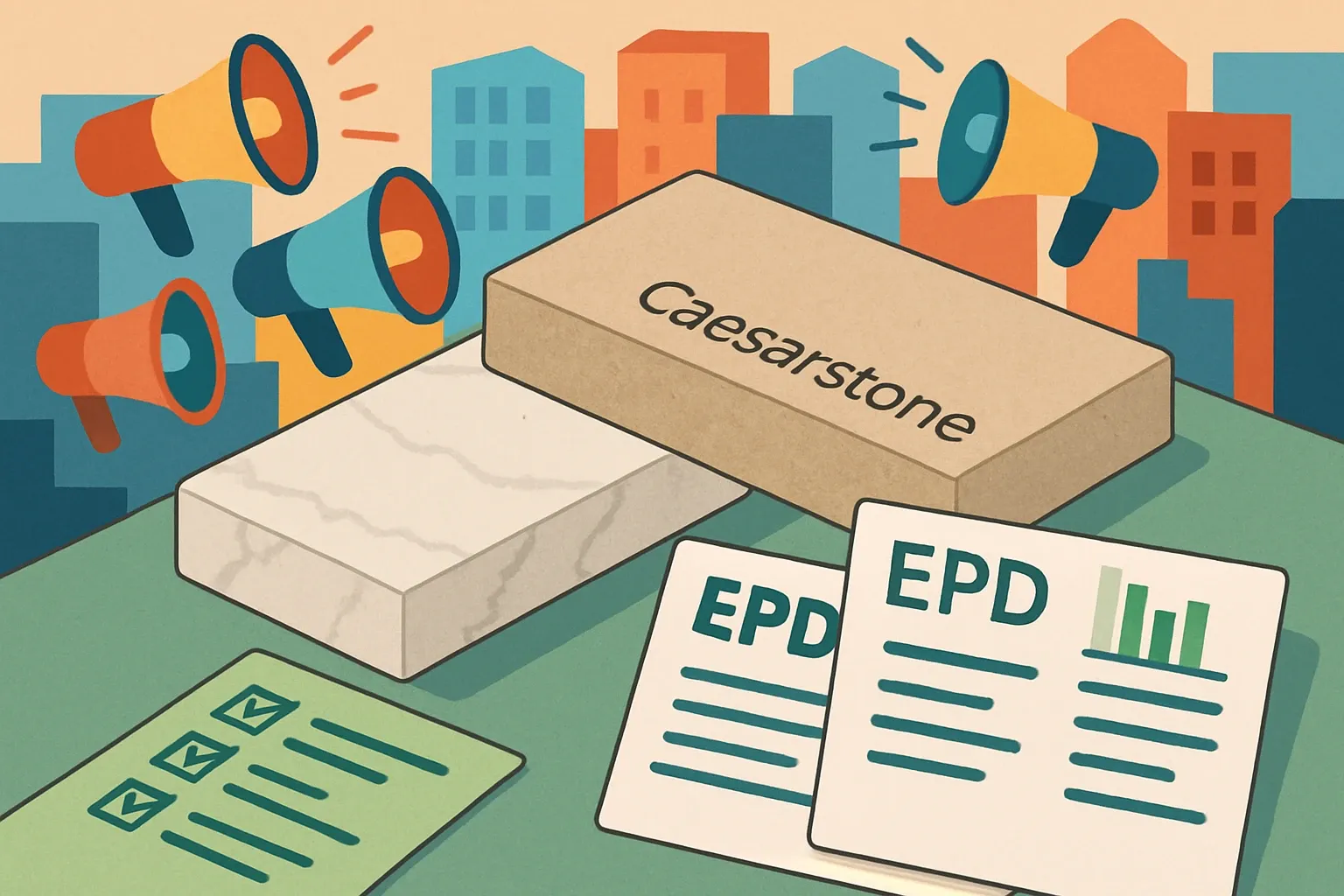
Product-specific EPDs now cover multiple Caesarstone families. The International EPD System lists a Caesarstone Mineral Surfaces EPD published on October 30, 2024, valid to 2029 (The International EPD System, 2024) and an ICON Advanced Fusion Surfaces EPD published on May 21, 2025, valid to 2030 (The International EPD System, 2025 and The International EPD System, 2025). In addition, quartz models produced by strategic partners and the Metropolitan collection have registered EPDs covering defined sets of designs, with validity into 2026 and 2028 respectively (The International EPD System, 2025).
Translation for spec teams. Caesarstone has a real, growing EPD footprint across key series. That footprint appears to be collection based, not yet blanket coverage for every design.
Likely portfolio breadth vs. disclosure breadth
The visual assortment runs deep. Think dozens of distinct designs per material family, plus multiple thicknesses and finishes. EPD coverage, by contrast, maps to specific collections and listed model codes. In practice this means some popular colors may be fully covered while look‑alike siblings are not. Architects care about that difference when a spec calls for an EPD by exact product.
Is your product ready for the spec game?
Follow us on LinkedIn for insights on EPDs that can help you win more tenders and boost your market presence.
Notable gaps to watch
As of December 20, 2025 we did not find a program-operator listing that clearly spans the full porcelain slab lineup. That may change quickly, but it is the gap most likely to stall a fast spefication on projects that require an EPD.
Competitive pressure in common substitutions
When a project needs a hard-wearing slab with an EPD, the short list often includes.
- Engineered stone from Cosentino, where Silestone carries EPDs valid to 2027, and Dekton ultracompact surfaces carry EPDs valid into 2026 (The International EPD System, 2027 and The International EPD System, 2026).
- Solid surface alternatives like Corian have multiple UL program EPDs with validity into 2029, which keeps them specification ready for interiors where acrylic composites work well (UL, 2029).
In real project life, switching between quartz, sintered stone, and solid surface happens when aesthetics are close enough and documentation is cleaner. An EPD can be the tie‑breaker that keeps the original pick.
Why this matters commercially in 2025
LEED v5 and many owner standards favor products with verified, product‑specific EPDs. Submitting without one pushes teams toward pessimistic default factors, which makes your submittal harder to accept. A current EPD shortens review loops and keeps pricing from becoming the only lever in play.
Fastest path to full coverage
Focus first on the highest volume or most frequently specified designs in each family. Target collection EPDs that clearly enumerate those SKUs, then backfill long‑tail colors. Pick a partner who can take on the heavy data collection across plants and bills of materials so your technical teams are not stuck chasing meters and mass balances. The right workflow means months not years to go from kickoff to a published, third‑party verified declaration.
Where this leaves spec teams
If you are writing a countertop or wall panel package today and want Caesarstone, check whether the exact color and thickness is named in one of the published declarations above. If it is, you are in good shape. If it is not, consider a covered sister design, or weigh documented competitors for the submittal window you are in. Either way, having the EPD in hand keeps your project narrative clean and your schedule moving.