
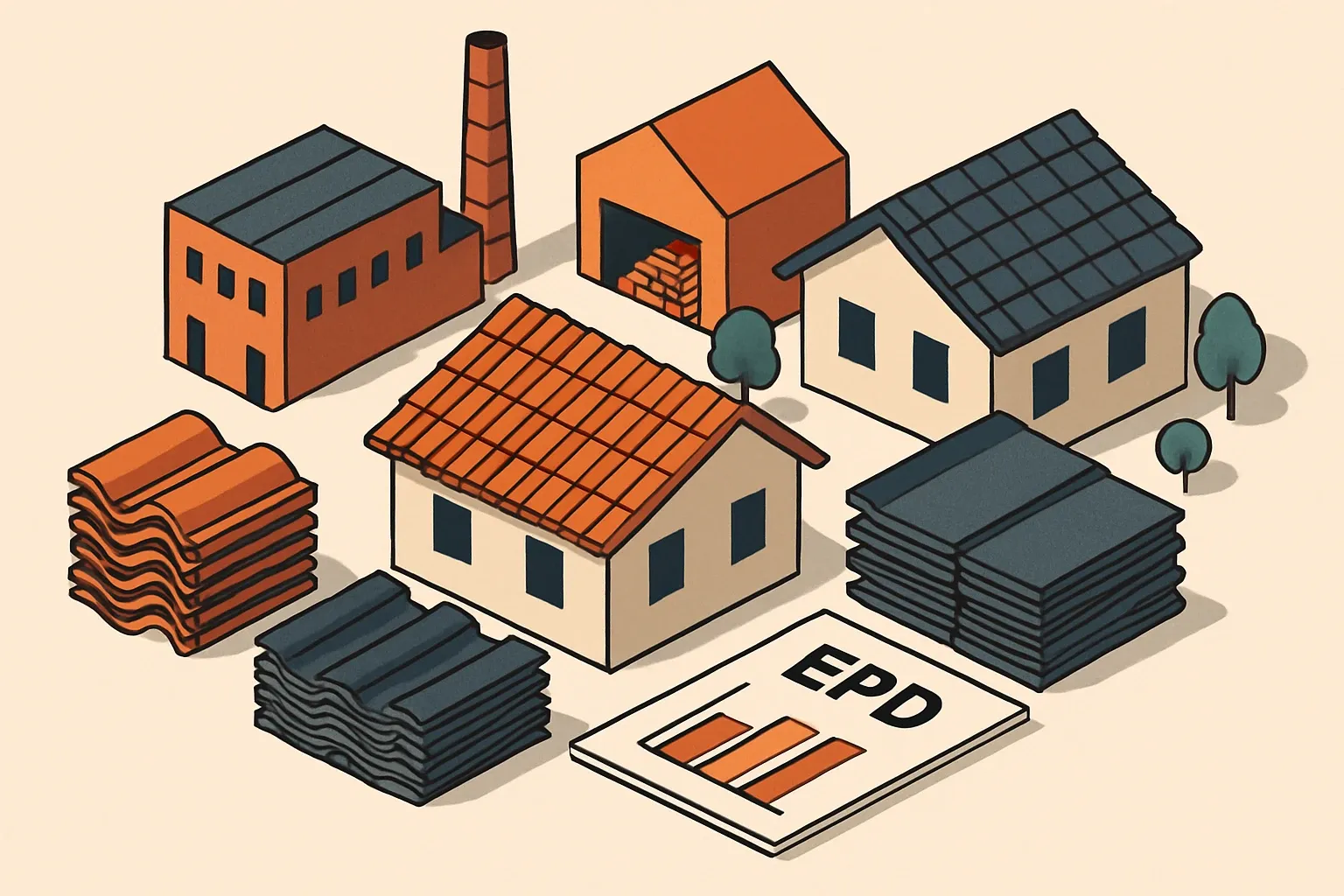
Who Bristile Roofing is
Bristile Roofing is Brickworks’ roofing brand in Australia, focused on clay terracotta and concrete tiles for detached housing and low‑rise projects. Brickworks publishes group sustainability targets and progress, including verified product credentials across other divisions, on its corporate hub (Brickworks Sustainability).
What they sell
The lineup spans classic terracotta profiles like Marseille and Curvado alongside concrete ranges such as 5XL, supported by accessories and technical guides. Between colours, profiles, and state‑specific ranges, the offer runs to dozens of distinct product options and likely into the hundreds of SKUs. Example product pages show detailed dimensions, pack sizes and warranties that specifiers expect, which is great groundwork for an EPD later.
EPD coverage today
We did not find publicly listed, product‑specific EPDs for Bristile roof tiles in major operator libraries as of December 19, 2025. Brickworks, however, does publish multiple EPDs for other product families like concrete pavers and blocks, valid to 2030, which shows the group knows the EPD process (EPD Australasia, 2025). That corporate know‑how should make tile EPDs a fast follow if prioritized.
Why this gap matters commercially
Project teams aiming for disclosure under LEED v5 and owner policies prefer products with third‑party verified EPDs. Without one, designers often have to model impacts with conservative defaults, which can disadvantage products at the point of selection. An EPD does not guarantee a win, but it removes a silent barrier so sales is not competing on price alone.
Work for Bristile Roofing or selling against them?
Follow us for a detailed product-by-product analysis to see which roof tiles get spec'd and where EPD gaps could cost you projects.
A likely bestseller without an EPD, and the alternative specifiers see
Take a flagship terracotta profile like Marseille. It has the aesthetics and longevity that architects love, yet no public EPD means a specifier may substitute a like‑for‑like clay tile with a verified declaration. For example, Marley’s clay roof tiles carry an EPD that reports GWP at 7.05 kg CO2e per square metre and is valid to June 2029 (EPD Hub, 2024). In concrete tiles, there are EN 15804 compliant roof‑tile EPDs valid to 2029 in the European market that teams can reference when benchmarking options (EPD International, 2024). That is the moment when a great Bristile product can be swapped out on a technicality.
Competitors Bristile meets most often
In Australia, Monier from CSR is the day‑to‑day rival in clay and concrete tiles. In export or design‑led projects, European tile brands like Marley and Wienerberger’s Koramic often appear as alternates. Metal roofing and insulated roof panels are frequent substitutes in education, healthcare and industrial settings, with several Australian steel and panel EPDs already public, so the bar is not theoretical. The competitive playing field is moving toward verified data, not just product lore.
How quickly could tile EPDs happen
The rulebook is clear. Tile EPDs commonly use PCR 2019:14 for construction products, with the concrete elements c‑PCR when relevant. Brickworks already publishes to EPD Australasia and EPD International for other lines, so program‑operator familiarity is high (EPD Australasia, 2025). With a clean reference year of plant data, one facility and one flagship tile can launch first, then scale to variants by colour and finish with shared datasets. The fastest teams treat data collection as a managed project so engineers keep building while LCA practitioners do the wrangling.
Where the story gets interesting
Bristile has been piloting lower‑carbon mixes with recycled inputs in full‑scale trials, which is exactly the kind of innovation EPDs make visible and comparable in specs. Locking those improvements into tile EPDs turns a good R&D headline into everyday spec power.
What to do next
Prioritise one hero tile in terracotta and one in concrete. Confirm the go‑to PCR and operator, pick the data year, and align sales on why a verified EPD removes friction in project submittals. Publish, then expand to the rest of the range in phases. It sounds obvious, but speed and completeness here are what win the silent battles in tender rooms.
Bottom line for specability
Bristile is not a niche player. The product depth is there, the warranties are there, and the parent group already publishes EPDs elsewhere. Closing the tile EPD gap is the quickest way to convert brand preference into resilient specification wins. It is also the easiest way to stop losing out on projects that definately prefer verified disclosures.


