What ACS Stainless makes
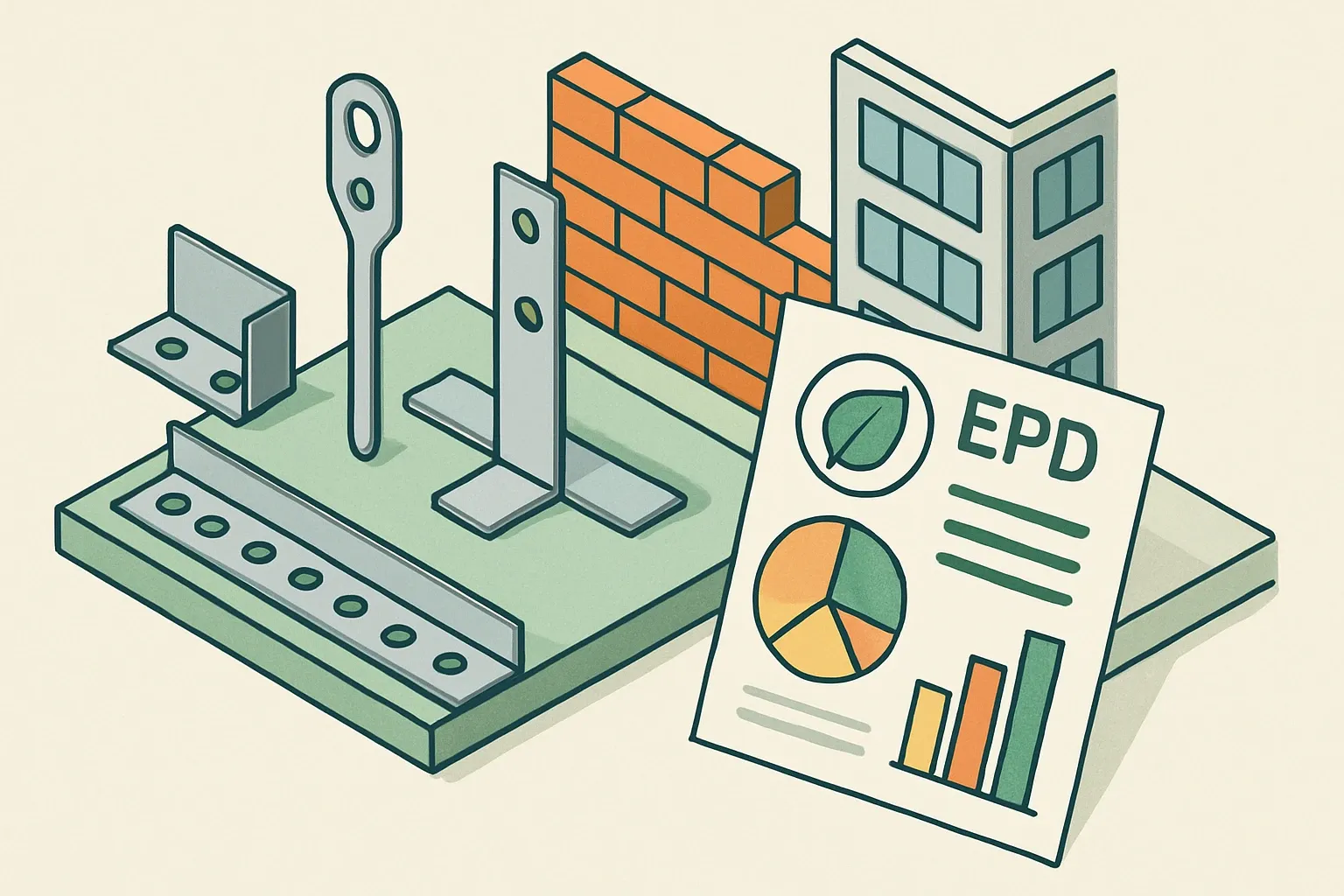
ACS Stainless is best known for stainless steel components used around brickwork and façades. Think masonry support systems, cavity and restraint ties, windposts, angle brackets, and related stainless fixings for modern brick cladding and mixed‑material envelopes.
They sell into commercial, education, healthcare and residential projects where brick or brick slips meet high thermal and structural demands. The kit is typically specified alongside insulation, anchors, and rainscreen assemblies.
Product families and rough scale
Across support brackets, rails, ties, windposts, and accessories, the range spans multiple product families rather than a single hero SKU. The combined catalog likely runs to dozens, possibly hundreds, of distinct SKUs when sizes and finishes are counted. Exact counts are not public, so treat that as directional.
EPD coverage today
We could not locate current, ACS‑branded EPDs in major public registries as of December 20, 2025. If something exists privately or within a distributor bundle it was not plainly visible. That creates a simple commercial problem on projects that prefer product‑specific, third‑party verified EPDs, because specifiers often default to conservative carbon assumptions when a product lacks one.
Work for ACS Stainless or selling against them?
Follow us for a product-by-product competitive analysis that reveals which masonry support and wall tie products get spec'd and where EPD gaps impact your positioning.
Why that matters at bid time
On jobs aiming for low‑carbon goals or LEED v5 alignment, products with their own EPDs are easier to compare and approve. Without one, teams face penalties from generic factors, which increases the chance a like‑for‑like item with an EPD stays in the submittal while yours gets swapped late in the game. No one wants a value‑engineer surprise two weeks before pour, it hurts margins and schedule.
A first EPD target worth prioritizing
If ACS is choosing where to start, masonry support systems or wall ties are strong candidates. They are high‑volume, technically differentiated, and central to brickwork packages, which makes them frequent decision points in submittals. An EPD here would lift the whole range by removing doubt for the core use cases.
Who ACS competes with on site
Expect frequent head‑to‑heads with Leviat brands such as Ancon in masonry support and ties, plus IG Masonry Support in bracketed brickwork systems. In the wider envelope package, anchor and fixing alternatives from Fischer and Hilti often ride in the same specification conversations, especially where a GC or façade engineer wants to consolidate suppliers.
Several of those adjacent products already carry EPDs, for example injection mortars from Fischer with validity into 2029 ([IBU, 2029](https://ibu-epd.com)) and self‑drilling screws and firestopping lines from Hilti with EPDs listed into 2030 ([EPD Hub, 2030](https://www.epdhub.com)). These are not one‑for‑one substitutes for masonry support, yet they shape expectations on documentation across the envelope package.
The commercial upside of closing the gap
A product‑specific EPD reduces friction in pre‑con and submittals, shortens back‑and‑forth with sustainability teams, and protects specification when carbon accounting tightens. The price of producing one is frequently dwarfed by a single mid‑size win that would otherwise slip due to paperwork, not performance. That is the quiet ROI many teams miss because they never see the bids they almost won.
Getting it done with less internal drag
The heavy lift is never the modeling, it is the data wrangling across plants, utilities, yields and scrap, then mapping the right PCR used by peer products. A partner that handles collection end‑to‑end, aligns the PCR with your competitive set, and publishes with the operator your market prefers, will get you to a dependable EPD quickly while R&D and ops stay focussed on throughput. Move one flagship line first, then roll lessons learned across the rest. It is definately doable in a tight calendar.
Bottom line for ACS watchers
ACS has a broad, spec‑heavy stainless portfolio and strong brand recognition in brickwork. Their biggest near‑term lift is simple, publish credible EPDs for the masonry support or wall tie families, then expand. Doing so meets where the market is heading, protects margin during substitutions, and keeps the product judged on performance rather than paperwork.