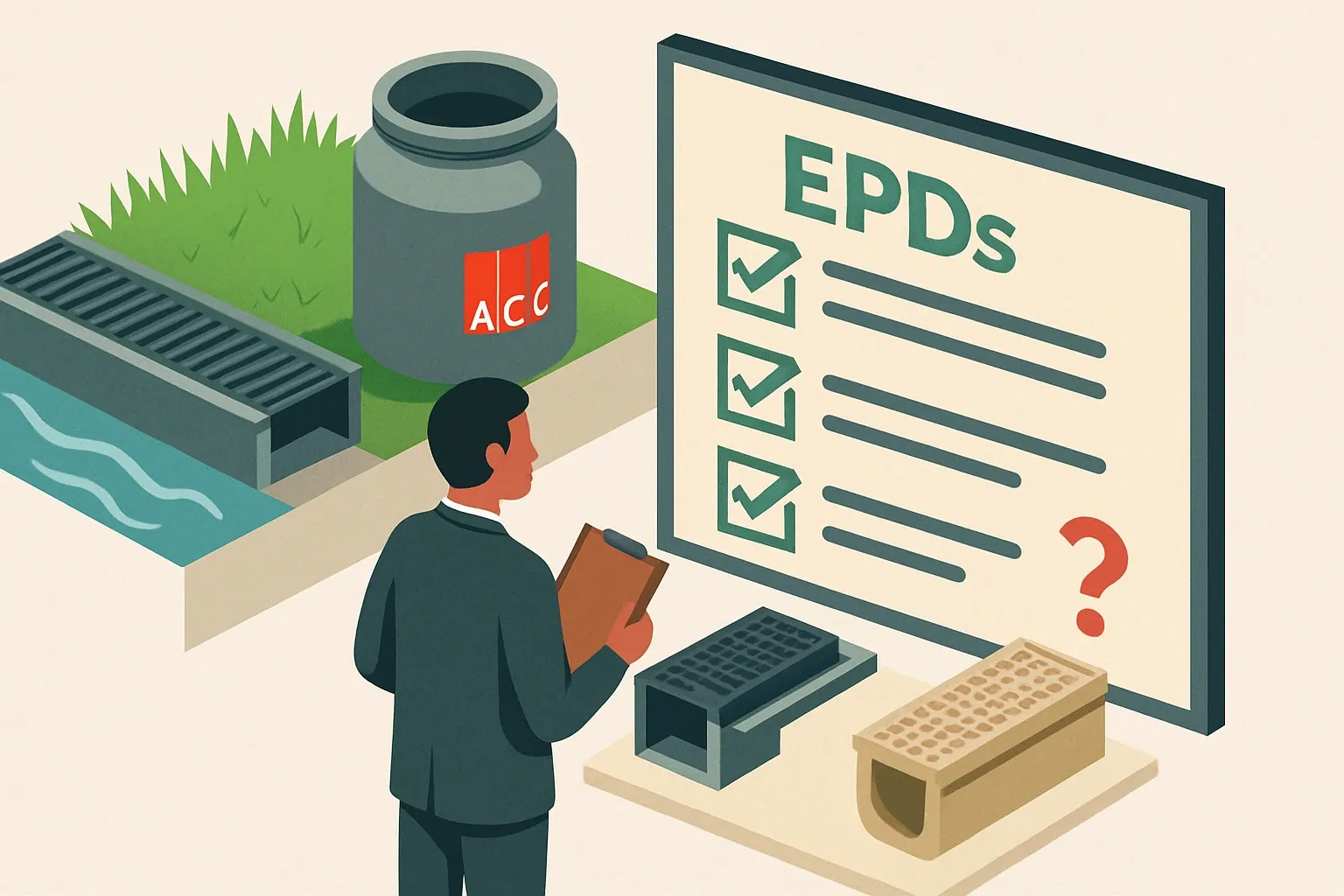
ACO Environmental at a glance
ACO Environmental represents ACO’s industrial and civil offer around surface water and pollutant management. Think polymer concrete trench drains, slot and grate systems, stainless steel building drainage, stainless steel push‑fit pipe, oil and light‑liquid separators, grease management, stormwater storage and treatment modules, plus access covers. They operate alongside other ACO business lines in Australia and the US with overlapping ranges for civil, food and beverage, and architectural landscapes.
Product ranges and rough breadth
Across the public sites serving Australia and North America, we see eight to ten distinct product categories and easily hundreds of SKUs when sizes, grates, load classes and accessories are counted. The civil side skews toward polymer concrete and FRP trench solutions with heavy‑duty grating. Building drainage leans stainless across channels, gullies and pipe. Stormwater includes geocellular storage, oil‑water separation and ancillary quality devices. It is a broad catalogue rather than a single‑product pure play.
Where EPDs show up today
ACO publishes EPD materials in parts of Europe covering items like hygienic channels, floor drains, ACO Pipe stainless steel, covers and polyethylene separators, visible via ACO Belgium’s EPD download hub. That signals corporate ability to field verified EN 15804 declarations in multiple lines. For Australia and the US portfolios that map to acoenvironmental.com’s scope, public program‑operator EPDs are not consistently listed across trench drains, polymer concrete channels or geocellular stormwater pages as of December 2025. The picture looks partial and geography‑dependent rather than empty.
Notable gaps worth closing
If we rank by spec frequency, polymer concrete trench drains and heavy‑duty grating are prime candidates. They appear widely in streetscapes, transport, distribution and industrial pavements, yet we do not see a unified, public EPD set for these lines in AU or US listings. Oil‑water separators are another likely win where a single product‑specific EPD can unlock recurring civil specs. Stainless building drainage also merits coverage where projects chase hygiene credentials alongside embodied‑carbon reporting.
At ACO Environmental or competing against them?
Follow us for product-by-product EPD insights to see which trench drains and separators get spec'd and where gaps could cost you bids.
Why the gaps matter now
LEED v5 is live for BD+C and ID+C with member ratification dated March 28, 2025, and it elevates materials transparency within a consolidated BPDO framework. Teams can earn credit with product‑specific, third‑party verified EPDs, and most large owners treat EPDs as the default document of record for embodied‑carbon math. That changes shortlists. If a specifier cannot plug in a product‑specific EPD, they often use conservative generic factors, which hurts competitiveness on carbon‑screened bids. (USGBC, 2025)
Competitive set and who already brings EPDs
On outdoor trench drains and channels, ACO frequently meets Zurn Elkay, ABT, MEA and local stainless fabricators in project alternates. In building drainage for food and beverage, BLÜCHER is a regular stainless competitor. In stormwater storage, geocellular and chamber systems put ACO up against Atlantis and ADS. At least one nearby rival in the Australian linear drainage niche, Stormtech, publishes Global GreenTag‑verified EN 15804 EPDs for stainless linear systems, which can tip indoor fit‑outs and hospitality toward the EPD‑visible option.
A practical play: cover the likely best‑seller without an EPD
Take a workhorse polymer concrete trench drain series with multiple widths and load classes. It is almost certainly a top revenue contributor across car parks, logistics aprons and streetscapes. Without a product‑specific EPD, that line risks losing out whenever councils or corporate campuses ask for documented embodied‑carbon data at product level. Meanwhile, specifiers comparing stainless linear drains for interiors can already point to a competitor with a published EPD, so parity there matters too.
What great EPD execution looks like here
Aim for product‑specific EPDs that group logically by family and width to keep publication lean while covering the majority of sales. Pick PCRs that align with the competitive norm so your numbers are comparable at bid time. Make data capture painless for plant teams, publish with a well‑recognized operator, and surface the PDFs on range pages, submittal packs and BIM objects. That keeps sales from getting stuck in document hunts on deadline. Done right, even one mid‑sized project win repays the effort quickly. We see teams loose weeks when they cannot find a verifiable PDF.
Sustainability posture you can reference
ACO communicates a broad corporate stance around materials durability, recyclability and water stewardship. If you need corporate context in tenders, start here: ACO Sustainability.
What we would prioritize next
- Publish product‑specific EPDs for two polymer concrete trench families that span most widths and load classes. That maximizes spec coverage for civil projects with minimal document sprawl.
- Add a stainless building‑drainage EPD covering a common channel and gully set for hygiene‑sensitive interiors. That neutralizes a visible competitor talking point in fit‑outs and F&B.
- Follow with an oil‑water separator EPD sized to typical council and depot flows. Civil consultants will use it repeatedly once it appears in their templates.
Final take
ACO Environmental’s portfolio is built for specification. EPD visibility simply has to catch up to the breadth of the range in AU and the US. Start with the trench SKUs that show up on almost every civil drawing, then cover stainless building drainage and a separator. That sequence aligns to how projects buy, and it reduces friction where LEED v5 and client carbon policies now steer material choices. (USGBC, 2025)