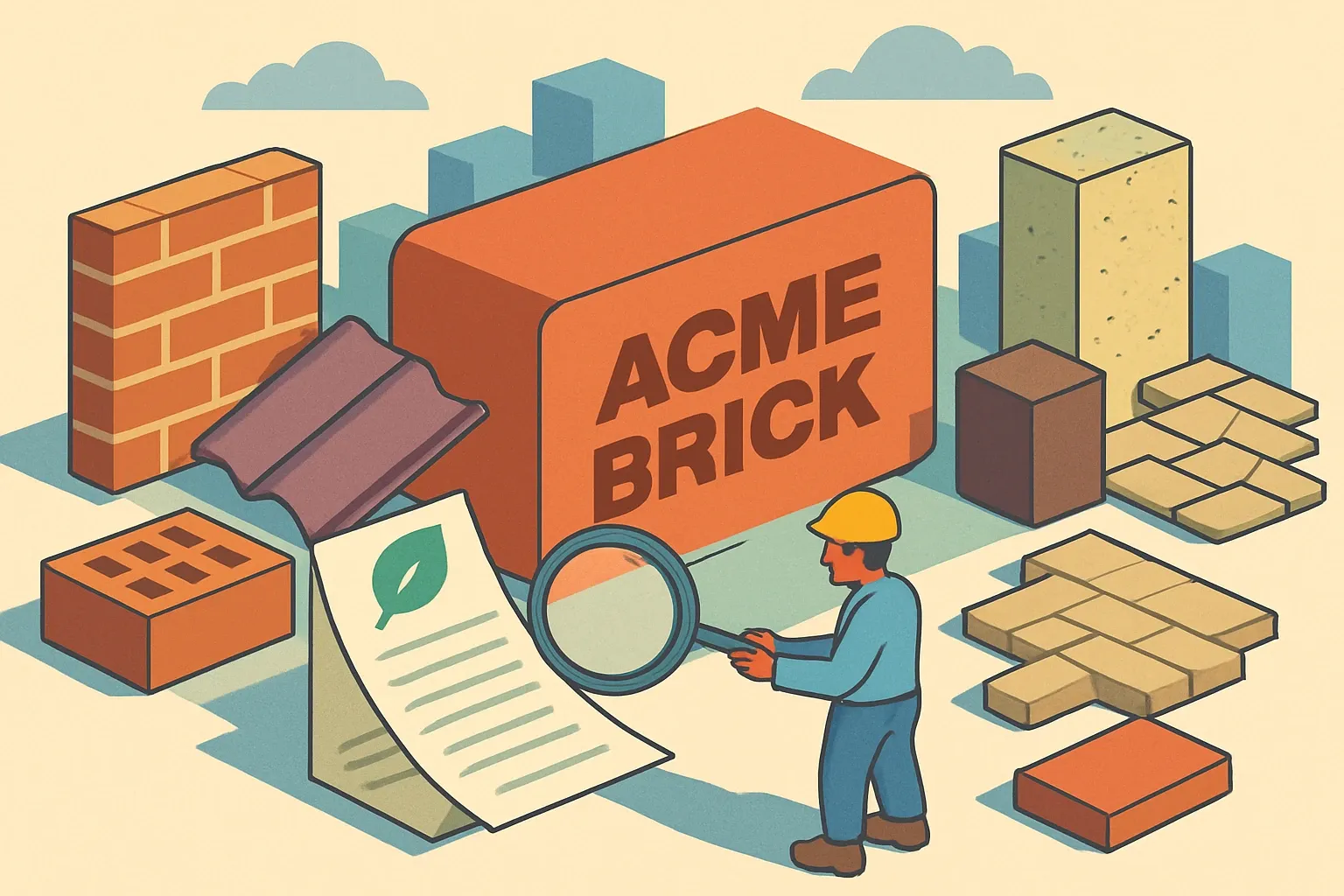
Who Acme Brick is
Founded in 1891 and now part of Berkshire Hathaway, Acme Brick manufactures clay brick and distributes a broad mix of masonry and facade materials across the U.S. Their reach spans residential and commercial work, from subdivisions to healthcare campuses.
What they sell
Acme is best known for face brick, but the shelf is wider. Expect thin brick lines, glazed thin brick, clay pavers, select CMU, natural and manufactured stone veneer, porcelain and ceramic tile, and ventilated facade systems sourced from partner brands. The active assortment runs to many hundreds of individual SKUs across roughly ten product families.
EPD coverage today
Acme publishes and points specifiers to the Brick Industry Association’s U.S.–Canada industry‑average EPD for clay masonry products. The latest version is cradle‑to‑grave, valid November 7, 2025 through November 7, 2030, and lists participating manufacturers that include Acme (NSF, 2025) (NSF, 2025) and (BIA, 2025) (BIA, 2025). Acme’s own site routes to this document and hosts a Health Product Declaration for clay brick, which helps on transparency checklists (Acme EPD & HPD).
Where the gaps sit
We did not find plant‑ or product‑specific Type III EPDs publicly attributed to individual Acme brick lines as of December 19, 2025. That means coverage hinges on the industry‑average document. For non‑brick items Acme distributes, EPDs typically come from the original brand owner, not Acme, so spec acceptance varies by product family and program operator.
Why that matters on submittals
Under LEED v4.1, product‑specific Type III EPDs with external verification are weighted as 1.5 products toward the BPDO‑EPD count. Industry‑wide EPDs count as 1.0 product, which is solid but not the multiplier many design teams aim for in tight schedules (USGBC Credit Library, 2024) (USGBC, 2024). LEED v5, ratified March 28, 2025, keeps disclosure while leaning harder into embodied‑carbon performance across the bill of materials, so published EPDs remain the ticket to entry as teams optimize specs at scale (USGBC, 2025).
Work for Acme Brick or selling against them?
Follow us for a product-by-product EPD analysis to see which SKUs get VE'd out against Glen-Gery or General Shale.
Best sellers most exposed
High‑volume face brick and house‑brand thin brick lines are the ones most likely to be value‑engineered off a shortlist when a project team is counting product‑specific EPDs. A school district or healthcare owner chasing points or internal carbon targets will prefer SKUs with that 1.5 weighting. Acme have deep color and texture variety, yet if equivalents from a competitor carry product‑specific EPDs, the submittal math nudges against them.
Who Acme competes with a lot
In face and thin brick, the regular cast shows up on bid lists:
- Glen‑Gery
- General Shale
- Belden Brick
- Triangle Brick
- Pine Hall Brick
- US Brick
Many of these manufacturers also appear as participants in the 2025 BIA industry‑average EPD, so the baseline disclosure is common across the category (BIA, 2025) (BIA, 2025). Where spec battles are decided is the presence of product‑ or plant‑specific EPDs for popular ranges.
Commercial upside of closing the gap
Product‑specific EPDs reduce friction in substitutions and simplify the tally for contractors and sustainability consultants. That can shorten decision cycles and protect price when alternatives look similar. Even one mid‑size project can return the investment in documentation, since being EPD‑ready means your SKUs are eligible on more jobs without last‑minute scramble.
A pragmatic playbook for Acme’s catalog
Start with top sellers and the geographies that see the most LEED‑active work. Pick a recent reference year, standardize utility and raw‑material pulls across priority plants, and align on the most commonly used PCR for clay brick so results are comparable to competitors. For thin brick and glazed thin brick, confirm whether a separate PCR path is needed, then mirror the workflow. Keep the industry‑average EPD in the kit for coverage while product‑specific files come online. And publish with a widely recognized program operator so project teams can verify quickly.
Where to learn more
Acme maintains a short EPD and HPD resource page that is easy to hand off to architects and GCs. It’s a good place to point a customer while you prepare a deeper submittal package (Acme EPD & HPD). If you’re bidding a project with LEED v4.1 or v5 goals, confirm exactly which EPD types the spec counts as multipliers. That small check avoids rework becuase the wrong file type was attached.
The takeaway
Acme’s breadth is an asset. Converting the highest‑velocity brick and thin brick lines to product‑specific EPDs would lift specability where it counts, while the BIA industry‑average EPD continues to cover the rest for general disclosure needs (NSF, 2025) (NSF, 2025). In a category where many brands look comparable from 30 feet away, the documents behind the sample board often decide who gets installed.