Where an industry‑wide EPD exists today
North America. The North American Insulation Manufacturers Association (NAIMA) has industry‑wide EPDs for mineral wool insulation categories such as heavy‑density board, light‑density board, and loose‑fill, independently verified by UL Solutions. You can start from NAIMA’s announcement hub and follow through to the documents. (Insulation Institute/NAIMA)
Europe. In Germany, the Fachverband Mineralwolleindustrie e. V. (FMI) publishes association EPDs for stone wool across density ranges with IBU as the program operator, aligned to EN 15804+A2. These are widely used as conservative sector references. (FMI, association EPDs)
What these “sector average” EPDs actually represent
Think of an industry‑wide EPD as the class average on a test. It aggregates primary data from multiple manufacturers, then a program operator verifies the result against the relevant PCR. Useful for early design and for whole‑building LCAs when no product is picked. Conservative by design, since they must represent a typical plant and supply mix, not a best‑in‑class line.
A quick reality check on carbon numbers
When teams model envelopes, they often ask what numbers to plug in before a product is chosen. The Carbon Leadership Forum’s 2025 North American baselines point to the following industry‑average values derived from the latest EPDs. Heavy‑density mineral wool board is about 6.82 kg CO2e per m² at RSI 1, light‑density blanket around 2.68, loose‑fill around 1.89. These are credible defaults for early LCA work. (Carbon Leadership Forum, 2025) (CLF, 2025)
Why a product‑specific EPD usually wins more specs
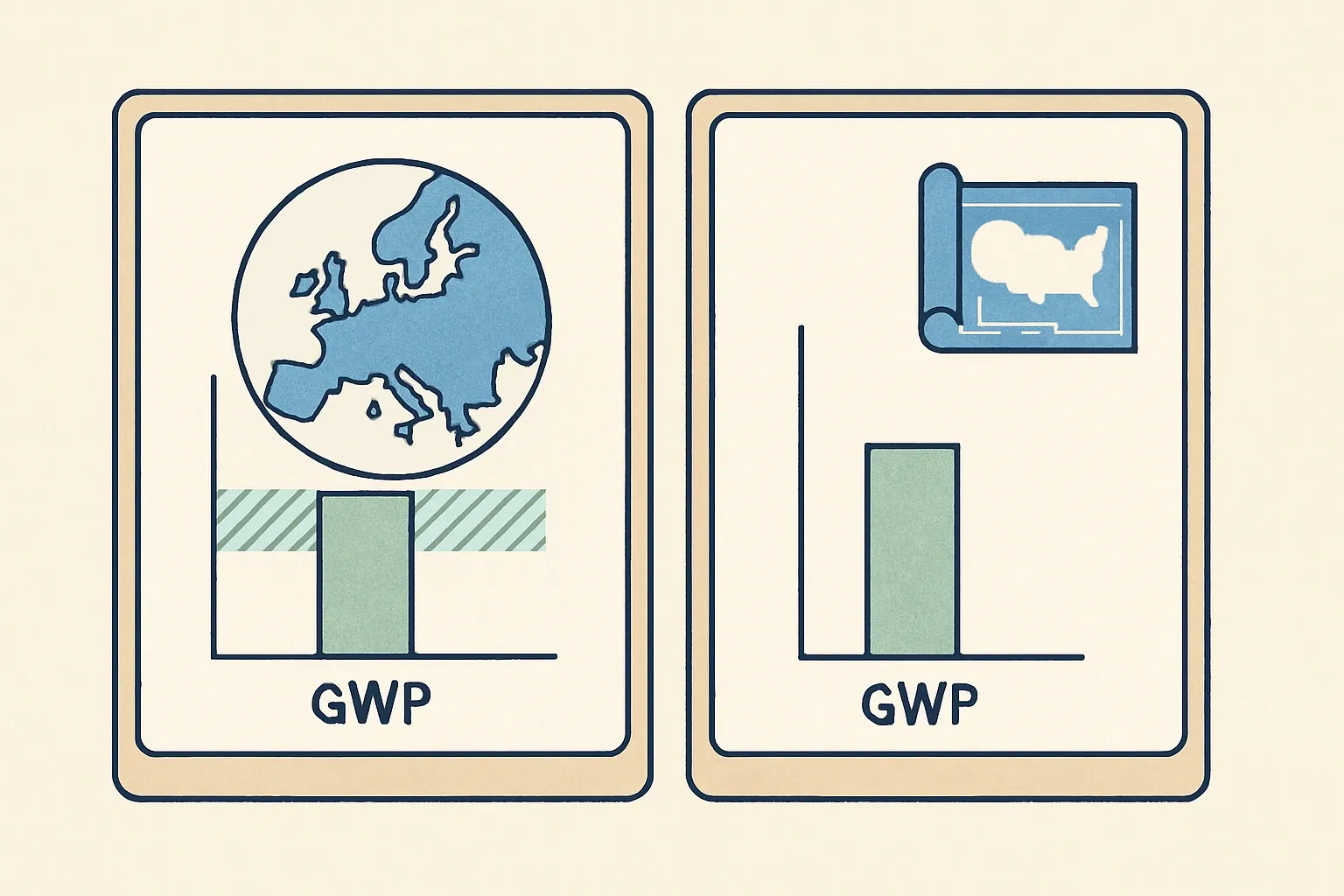
Specifiers increasingly compare declared unit GWP side by side. If a product‑specific EPD beats the sector average, it often clears low‑carbon thresholds and earns preference without resorting to price. Industry‑wide values are safe placeholders, yet they rarely capture plant upgrades, higher recycled content, cleaner fuels, or optimized logistics that your operation already delivers.
Put simply, the sector average is the starting grid. A strong product‑specific EPD lets you start closer to the finish line, and it tends to pay back fast on even one mid‑sized project. ROI figures vary by market and channel, so reliable averages are scarce, but most teams report the commercial impact as manyfold of the EPD effort.
Are you leveraging industry-wide EPDs for competitive advantage?
Follow us on LinkedIn for insights on maximizing your specifications and driving ROI.
Who is behind the sector documents
- Data owners. Trade associations coordinate participants, collect primary data, and set eligibility rules.
- Rulebook. Product Category Rules for thermal insulation govern scope, declared units, system boundaries, and allocation.
- Verifiers and operators. UL Solutions, IBU, and EPD International AB frequently appear on mineral wool insulation EPDs, providing third‑party verification and publication.
Regional links you can bookmark
- North America, industry‑wide mineral wool EPDs, via NAIMA’s Insulation Institute hub. Useful entry point to the current UL‑verified PDFs.
- Germany and EU market, association EPDs for stone wool via FMI with IBU. Clear mapping to EN 15804+A2.
If a national or regional association has not issued one, project teams typically fall back to a related industry average or to a conservative database default, which can be higher than your real performance.
Competitors already publishing product‑specific EPDs
Many mineral wool producers now publish product‑specific EPDs. A few examples across regions, focused on mid‑sized or specialist players:
- Bonus by Eryap Group, Turkey. Stone wool EPDs published with EPD International AB.
- ODE Insulation, Turkey. Multiple mineral wool blanket and board EPDs with EPD International AB.
- Paroc, Nordics and EU. Stone wool insulation EPDs published with EPD Norway.
- Saudi Rock Wool, Saudi Arabia. Mineral wool boards and blanket EPDs published with SCS Global Services.
These examples signal that peers are moving beyond sector averages. If your line performs better than the industry‑wide value, a product‑specific EPD makes that advantage visible.
How to decide your next move
Start with three questions. Do your current processes likely beat the sector average on A1 to A3. Do key customers face low‑carbon bid screens or owner thresholds on envelope materials. Do you sell into markets where LEED v5 and procurement policies reward product‑specific, third‑party verified declarations. If the answers lean yes, a product‑specific EPD is the smarter play.
Great partners minimize the internal lift by structuring data pulls around a clear reference year, aligning to the common PCR, and project‑managing reviews with the program operator of your choice. That means your R&D and plant teams stay focussed on making product, not wrangling spreadsheets.
Bottom line for mineral wool manufacturers
Yes, an industry‑wide EPD for mineral wool insulation exists in North America and parts of Europe, and it is a useful, conservative benchmark. If your product can outperform that benchmark, a product‑specific, third‑party verified EPD will help you get specified more often and protect margin. Waiting on the sector average might feel safer today, but it often leaves money on the tabel tomorrow.