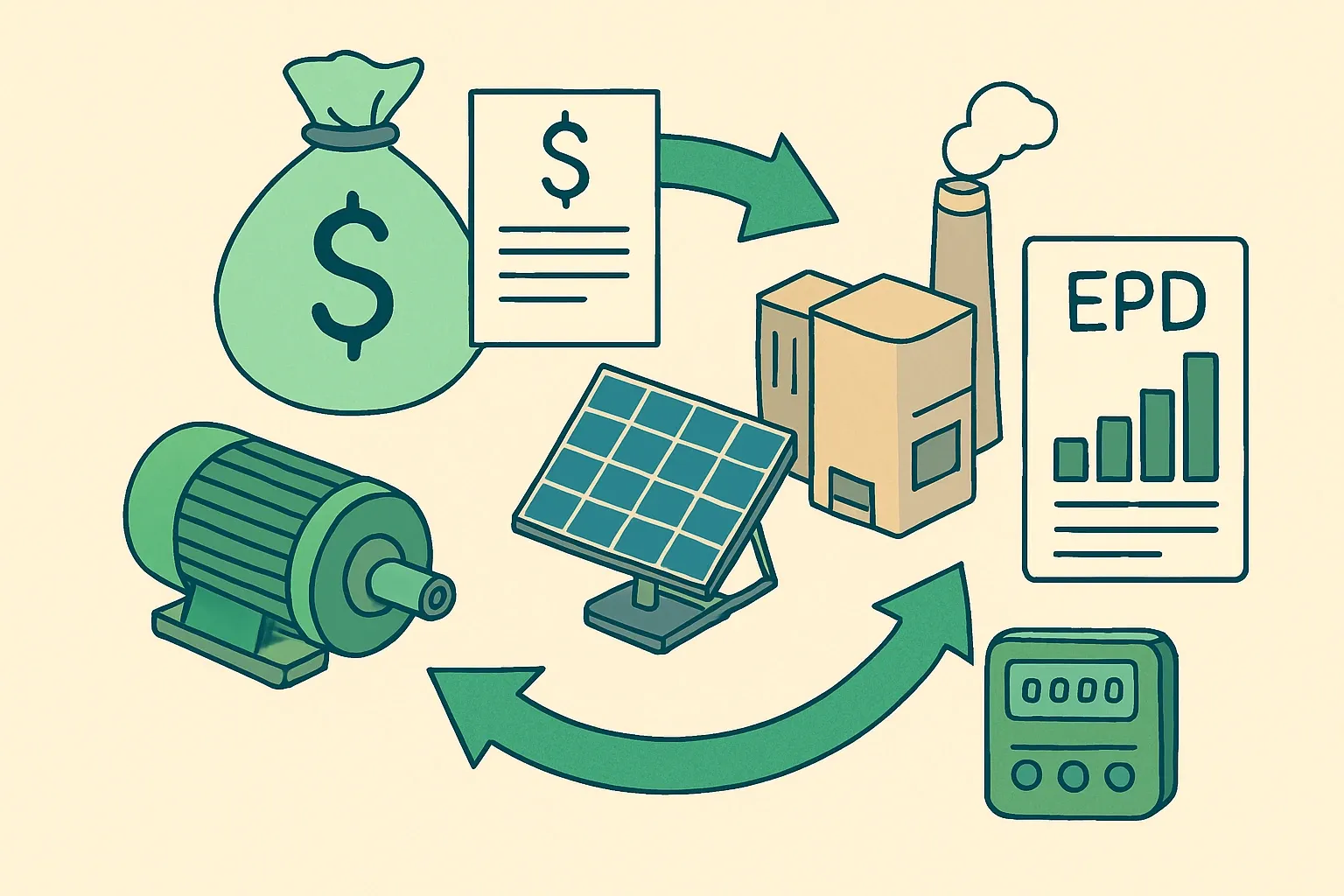
Why energy projects can move your EPD needle
Electricity and fuel still dominate many A1–A3 footprints. The U.S. national delivered electricity rate is roughly 0.394 kg CO2 per kWh using 2022 eGRID data with losses included (EPA Equivalencies Calculator, 2025) (EPA, 2025). Direct natural gas combustion averages about 117 lb CO2 per MMBtu, or 53 kg per MMBtu (EPA, 2024) (EPA Household Calculator Assumptions, 2024). Cut energy intensity and those numbers flow directly into product GWP.
Grants and incentives are shifting, not disappearing
Federal policy moved in early 2025, yet state and utility programs remained active and grew in 2023. Utility‑funded efficiency investment hit a record 8.8 billion dollars in 2023, with 6.9 billion electric and 1.9 billion gas efficiency spending (ACEEE, 2025) (ACEEE State Energy Efficiency Scorecard, 2025). States with formal Efficiency Resource Standards delivered 82% of total U.S. utility efficiency savings despite covering 59% of the population (ACEEE, 2025). Those dollars can underwrite the metering and verification you need for a stronger EPD.
Pick an EPD reference year, then design the M&V around it
An LCA uses a defined reference year for utilities, volumes, and waste. Put a stake in the ground early. If your project lands mid‑year, set a plan to capture a clean pre‑period and a clean post‑period that align to the EPD reference year. Avoid split baselines that force a verifier to guess. Future‑proof the schedule by locking when the EPD model will freeze and when the verification window opens.
Meter once, use twice
Think of metering as a director’s cut that lets your verifier watch the improvement happen. Prioritize system boundaries that mirror your LCA model so savings drop into A3 without heroics.
- Submeter major energy users tied to product families, not just the whole plant.
- Log electricity by source type where relevant to the EPD (grid, on‑site solar, contracted RECs) and keep REC serials separate from metered kWh.
- Track thermal fuels by process line with higher‑heating‑value basis and calibration certificates.
- Record production volumes, scrap, rework, and uptime with the same cadence as energy logs.
- Save utility bills, interval data exports, BMS trend files, and commissioning reports in a verifier‑friendly archive.
Use recognized M&V methods so evidence lands
DOE’s FEMP M&V Guidelines v5.0 keeps the familiar Options A through D. Pick the option that matches risk and complexity, then stick to it. For a VFD or compressor swap, an isolation method with spot‑metered power can be enough. For plant‑wide controls, whole‑facility with weather and throughput normalization is safer. Verifiers are not interested in custom math tricks; they want traceable calculations, versioned spreadsheets, and clear variable controls.
Want to unlock EPD-driven revenue opportunities?
Follow us on LinkedIn for insights on turning EPDs into your competitive advantage and boosting your bottom line.
Translate operations into LCA inventory changes
A project changes more than a meter reading. Update the LCA foreground to reflect:
- Fuel switching that changes emission factors and upstream transportation.
- Load shifting that alters grid mix timing if your PCR or model treats time‑of‑use.
- Maintenance effects that cut scrap or rework rates.
- On‑site generation boundaries so you avoid double counting with RECs. Get this mapping wrong and you leave impact reductions on the table. Or worse, you create a verifier objection that slows publication.
Align PCR expectations with your evidence
Different PCRs treat allocation, energy quality, and cut‑off rules differently. Before you install, confirm whether the target PCR favors mass or economic allocation, whether low‑carbon electricity can be market‑based, and how to disclose renewable attributes. A smart plan picks the metering and document set that answers those rules without acrobatics.
Document like a skeptic will read it
EPDs are audited documents. Keep a one‑folder narrative that includes the project scope, baseline definition, measurement plan, commissioning results, raw data extracts, and the exact calculation chain used in the LCA. Add photos of meters with serials and timestamps. It sounds fussy, but it makes verification boring in the best way. And boring is fast.
Make the ROI story obvious
Grant dollars reduce capex pain. Efficiency lowers operating expense. A better EPD sharpens your position in low‑carbon specs and LEED v5’s embodied‑carbon focus. Tie those three into one page: award amount, verified annual kWh or MMBtu reduction, resulting kg CO2 per unit change using published factors, and the commercial plays that open up. Where numbers are scarce, say so plainly rather than round up to magic.
Common pitfalls to avoid
- Letting finance pick a project close date that chops your EPD year in half.
- Treating RECs as the same as metered on‑site generation in the inventory.
- Forgetting that new control sequences change production rates, which shifts allocation.
- Waiting until LCA kickoff to hunt for data. By then, meters have been overwritten.
The quiet advantage of white‑glove data collection
Most teams can model. Few want to chase interval data at 2 a.m. A partner that shoulders the metering plan, normalization, and document control lets engineers focus on running the plant. That is how energy projects become verified inventory changes quickly, not just internal success stories. It’s definately the calmer path.
Thread it all together
Start the EPD reference year clock when the project scoping starts. Choose M&V that a verifier already speaks. Capture pre‑ and post‑ data at the process level. Carry the evidence into the LCA model without translation losses. Then publish the improved EPD while the grant press release is still fresh. That is how capital upgrades become market advantage, not just lower utility bills.