The spec scramble, solved
Most manufacturers carry hundreds of SKUs and regional variants. One RFQ asks for compressive strength. The next asks if PFAS appear above a threshold. Without a system, people hunt for files while the project moves on. An AI product intelligence layer makes the search invisible and gives the sales rep an answer that is precise, sourced, and ready to paste into a submittal.
What a product intelligence layer actually is
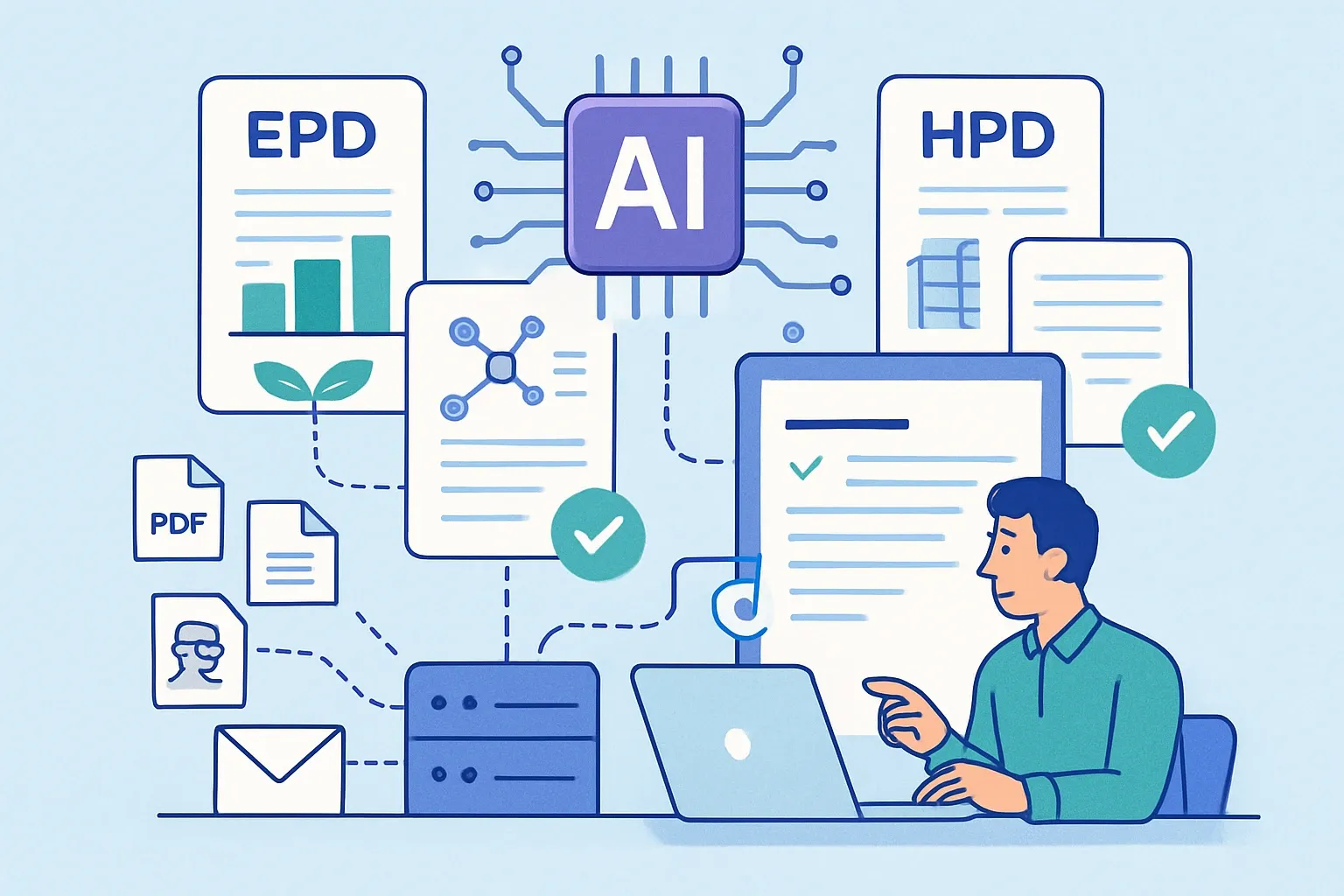
Think of it like a librarian, not a chatbot. It parses product data sheets, safety data sheets, EPDs, HPDs, test reports, and certifications. It stores clean fields such as product family, plant, mix design, PCR used, verification method, and expiry or review dates. Retrieval then pulls only from approved records and returns an answer with the exact file name and page reference.
Governed library first, open web second
Set a simple rule. Questions are answered from a governed, curated library by default. Web research is a separate route with an allow list of sources and a stop list for competitor mentions. If the trusted library lacks an answer, the system either routes to the allowed sources or gracefully says no. That single fork avoids hallucinations and keeps reviewers comfortable.
Controls that keep sales out of trouble
The best setups include three gates. First, a source allow list by domain and document type. Second, a policy on naming competitors, so answers compare against classes of products unless the buyer explicitly requests brands. Third, answer templates that format to the buyer’s spec section, including CSI code, test method, declared unit, and linkable citations. The team moves faster and keeps legal calm.
Why the answers are trustworthy
Trust comes from page level citations and standards alignment. For construction EPDs, program operators updated their default indicator lists to align with EN 15804 A2 and EF 3.1 characterization factors, so the model must pull the same indicators and names from your declarations (EPD International, 2024). When PCRs update, the system should flag which products need rework. For example, PCR 2019:14 v2.0.1 is valid until April 7, 2030, which sets a clear horizon for many construction materials (EPD International, 2025).
Want to turn EPDs into revenue-generating assets?
Follow us on LinkedIn for insights that help you unlock tenders and boost your bottom line.
Bundling EPD and HPD generation supercharges sales
If the same platform and team create your EPDs and HPDs, the model learns once from controlled master data. That means a banned substance question is answered with the official HPD version and a link to the repository record. Scale matters here. The HPD Public Repository lists over 13,000 published HPDs, which signals broad market adoption and buyer familiarity (HPD Collaborative, 2025).
A day in the life, AI on your shoulder
Picture the rep on a hyperscaler bid. They ask, “Show the GWP total for the 4,000 psi mix, Georgia plant, and the PCR used.” The system returns the EPD file, page reference, GWP total, the PCR title, program operator, and verification type. Next question. “Confirm the HPD screens for LT‑1 hazards and PFAS.” It returns the HPD record, version, screening scope, and a buyer friendly sentence. Minutes, not hours.
Guardrails that seperate toy from tool
Here is what we consider table stakes for production use:
- Page level citations into every answer, with file and page. If a buyer cannot click to verify, it does not ship.
- A permissions model that hides restricted drafts and marks obsolete versions as read only.
- A policy engine for allowed sources, banned terms, and answer length. The guardrails is simple to explain and easy to audit.
How the data pipeline works under the hood
Ingest parses PDFs and spreadsheets into structured fields and chunks for retrieval. A validator checks dates, declared units, PCR version, and plant tags. A router decides governed library or allowed web. Generation assembles a response from only cited chunks, then a formatter puts it into spec language. A final checker ensures no unauthorized competitor names appear. Humans recieve an answer with citations and a one click submittal pack.
Formatting answers buyers actually use
Great systems return exactly what a reviewer wants to see. For EPDs, list declared unit, standard, program operator, PCR reference, version date, verifier, and results for climate change and other required indicators. For HPDs, list version, screening threshold, and summary of any listed hazards. For performance, show the test standard, measured value, and conditions. Keep tone neutral, and never bury the citation.
What changes with LEED v5
LEED v5 moves to a five year development cycle, which means credit language and documentation expectations will evolve at a steady cadence. Your product intelligence layer must capture version shifts so submittals stay aligned without last minute rewrites (USGBC, 2025). Tie that to alerts for PCR milestones and verifier deadlines, and sales stays in sync with compliance.
Pitfalls to avoid before you launch
Do not mix plant specific and corporate average results without clear labels. Do not answer with TRACI metrics when the buyer expects EF 3.1 names. Do not let the model guess at chemistry. If the HPD is out of date, the system should refuse to answer until the new version is published. Small discipline up front protects credibility when the project team looks closely.
From paperwork to pipeline
An AI product intelligence layer will not sell for you. It makes every technical reply crisp, proven, and consistent, which shortens cycles and removes friction in the moments that decide a spec. Pair that with a white glove approach to data collection and verification, and your experts can focus on product decisions while the machine handles the find, format, and cite.