The big idea from Ecochain’s piece
EPDs are the fuel for LEED materials points. The article spotlights a simple truth manufacturers can use today. Publish credible, product‑specific EPDs and make them easy to find, then teams can document credits faster and with fewer RFIs. Worth a read for context: Ecochain, EPD and LEED.
LEED v4.1 mechanics you still need to hit
Most active projects continue to use v4.1 while v5 scales up. For the MR credit tied to EPDs, Option 1 asks for at least 20 permanently installed products from five manufacturers. A product‑specific Type III EPD with external review counts as 1.5 products, which is why your own product‑specific EPDs punch above their weight (USGBC, 2024) (USGBC, 2024).
What shifts with LEED v5
LEED v5 was ratified on March 28, 2025 and moves materials from disclosure toward measured decarbonization, while keeping performance at the center. Expect embodied‑carbon outcomes to be more explicit, with procurement and product selection organized to favor verified improvements over paperwork alone (USGBC, 2025) (USGBC, 2025).
Product‑specific beats average
Ecochain highlights it and we agree. Industry‑wide EPDs help with counting, but product‑specific Type III EPDs tend to be the tie‑breaker in specs because they reflect your exact bill of materials and process. Treat them like a SKU’s passport. Clear identity. Fast checks. Fewer back‑and‑forths.
Documentation hygiene that wins points
Small habits prevent big misses.
- Check expiry dates and scope on every EPD before submittal. Cradle‑to‑gate is the norm for MR Option 1.
- Keep the program operator and verification details visible in your cut sheets.
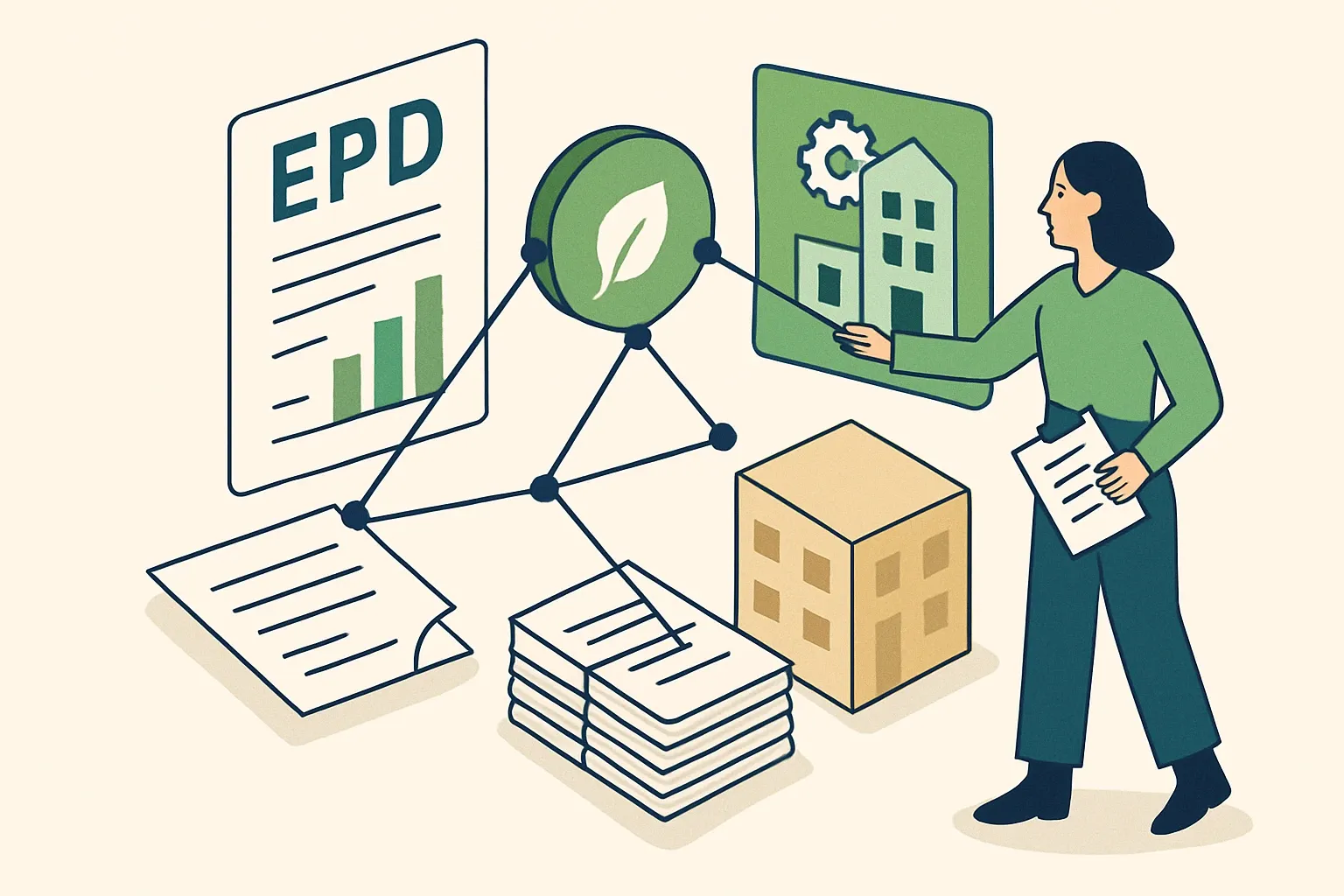
- Store a single, project‑ready EPD bundle per SKU so estimators and subs aren’t hunting across folders.
Want to turn EPDs into revenue generators?
Follow us on LinkedIn for actionable insights that help you win more projects and enhance your ROI.
From disclosure to performance
The article’s main lesson for v5 readiness is to pair EPD coverage with reduction narratives. Start converting easy wins into quantifiable deltas. Cleaner fuels, recycled inputs with traceable quality, transport shifts, or yield improvements can move global warming potential in the right direction. Then refresh the EPD so the improvement is verifiable, not just claimed.
Handshake with sales and specifiers
Sales often skips projects that ask for EPDs because the clock is tight. Centralize your product‑specific EPDs and make a lightweight spec packet so reps can act immediately. Treat EPDs as revenue unlockers, not paperwork. One mid‑sized win typically dwarfs the credential cost, though reliable cross‑market averages are hard to pin down because scopes differ.
Fast path to being v5‑ready
Three moves set you up without boiling the ocean.
- Publish product‑specific Type III EPDs for top sellers first, then roll down the tail.
- Map which SKUs replace common high‑impact materials on projects you target. Position them early in the bill of materials.
- Put a simple change log behind each EPD so the next renewal is fast and the improvement story is easy to prove.
Watchouts Ecochain surfaces
Counting without verifying is the silent credit killer. Make sure each EPD is current, public, and clearly tied to the installed product. Avoid look‑alikes where only colors or dimensions change but the formulation is identical. That does not create additional unique products for credit counting in v4.1.
Bringing it together
Publish credible, product‑specific EPDs. Package them so field teams can document quickly. Track real reductions and roll them into renewals. Do that and you’re not just compliant. You’re the easy choice in a short‑list. It’s honestly the simplest way to turn sustainability paperwork into specification momentum.
(Quick note: if you see conflicting numbers online for how many products count in v4.1, rely on USGBC’s current language. It’s the source of truth and it was updated recently.)
Numbers that matter at a glance
- MR Option 1 in v4.1 uses at least 20 qualifying products from five manufacturers, with product‑specific Type III EPDs weighted as 1.5 products (USGBC, 2024) (USGBC, 2024).
- LEED v5 was ratified on March 28, 2025 and is active, with credit forms and calculators accessed via Arc as v5 scales across project types (USGBC, 2025) (USGBC, 2025).
That’s the play. Simple, sharp, and definately repeatable.