What procurement teams actually need from an EPD
An EPD is evidence, not a brochure. Reviewers look for a product‑specific, third‑party verified declaration that cites the governing PCR, follows ISO 14025 and EN 15804, and reports the cradle‑to‑gate modules A1 to A3 clearly. The plant that made the product must be named, the declared unit must fit the bid item, and the validity date cannot be near its cliff.
Most programs treat five years as the validity window, subject to earlier updates if impacts worsen materially. That five‑year cycle is stated plainly by major operators such as IBU and EPD International (IBU, 2025) (EPD International, 2024).
When EPDs are a hard gate in public bids
Several public owners require EPDs and in some cases cap Global Warming Potential values. California’s Buy Clean sets maximum GWPs for eligible materials, for example 1,010 kg CO2e per metric ton for hot‑rolled structural steel and 1,430 kg CO2e per metric ton for flat glass, effective January 1, 2025 (California DGS, 2025). If your EPD is industry‑average or expired, it will not clear the bar.
Transportation owners have followed suit with submittal rules that pull EPDs into standard specifications, which means your packet has to be audit‑ready before bid day. Waiting for an after‑award scramble is a risky habit.
The market pull outside mandates
LEED v5 was ratified by USGBC members on March 28, 2025. The rating system keeps pressure on transparent product data, including product‑specific EPDs, across commercial work where owners chase certification benefits (USGBC, 2025). Embodied carbon is not a niche topic, it is tied to a sector that accounts for roughly one third of global energy and process‑related CO2 emissions (UNEP Global Status Report, 2025).
Want to turn EPDs into gold for your bids?
Follow us on LinkedIn for insights that help you enhance your project specifications and boost your bottom line.
The anatomy of EPD documentation for bids
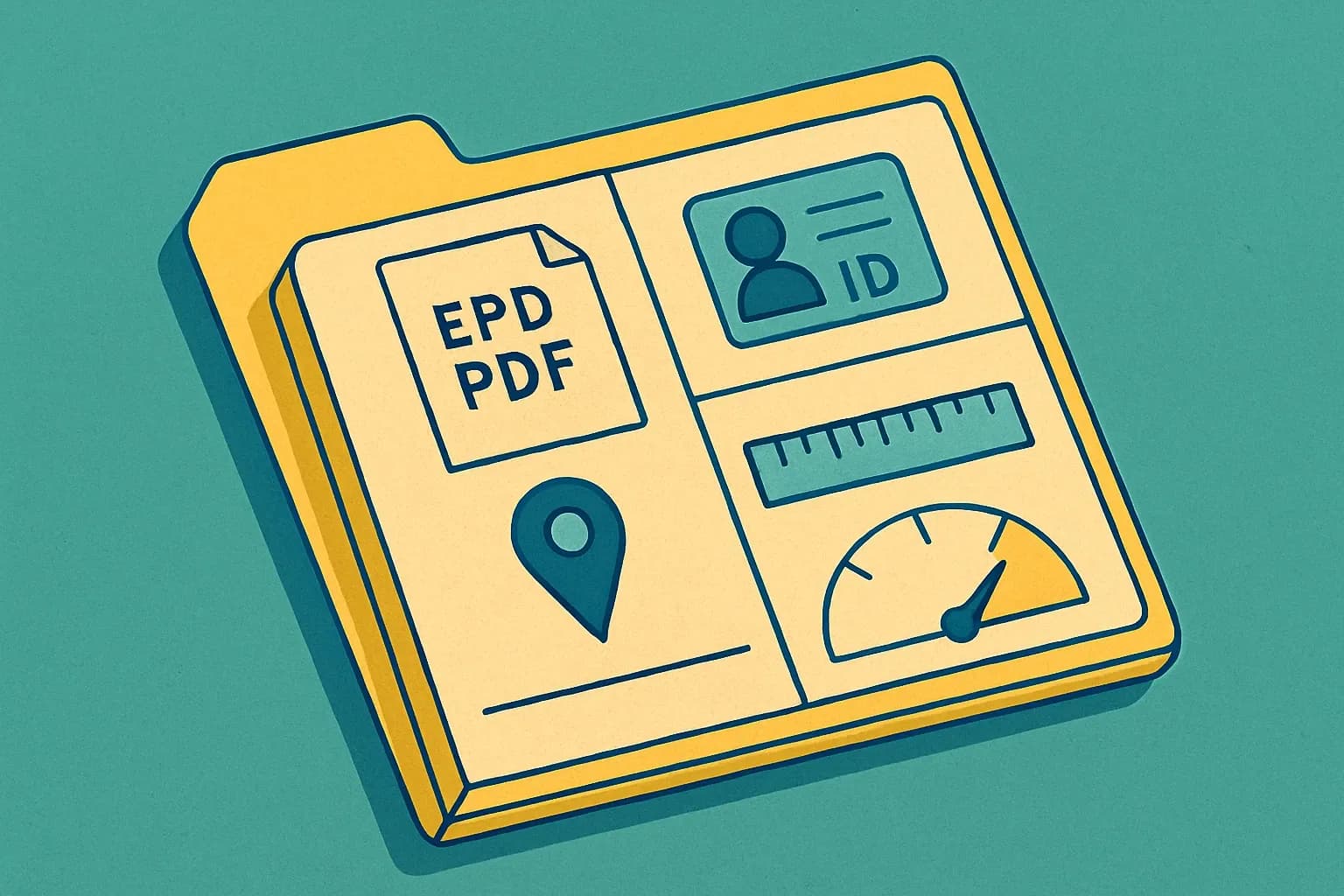
Think of your EPD packet like a well‑labeled toolkit. Every tool has a slot, nothing rattles.
- The EPD PDF and, if available, machine‑readable file, with program operator name and publication ID.
- PCR reference and version, plus the standard referenced (EN 15804+A2 or equivalent).
- Declared unit and A1 to A3 GWP values that match the bid item’s units.
- Facility name and address, production date range, and the EPD validity date.
- A one‑page cover note that maps internal SKUs to line items in the bid schedule.
- QA contact for technical questions during evaluation.
Facility‑specific or bust
Many awarding authorities evaluate only facility‑specific EPDs, not industry‑wide averages. California’s FAQ spells this out, and reviewers in other jurisdictions follow the same logic because they must compare a plant’s actual impact to a threshold (California DGS, 2025). If your operations span plants, submit one EPD per plant or a multi‑plant EPD that reports each site separately.
Validity windows, PCR updates, and timing
EPDs is valid for five years in most programs, but a significant change in manufacturing can trigger an earlier revision requirement (EPD International, 2024). When a PCR is updated during your EPD’s life, the published document stays valid until its stated expiry, then the renewal must use the newer PCR. Plan renewals so no critical EPD expires mid‑construction season.
“EPD documentation for bids” that is audit‑proof
Add a short compliance memo to your packet. In plain bullets, restate the product, plant, declared unit, A1 to A3 value, and how that value meets any posted cap. Cross‑reference the page numbers in the EPD. Add a link to a stable download location so reviewers can re‑pull the PDF. Small touches like this reduce back‑and‑forth and signal reliability.
Choosing an LCA and EPD partner built for bids
Speed matters because internal data collection drags projects, not modeling alone. Pick a partner that leads hands‑on data gathering across plants, utilities, and waste streams, then project manages verification so engineers and production managers stay focused on operations. Operator agnostic publication helps too, since many teams publish in Smart EPD in the US and IBU in Europe, yet owner preferences vary by project.
Look for pre‑flight checks against active GWP caps, unit conversions aligned to the bid schedule, and clear version control so the right EPD lands in the bid folder every time. These services sound simple, they save alot of grief.
Your next bid week playbook
Confirm which materials in the scope need EPDs, verify each is facility‑specific and within its validity date, map declared units to line items, and write a one‑page memo that proves threshold compliance where required. If you address those steps early, your EPD documentation for bids becomes a door‑opener, not a hurdle.