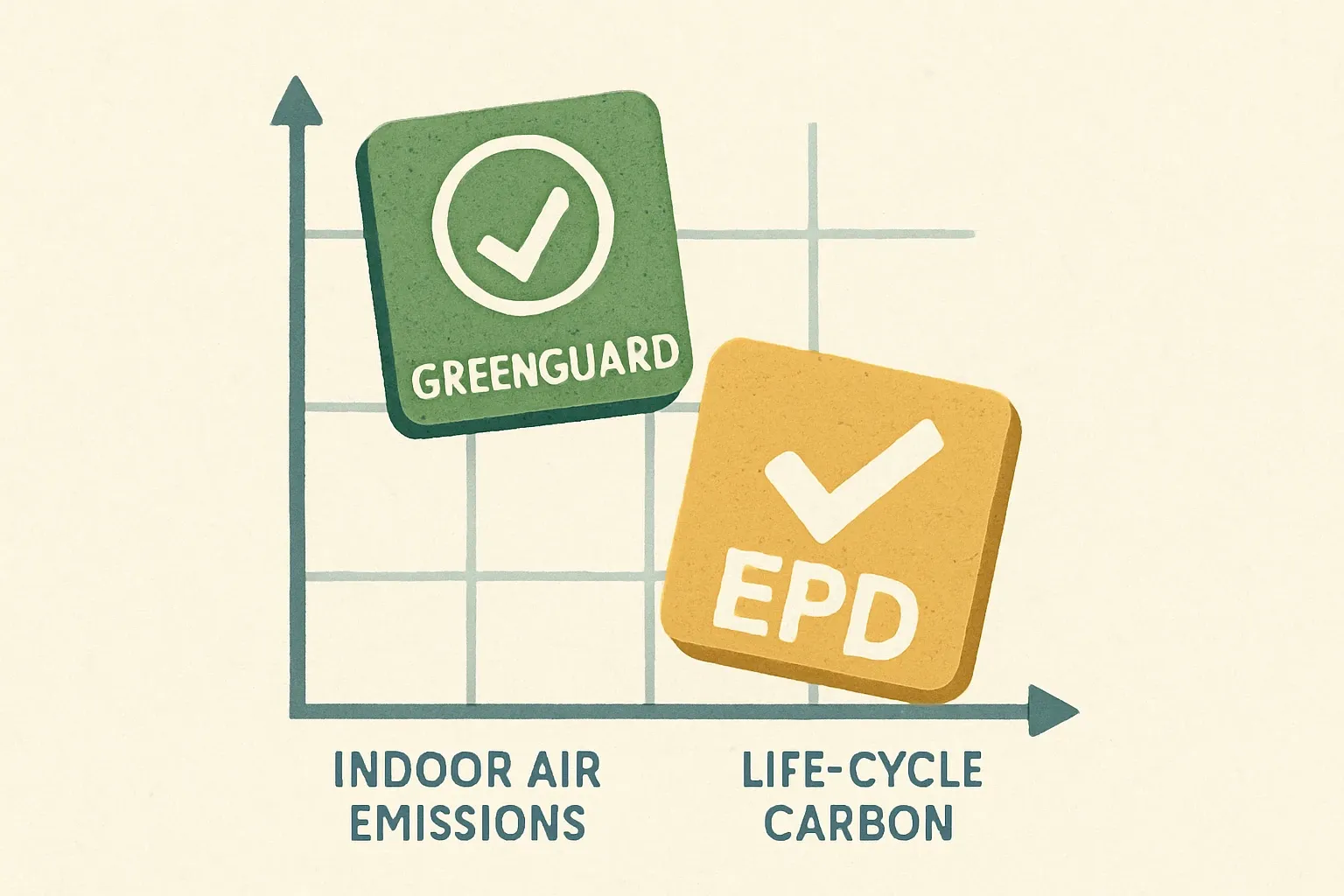
Two credentials, two problems to solve
UL GREENGUARD is an emissions certification. It tells architects your product will not dump excessive VOCs into occupied spaces.
An Environmental Product Declaration (EPD) is a verified report of life‑cycle impacts across set categories, usually aligned with EN 15804 and ISO 14025. It enables apples‑to‑apples comparison within a product category.
What UL GREENGUARD actually proves
Products are tested in chambers for specific chemicals and total VOCs, then benchmarked against health‑based limits. Certification is maintained through ongoing surveillance and periodic re‑tests, with certificates renewed every 12 months (UL Solutions GREENGUARD Program Manual, 2024).
GREENGUARD Gold sets tighter thresholds that are often referenced for schools and healthcare. Think of it as a bouncer at the door that checks emissions before your product enters the room.
What an EPD actually proves
An EPD reports impacts like Global Warming Potential, resource use, and waste across declared life‑cycle stages. It follows a Product Category Rule (PCR) that defines the rules of engagement so competitors play by the same playbook.
EPDs are typically valid for five years before renewal, subject to the program operator’s rules (EPD International GPI, 2024). That window is long enough to support multi‑year spec cycles without constant rework.
When project teams ask for which
Interior fit‑out packages often request GREENGUARD or GREENGUARD Gold, especially for furniture, flooring, paints, sealants, and wall systems. The goal is straightforward indoor air quality assurance.
Whole‑building programs and public tenders increasingly call for product‑specific EPDs to support carbon accounting and procurement rules. LEED v5 draft language continues to emphasize product‑specific EPDs and low‑emitting materials, so both signals still matter in submittals.
How they’re created, at a glance
GREENGUARD centers on physical testing plus quality audits. The heavy lift is sample prep, testing windows, and keeping production consistent.
An EPD starts with data collection across energy, materials, transport, and waste, then modeling per the PCR and third‑party review. The heavy lift is wrangling accurate plant data without slowing operations, which is where process rigor pays off.
Confused about EPDs and GREENGUARD credentials?
Follow us on LinkedIn for clarity on how to leverage both for winning project specifications.
Can one replace the other
No. GREENGUARD answers “Is it low‑emitting in rooms where people breathe” while an EPD answers “What are the product’s quantified life‑cycle impacts.” Substituting one for the other is like bringing earplugs to a rainstorm.
Common misconceptions to drop
“GREENGUARD Gold equals low carbon.” Not true, it is an IAQ label, not a carbon label.
“An EPD means zero VOCs.” Also not true. An EPD may list ingredients and impacts, but it does not certify chamber emissions.
Picking the sequence without losing momentum
If your product lives indoors, lead with GREENGUARD or GREENGUARD Gold to satisfy immediate IAQ submittals. Follow with an EPD once operational data is ready and the right PCR is confirmed.
If your product is structural or exterior, start with the EPD since carbon drives procurement. Add GREENGUARD only if your assemblies cross into occupied space.
Documentation details that matter
For GREENGUARD, keep bill of materials and formulations under change control so recertification does not trigger delays. Certificates expire annually, so align renewals with your launch calendar to avoid submittal gaps (UL Solutions GREENGUARD Program Manual, 2024).
For EPDs, pick a stable reference year for plant data, and track PCR expiry dates so your next renewal meets the current rulebook. Program operators typically set five‑year validity, then require renewal with updated data or a newer PCR if available (EPD International GPI, 2024).
Where these labels show up in specs and tools
Procurement portals and design tools often filter for “low‑emitting” and “product‑specific EPD.” Treat both fields as gates. If one is blank, your product slides out of view in seconds.
We see teams that secure both credentials tend to shorten submittal ping‑pong, because IAQ and carbon questions get answered up front. That is boring in the best possible way.
Quick buyer‑facing language you can reuse
- For UL GREENGUARD Gold, say: “Certified for low chemical emissions for sensitive use cases.”
- For EPDs, say: “Third‑party verified life‑cycle impacts reported per EN 15804 and ISO 14025.”
Simple phrases keep sales and technical teams on the same page during fast RFIs.
A calm way to plan the year
Map GREENGUARD testing to formulation freeze dates, then set a 12‑month renewal reminder. In parallel, lock a data plan for the EPD reference year, including utilities, material inputs, and outbound logistics.
If trustworthy averages for testing lead times or LCA modeling hours are missing for your category, say so to stakeholders rather than guessing. Clarity beats surprizes every time.
UL Solutions GREENGUARD Program Manual, 2024
EPD International GPI, 2024