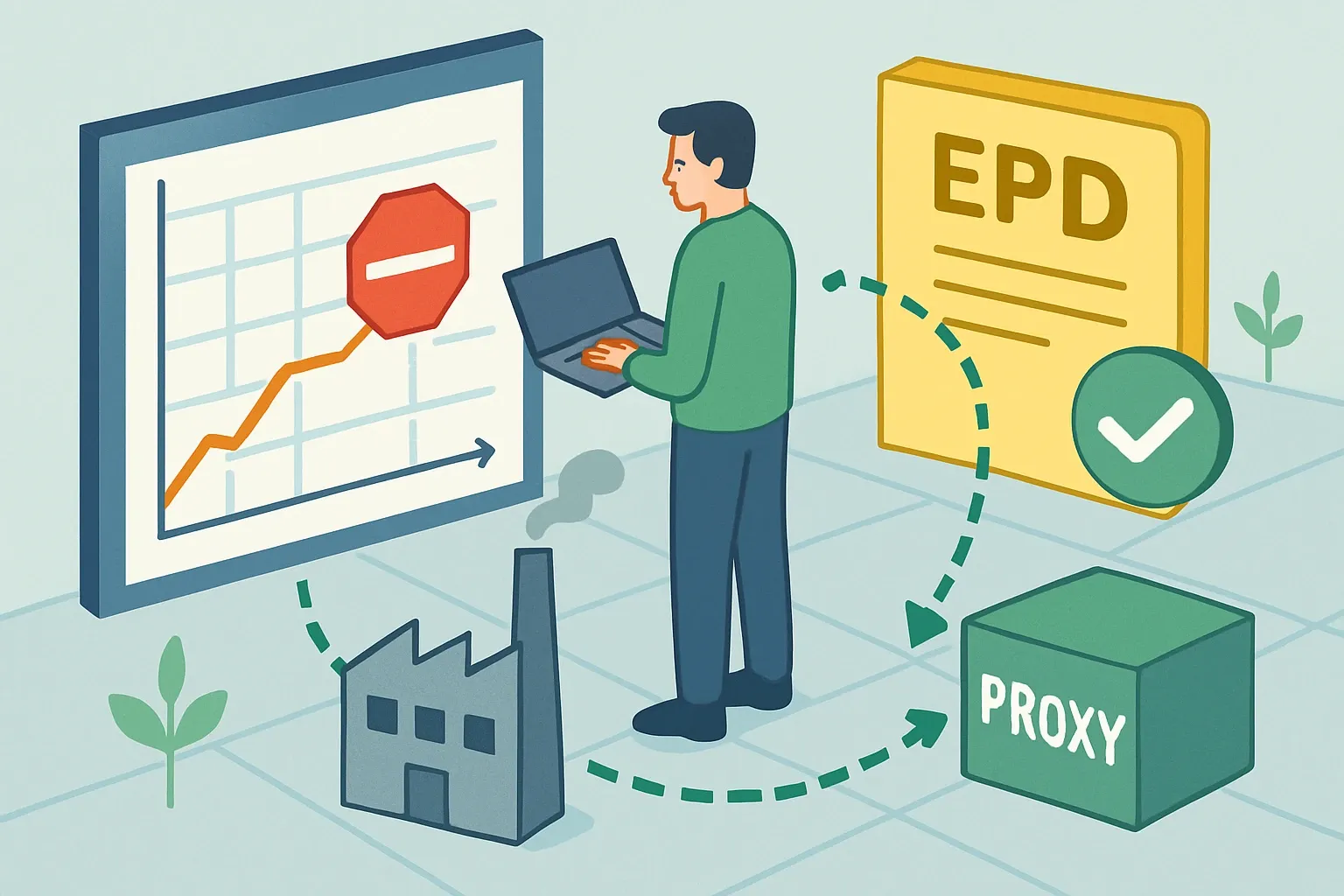
Why proxy data exists in credible LCAs
Supplier blackouts are normal in global supply chains. Pausing the whole EPD until every meter reading arrives only shifts risk to your bid calendar. Strategic proxies preserve momentum while making clear where primary data will replace placeholders later.
Think of proxies as temporary scaffolding. They hold shape so the building can rise. The scaffolding comes down once the permanent structure is ready.
What you can proxy (safely, for now)
Interim electricity factors using the correct region and year. Transport modes and distances based on routing logic and known carrier types. Waste splits where on‑site logs lag, provided treatment methods match reality.
These proxies are fine because they rarely change the declared unit definition. They influence magnitude, not the product’s identity.
- Grid electricity using regional averages for the reference year.
- A4 transport using mode‑specific factors and known lanes.
- Ancillary materials when consumption is small and stable quarter to quarter.
What must be exact from day one
Your bill of materials at declared‑unit level is non‑negotiable. Resin grades, alloy specs, additives, coatings, and densities define the product you sell. Guessing here can break comparability and trigger rework in verification.
Production boundaries also belong in the “exact” bucket. Keep plant list, lines included, and time coverage crisp so scenarios do not drift later.
- Product recipe and declared unit.
- Facility list and reference year choice.
- Allocation rules for co‑products.
Is supplier data stalling your EPDs?
Follow us on LinkedIn for strategies to keep your bids alive and insights that drive project specifications.
Pick sources reviewers recognize
Use regional power data that matches where you manufacture. For example, EPA eGRID 2023 (released in 2025) shows CAMX at about 430 lb CO2e per MWh while HIOA is about 1,500 lb CO2e per MWh, a swing that matters in A3 results (EPA eGRID, 2025).
Where supplier logistics are late, apply nationally maintained conversion factors for ton‑km by mode. The UK Government publishes an annually updated set many practitioners reference for methodology discipline even outside the UK context (2025 release provides the latest workbook users can consult).
Stay inside EN 15804 data‑age guardrails
Standards limit how old your inputs can be. EN 15804+A2 requires producer‑specific data to be less than five years old and generic background data to be less than ten years, with one‑year averaging for inventories unless justified (EN 15804+A2, 2019). Keep a note beside each proxy stating its vintage and the planned primary replacement date (EN 15804+A2, 2019).
This is not busywork. It is how you avoid reviewer ping‑pong when a factor is out of bounds.
Conservative by design, not by accident
Pick the conservative end of a credible range so replacements do not worsen published numbers. If two truck factors both fit your route, choose the higher one and annotate why. Future primary data that is cleaner will move results in the right direction.
Document the logic in plain language. Reviewers prefer clear sentences over spreadsheet riddles, and so do product managers.
Model so swaps take minutes, not days
Name variables for each proxy and tag them in your LCA model. Keep a short register with source, version, contact, and the exact cell or parameter it feeds. When the supplier sends real data, you replace once and everything updates.
If multiple plants feed one EPD, store proxies per site. Rolling them up first will bite you later.
Communication that keeps trust intact
Flag proxies transparently in the background report and in any customer‑facing summary. State what will change when primary data lands and whether directionally better or neutral is expected. That tone wins confidence.
Internally, align sales so no one over‑promises. A one‑page cheat‑sheet listing active proxies avoids mixed messages and is definately worth the five minutes it takes to maintain.
A simple cadence that survives supplier silence
Set monthly checks on the proxy register. Replace anything older than your chosen window and log the change. Tie the register review to your production reporting rhythm so nothing slips during holidays.
Do this well and proxies stop feeling like compromise. They become a practical way to keep EPDs on track, bids live, and verification smooth without sacrificing rigor.