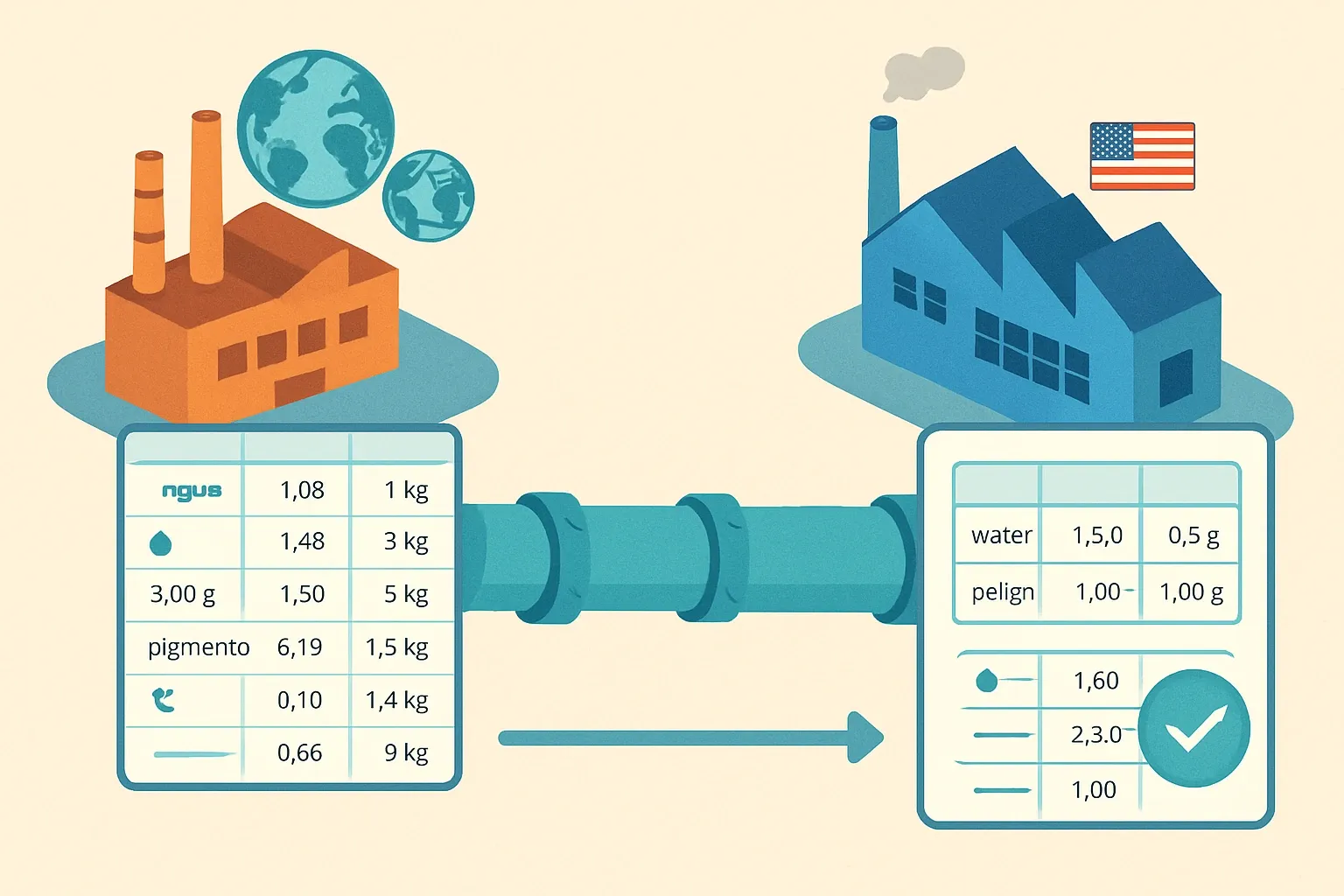
The multilingual plant puzzle
Multiple plants mean multiple dialects of reality. Labels, abbreviations, and column headers vary by site and by person. If the EPD workflow assumes one pristine master spreadsheet, the project will crawl. Treat plant data like regional accents, then systematically translate them into one shared vocabulary.
Model your world, not a fantasy one
Start with a canonical product schema that maps every SKU to the plants that can produce it. Capture plant attributes like kiln type, fuel mix, and packaging lines. Version those attributes by reference year so verification can trace any result back to a specific configuration. Auditors relax when lineage is obvious.
Language, acronyms, and decimal commas
Acronym dictionaries turn CaCO3, limestone, and caliza into the same substance record. Locale‑aware parsers convert 1,50 into 1.50 without human fixes. This is boring plumbing, which is precisely why it works. ÖKOBAUDAT even ships CSV exports with period or comma decimal separators, which shows how common this issue is in European workflows.
Units and currencies without drama
Normalize at ingestion. Convert all masses to kilograms, volumes to liters, and energies to kWh using a governed unit table. Lock conversion factors by reference date and region. Store supplier prices and transport distances in native units, then compute harmonized figures in the model layer. Duplication disappears, and so do endless copy‑paste errors.
Plant‑level variation, parameterized
Plants rarely run identical mixes. Keep a base recipe per product family, then apply plant parameters for real‑world deltas like recycled content, admixture dose, or moisture. Parameterization beats cloning a new product record for every factory. It also lets verification sample extremes instead of rereviewing the same math twenty times.
Want to streamline your EPD data process?
Follow us on LinkedIn for insights that can help you win more projects and unlock new markets.
Make verifiers smile with packet discipline
Package inputs the way verifiers read. That means a structured bill of materials with CAS numbers, supplier IDs, transport modes, grid factors with citations, and a clear reference year. Include change logs that show when a field moved and why. Small things, big speed.
Europe expects consistency, so feed their pipes correctly
If Europe is a target market, design for EN 15804 A2, national complements, and national data hubs. Modelers in France pull from INIES, which listed 5,315 FDES and 1,512 PEP on February 8, 2026, representing 309,105 commercial references (INIES, 2026 link). Germany’s ÖKOBAUDAT expects ILCD+EPD format with annual generic updates and continuous EPD additions, so plan exports that comply on day one.
Digital EPDs are rising, which rewards clean data
EPD International reported 9,395 EPDs published in 2025, including 252 in digital format after launching its compiler in January 2025 (EPD International, 2025 link). Digital publication favors teams with structured, validated inputs. Good pipelines turn that into calendar time saved.
Program operators vary, volume signals maturity
ECO Platform lists operator scale by issued EPDs. As of July 1, 2025, Environdec showed 12,749, IBU 2,565, and PEP Ecopassport 4,740, among others (ECO Platform, 2025 link). High volumes do not replace verification quality, yet they indicate the ecosystems your data must fit without friction.
What to ask any platform or partner
- Can it auto‑ingest multilingual plant files and map local names to a governed material master without manual relabeling?
- Does it parse locale formats, including decimal commas, thousands separators, and date styles, then log every transformation?
- Are units, currencies, grid factors, and transport modes standardized with version control and region tags?
- Can it parameterize plant differences instead of cloning products, and output EN 15804 A2 plus national complements like INIES FDES schemas?
- Does it produce verifier‑ready packets with traceable references and a change log that a third party can audit quickly?
The commercial angle that often gets missed
Specification teams prefer product‑specific, third‑party verified data because defaults are conservative. When your declarations land in the tools buyers already use, your product stays in the running without cutting price first. Reliable cost averages for producing EPDs are hard to pin down because scopes differ, but the revenue from even one mid‑sized project often dwarfs the paperwork outlay.
How we keep speed without cutting corners
We favor ruthless data hygiene, human‑in‑the‑loop reviews where judgement matters, and automation everywhere else. That mix turns messy plant spreadsheets into model‑ready datasets, then into consistent EPDs across regions. It is not glamorous, but it beats waiting an extra quarter for a defintion to be clarified.
Tie it together
Design once for multilingual, plant‑level reality. Normalize everything on entry. Parameterize differences. Export in the schemas verifiers and national databases expect. Do this and global EPD coverage stops feeling like a juggling act and starts looking like a repeatable production run.