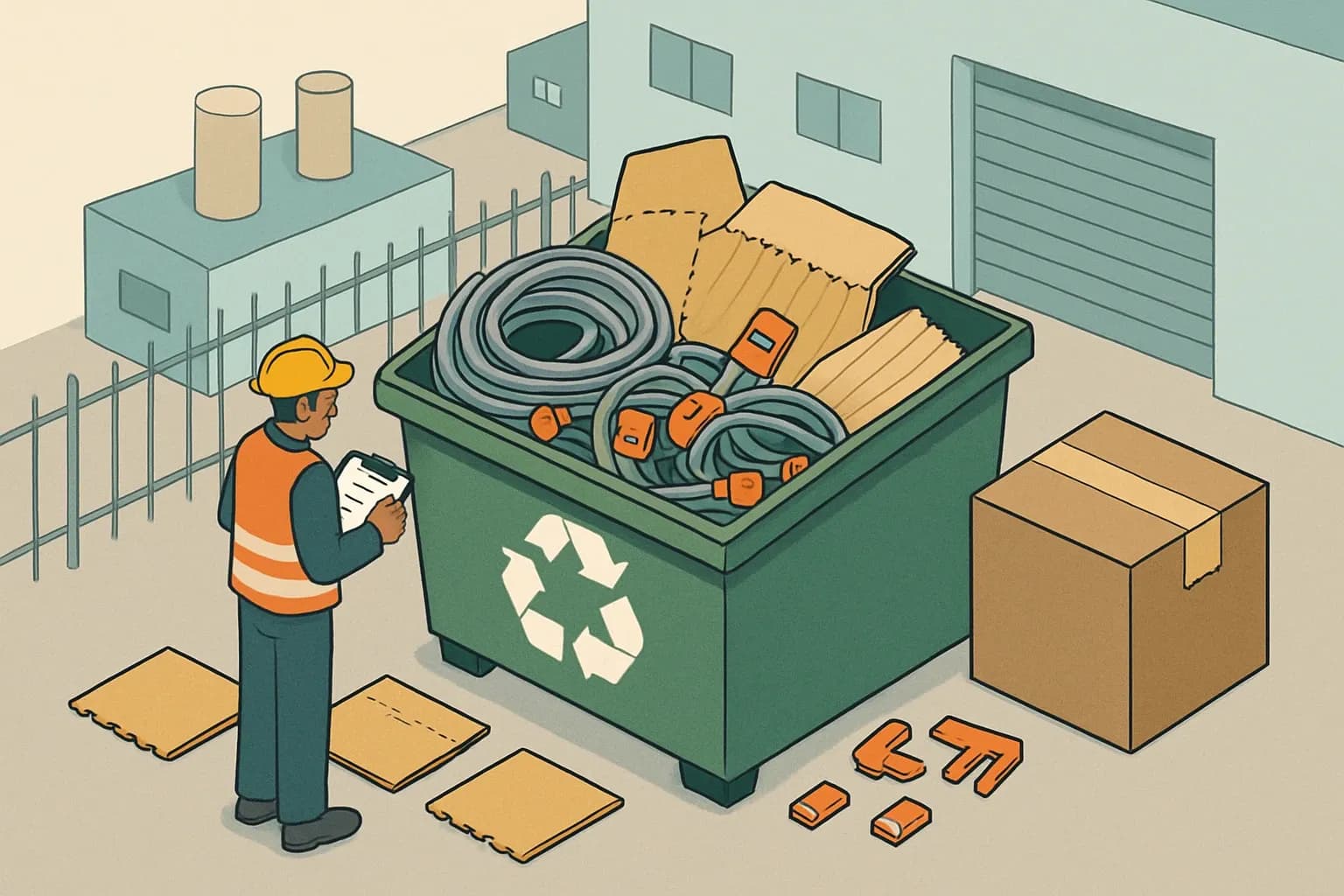
Why non‑hazardous scrap matters
Non‑hazardous waste often outweighs hazardous in discrete manufacturing. EPDs ask where it comes from, which material it is, and where it ends up. Treat it like box‑score stats rather than a single final score.
Think in unit processes, not dumpsters. If offcuts happen at cable sheathing, tie the scrap to that step and to the product BOM that drove it.
Define waste by type and fate
Scrap is not a pile. It is a dataset. Separate by material family and by what happens next.
- Fate buckets that satisfy most PCRs: internal re‑use as feedstock, closed‑loop recycling on site, external recycling, energy recovery, landfill, special treatment.
Short names beat long memos. “PVC offcut, external recycling” tells a verifier more than “non‑hazardous waste”.
The data you actually need
Collect only what moves the needle.
- Material type and spec (e.g., PVC compound grade, copper 99.9%).
- Originating step and scrap driver (trim, setup, QC reject).
- Quantity and unit per reference period and per product family.
- Fate and handler (internal line, recycler, hauler) with receipts if available.
This small schema maps directly to LCA unit processes and keeps auditors from chasing ghosts.
Cut‑off rules without the confusion
Construction PCRs based on EN 15804 commonly cap exclusions at no more than 1% of total mass and 1% of primary energy per unit process, with the sum across a full module capped at 5%. Verifiers want the arithmetic and the rationale spelled out, not just a blanket claim (EPD International, 2025) (EPD International, 2025).
ISO 14044 also requires you to define cut‑off criteria up front and check sensitivity, using mass, energy, and environmental relevance as the screen. In plain English, show that the bits you excluded cannot swing the result (ISO 14044, 2006) (ISO 14044, 2006).
Want to streamline your EPD data collection?
Follow us on LinkedIn for insights that help you unlock faster verification, win more projects, and improve your bottom line.
Estimating the “small stuff” fast
Auxiliaries like epoxies, thread‑lockers, or mold release often sit below cut‑offs. You still need evidence. Use a short, ordered playbook.
Start with known dosing rates from work instructions. If missing, use supplier SDS content ranges multiplied by typical application weights per part. As a backstop, convert procurement volumes to per‑unit estimates with credible scrap and loss assumptions and flag uncertainty.
Keep the math in a single sheet. A verifier wants to see the ladder of estimation, not perfection.
BOM‑tied waste beats plant‑wide averages
Plant averages hide which products generate which waste. Tie each scrap stream to BOM nodes or manufacturing families. For cable assemblies, that means copper conductor trim under “cut and strip,” PVC jacket trim under “extrusion,” and unused connectors under “final assembly reject.”
When multiple SKUs share a line, allocate by the real driver. Length cut? Allocate by linear feet. Plating reject? Allocate by plated area. If you guess by volume when length drives scrap, you will be politely destroyed in review.
Internal reuse without double counting
If you granulate PVC offcuts and feed them back into extrusion, document the loop. Closed‑loop reuse reduces purchased resin, but the reprocessing energy still belongs in A3. External recycling is different. Burdens stay with the product that creates the waste, and benefits show up in Module D when appropriate under your PCR.
Name the loop, prove the flow, and show how you prevented counting the same kilogram twice.
Packaging remnants count too
Reels, spools, trays, films, and dunnage rarely reach the customer. Track them by type and fate the same way you treat production scrap. If a supplier takes reels back, record that as closed‑loop return rather than generic recycling. Those details de‑risk verification and keep comparisons fair.
A good rule is to tag packaging to the inbound material it serves. Copper on wooden reels makes reel waste a copper BOM companion, not a miscellaneous line item.
A verifier‑ready waste worksheet
Two tabs do the job. One for streams, one for evidence.
Tab 1 fields: material, origin process, SKU family, quantity, unit, fate, handler, allocation driver, module mapping. Tab 2 fields: source doc, date, owner, calculation notes.
Keep it living. If a new adhesive shows up on the floor in June, add it that week. Don’t wait for year‑end and then panic.
What to do when numbers are thin
If you cannot pin an auxiliary under 1% with confidence, model a conservative upper‑bound and run a sensitivity test. If results barely move, journal that and proceed. If they budge materially, keep the flow in. There is no shame in caution, only in hand‑waving.
Some PCRs tighten language over time and expect clearer documentation of exclusions by module. Check the version listed in the PCR header before you start, then align your worksheet headings accordingly.
The commercial payoff
Clean waste data shortens verification and reduces rework. That lets teams publish sooner and show up in specs where EPDs are a pass‑fail gate. The cost of getting your scrap story straight is usually dwarfed by a single mid‑sized project win. We care about speed because speed protects pipeline, not because fast looks flashy.
Quick recap you can act on today
Capture scrap by material and fate. Tie it to BOM structures and allocation drivers. Prove that any exclusions stay within the 1% per process and 5% per module guardrails, with a simple sensitivity check to back it up (EPD International, 2025) (EPD International, 2025). Do this, and your factory waste will be EPD‑ready without accidently drowning engineers in trivia.